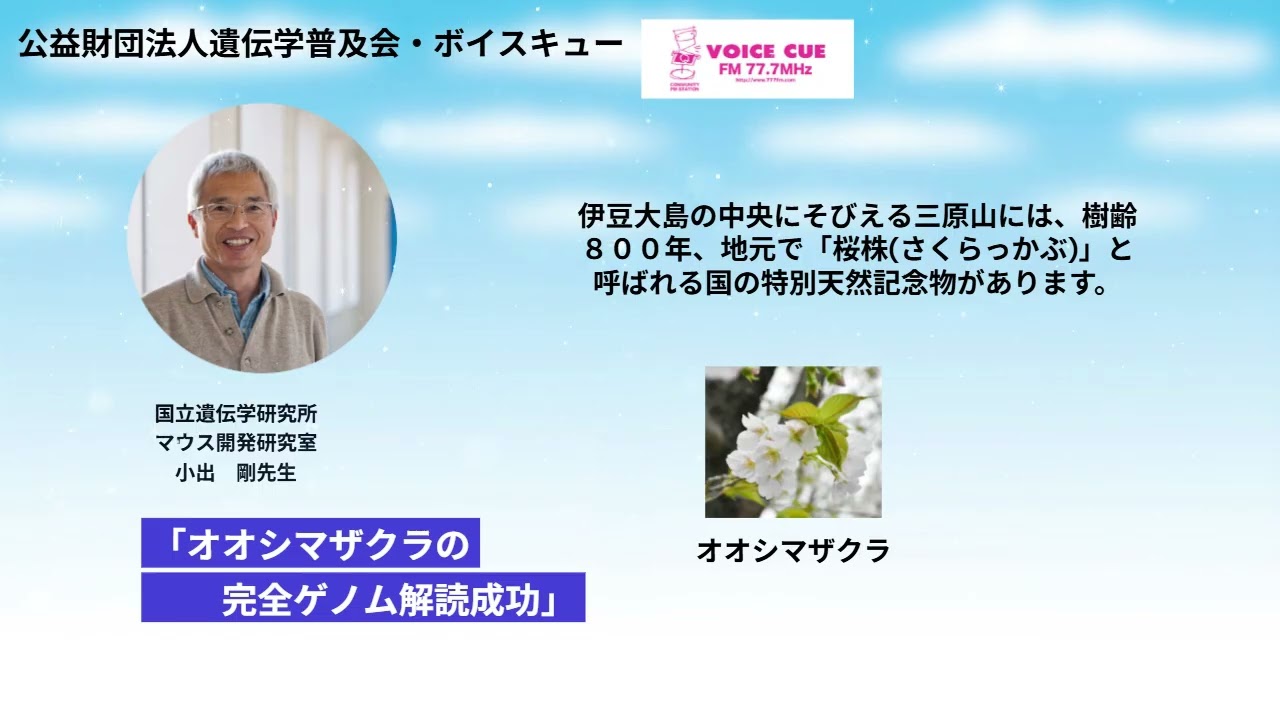
きゅんです!サイエンス|オオシマザクラの完全ゲノム解読成功 国立遺伝学研究所・小出剛先生
Keywords
Summary
152 words
Critical Evaluation
Value of the Information & Strength of the Argument
The video provides valuable insights into the process and significance of complete genome sequencing, particularly for a culturally important species. The argumentation is solid, based on the researcher’s own work and published results. The discussion of the centromere structure and the comparison with related species adds depth. However, the video is more of an overview than a detailed scientific explanation, and some claims (e.g., about the origin of Oshima cherry) are presented with appropriate uncertainty.
Scientific Rigor, Source Quality, Title Accuracy
The scientific rigor is high, as the researcher is directly involved in the study and the work has been published. The sources are not explicitly cited in the video, but the context implies peer-reviewed publication. The title accurately reflects the content. The video is a popular science interview, so it lacks detailed methodological descriptions, but the information is consistent with current knowledge in plant genomics.
155 words
Title / Content Match
The title accurately reflects the content, which focuses on the successful complete genome decoding of Oshima cherry.
Quality & Reliability
8/10
The video features a researcher from the National Institute of Genetics discussing their own published work on the complete genome sequencing of Oshima cherry. The information is presented with appropriate caveats and references to ongoing research. However, the video is a popular science interview, not a peer-reviewed presentation, and lacks detailed methodological transparency.
Key Moments
Markers derived by PSI from the transcript: the creator did not define chapters.
- Introduction and start of the interview with Dr. Tsuyoshi Koide.
- Discussion about Oshima cherry's natural habitat and distribution.
- Explanation of the special natural monument 'Oshima no Sakurakabu' and its 800-year history.
- Details on the process of obtaining permission to sample from the protected tree.
- Successful grafting and cultivation of clones from the ancient tree.
- Start of the second half: announcement of the complete genome sequencing success.
- Comparison with the Chinese team's sequencing of Kawazu cherry.
- Description of the genome size (270 Mb) and gene count (~30,000).
- Discussion of the centromere structure and its repetitive sequences.
- Comparison of genome similarity with Kawazu cherry and peach.
Cited Sources
- No explicit sources cited in the video — The video does not mention specific publications or external sources.
Concurring Sources
- Prunus speciosa - Wikipedia — Provides background on the species and its distribution.
Contribution & Novelties
The video presents the first complete genome sequence of a cherry species, specifically Oshima cherry, which is a significant contribution to plant genomics. It highlights the challenges of sequencing repetitive centromere regions and provides insights into the evolutionary relationships among Prunus species. The research enables future studies on cherry genetics, breeding, and disease resistance.
Pour aller plus loin :
- Prunus speciosa (Wikipedia) — Overview of the species.
- Centromere (Wikipedia) — Explanation of centromere structure and function.
- Plant genome sequencing (Wikipedia) — General context on genome sequencing projects.
87 words
Radar Profile
The radar profile shows high scores in quality and reliability, reflecting the expert source and published research. The quantity of information is moderate, and the technical level is accessible to a general audience. The overall balance indicates a reliable and informative video.