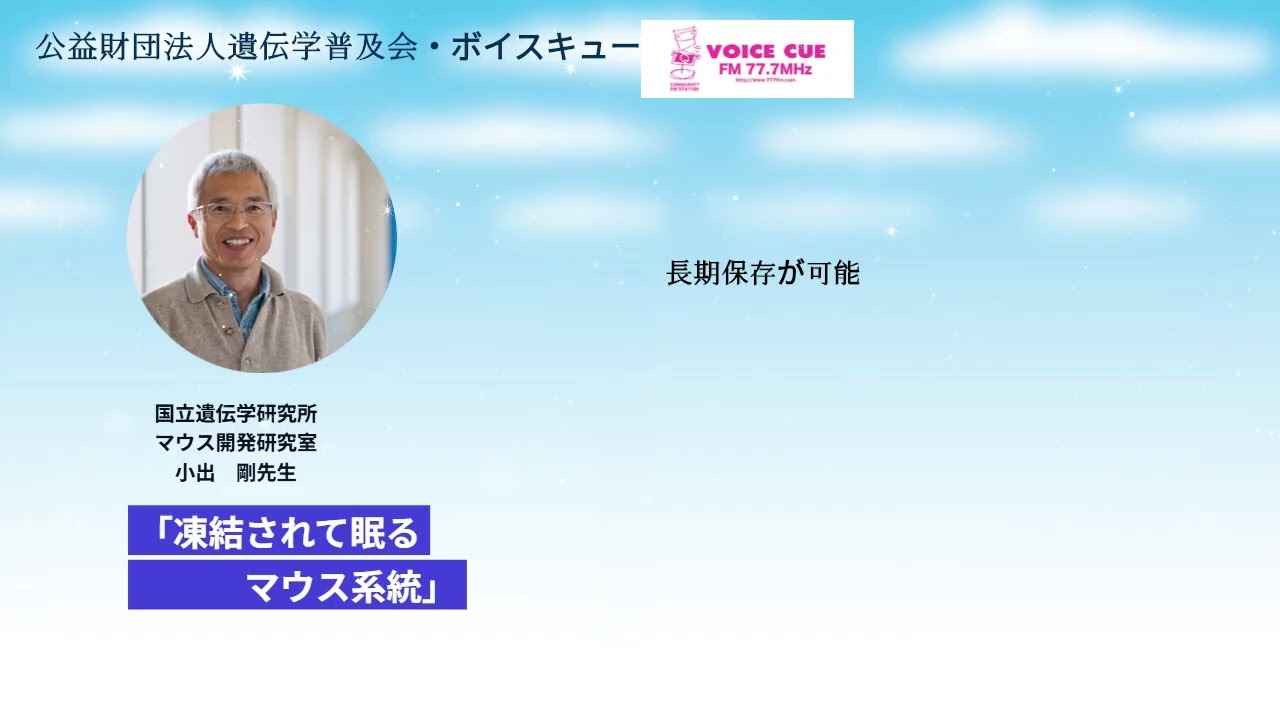
きゅんです!サイエンス ‐ 小出剛先生(2025.9.7)
Keywords
Summary
170 words
Critical Evaluation
Value of the Information & Strength of the Argument
The video provides valuable insights into the practical aspects of cryopreserving mouse strains, a topic not commonly covered in general science communication. The argumentation is clear and logical, explaining the reasons for cryopreservation, the technical process, and the benefits. The speaker’s expertise adds credibility, and the conversational format makes the information accessible. The discussion on the limitations of inbred strains as models for human genetics is particularly insightful, highlighting a shift towards using genetically diverse populations in research.
Scientific Rigor, Source Quality, Title Accuracy
The scientific rigor is high, as the speaker is a professional in the field. The information is consistent with established knowledge about cryopreservation and mouse genetics. However, no specific sources are cited in the video, and the description does not provide references. The title accurately reflects the content, which is a science communication interview. The video does not include any advertising segments.
155 words
Title / Content Match
The title accurately reflects the content, which is a science communication interview with Dr. Koide about cryopreserved mouse strains.
Quality & Reliability
8/10
The speaker is an associate professor at the National Institute of Genetics, providing expert knowledge on mouse strain cryopreservation. The information is accurate and well-explained, though it is a conversational interview rather than a peer-reviewed presentation.
Key Moments
Markers derived by PSI from the transcript: the creator did not define chapters.
- Introduction and recap of inbred mouse strains from previous episode.
- Discussion on the limitations of inbred strains as models for human genetics.
- Introduction to cryopreservation of mouse strains and its importance.
- Explanation of vitrification method and use of liquid nitrogen at -196°C.
- Details on thawing process and transfer to surrogate mothers.
- Statistics on number of strains and samples stored at NIG.
- Benefits of cryopreservation: recovery from disasters, transport, and long-term storage.
Contribution & Novelties
This video offers a unique behind-the-scenes look at the cryopreservation practices at a major genetics institute, providing specific details on the number of strains and samples stored. It also discusses the shift from inbred to outbred models, which is a current trend in genetics research.
Pour aller plus loin :
- Cryopreservation — General overview of cryopreservation techniques and applications.
- Inbred strain — Definition and use of inbred strains in research.
- Vitrification — Explanation of vitrification as a cryopreservation method.
- National Institute of Genetics — Official website of the institute where the speaker works.
93 words
Radar Profile
The radar profile shows high scores in quality and reliability, reflecting the expert speaker and accurate information. The quantity of information is moderate, and the technical level is suitable for a general audience, making it a balanced educational resource.