OAL-RAG 2024: Jingjing Ma (University of Houston-Clear Lake)
Keywords
Summary
209 words
Critical Evaluation
Value of the Information & Strength of the Argument
The talk provides valuable insights into the theory of infinite primes and their applications to partially ordered rings. The argumentation is solid, with clear definitions, rigorous proofs, and connections to existing literature. The speaker demonstrates the utility of infinite primes in solving problems in ordered algebra, such as characterizing O-star fields and proving the non-existence of directed partial orders on certain fields. The presentation is well-structured, moving from foundational concepts to recent results and open questions.
Scientific Rigor, Source Quality, Title Accuracy
The talk is scientifically rigorous, with precise definitions and proofs. The speaker cites relevant literature, including works by Harrison, Dubois, Schwartz, and others. The title accurately reflects the content, which focuses on infinite primes for rings. The talk is aimed at a specialized audience, but the reasoning is clear and well-supported. The description provides a link to the abstract, which is properly rendered.
154 words
Title / Content Match
The title accurately reflects the content, which focuses on infinite primes for rings and their connections to partial orders.
Quality & Reliability
8/10
Presentation of original research with rigorous definitions, proofs, and references to established literature (Harrison, Dubois, etc.). The talk is technical and assumes familiarity with algebra, but the reasoning is clear and well-structured.
Key Moments
Markers derived by PSI from the transcript: the creator did not define chapters.
- Introduction and definitions of preprime, prime, infinite prime, and full prime.
- Definition of partial order and comparison with preprime.
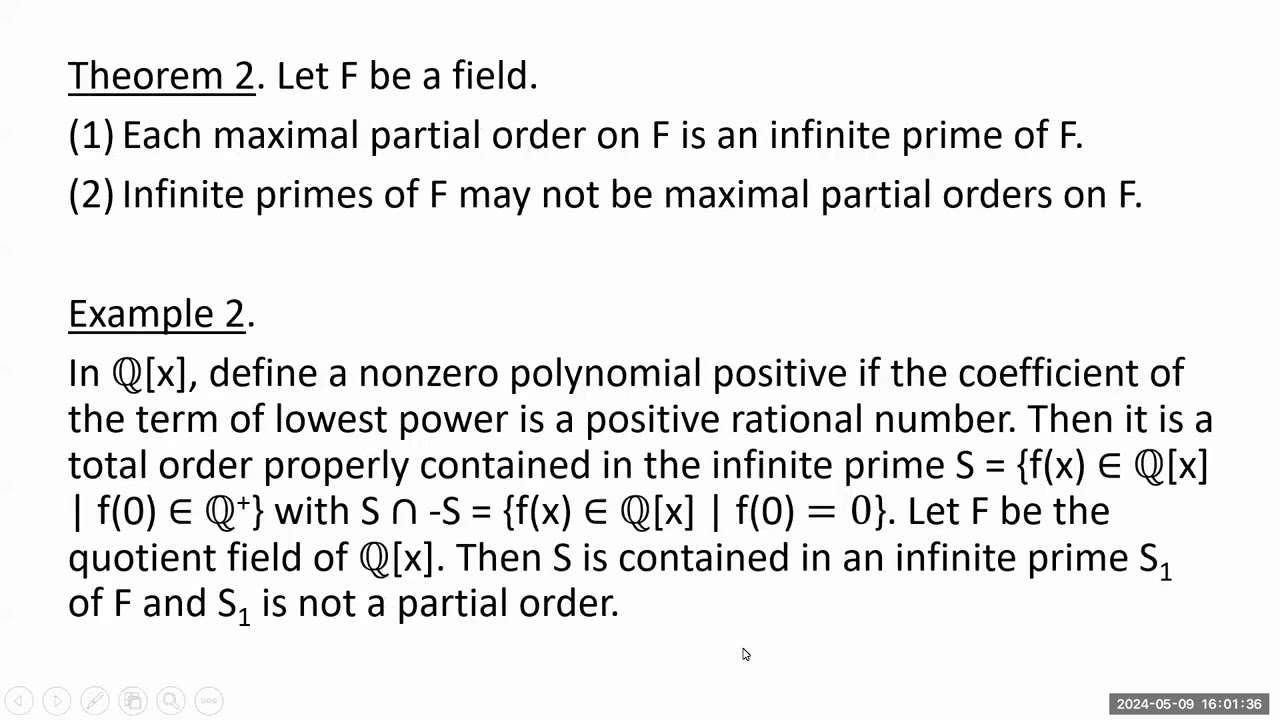
- Connection between maximal partial orders and infinite primes; Harrison's result for number fields.
- Characterization of O-star fields using infinite primes.
- Example of a maximal partial order that is not directed.
- Example showing that infinite primes may not be maximal partial orders.
- Archimedean property and Harrison's theorem on Archimedean infinite primes.
- Theorem: For a domain algebraic over Z, every directed maximal partial order is a total order.
- Applications to fields like Q-bar and Z-bar, and to complex numbers and quaternions.
- Dubois's proof using infinite primes to show existence of directed partial orders on non-algebraic fields.
Cited Sources
- OAL-RAG 2024 Abstracts — Link provided in the video description for properly rendered abstract.
Concurring Sources
- Harrison, D. K. (1966). Finite and infinite primes for rings and fields. Memoirs AMS, #68. — Foundational work on infinite primes, cited in the talk.
- Dubois, D. W. (1970). Infinite primes and ordered fields. — Work using infinite primes to study ordered fields, discussed in the talk.
Contribution & Novelties
The talk presents recent developments in the theory of infinite primes, particularly their connection to maximal partial orders. It offers new results, such as the theorem that for domains algebraic over Z, every directed maximal partial order is a total order, and uses this to answer open questions about the existence of directed partial orders on fields like C and quaternions. The talk also highlights the work of Dubois and others, providing a new perspective on classical problems.
Pour aller plus loin :
- Partially ordered ring — Provides background on partially ordered rings, relevant to the talk’s context.
- Ordered field — Discusses ordered fields, which are central to the talk’s applications.
- Zorn’s lemma — Used in the definition of primes and maximal partial orders.
124 words
Radar Profile
The radar profile shows high scores in quality of information, technical level, and reliability, with slightly lower scores in quantity of information and global reliability. This reflects a specialized, rigorous presentation with a focused scope.