OAL-RAG 2024: Rick Ball (University of Denver)
Keywords
Summary
254 words
Critical Evaluation
Value of the Information & Strength of the Argument
The talk provides a high-value contribution to the field of point-free topology and lattice-ordered groups, presenting original research that extends classical results. The argumentation is rigorous and well-structured, building from classical background to new definitions and theorems. The speaker carefully motivates each concept and provides clear explanations of the mathematical machinery. The results are significant, offering new characterizations and adjunctions that deepen the understanding of uniform frames and their relationship to W-objects. The presentation is logically coherent, with each step building on previous ones, and the speaker effectively communicates complex ideas.
Scientific Rigor, Source Quality, Title Accuracy
The scientific rigor is high, as the talk is based on original research by established mathematicians, with a detailed abstract and references to prior work (e.g., Banaschewski, Madden, Yosida). The sources are not explicitly cited in the video, but the abstract and the provided link to the conference abstracts page offer additional context. The title accurately reflects the content, focusing on uniformly continuous real functions on locales. The talk is well-organized and the mathematical arguments are presented with precision. The lack of explicit citations within the talk is typical for a research presentation, but the link to the abstract provides a reference point.
209 words
Title / Content Match
The title accurately reflects the content: a talk by Rick Ball at the OAL-RAG 2024 conference, focusing on uniformly continuous real functions on locales.
Quality & Reliability
8/10
The talk is a research presentation by established mathematicians, presenting original results with rigorous mathematical reasoning. The abstract is detailed and the content is consistent with the field of point-free topology and lattice-ordered groups. However, the video is a lecture without peer review or external verification, and the technical depth limits accessibility.
Key Moments
Markers derived by PSI from the transcript: the creator did not define chapters.
- Introduction and acknowledgments
- Overview of classical Yosida adjunction
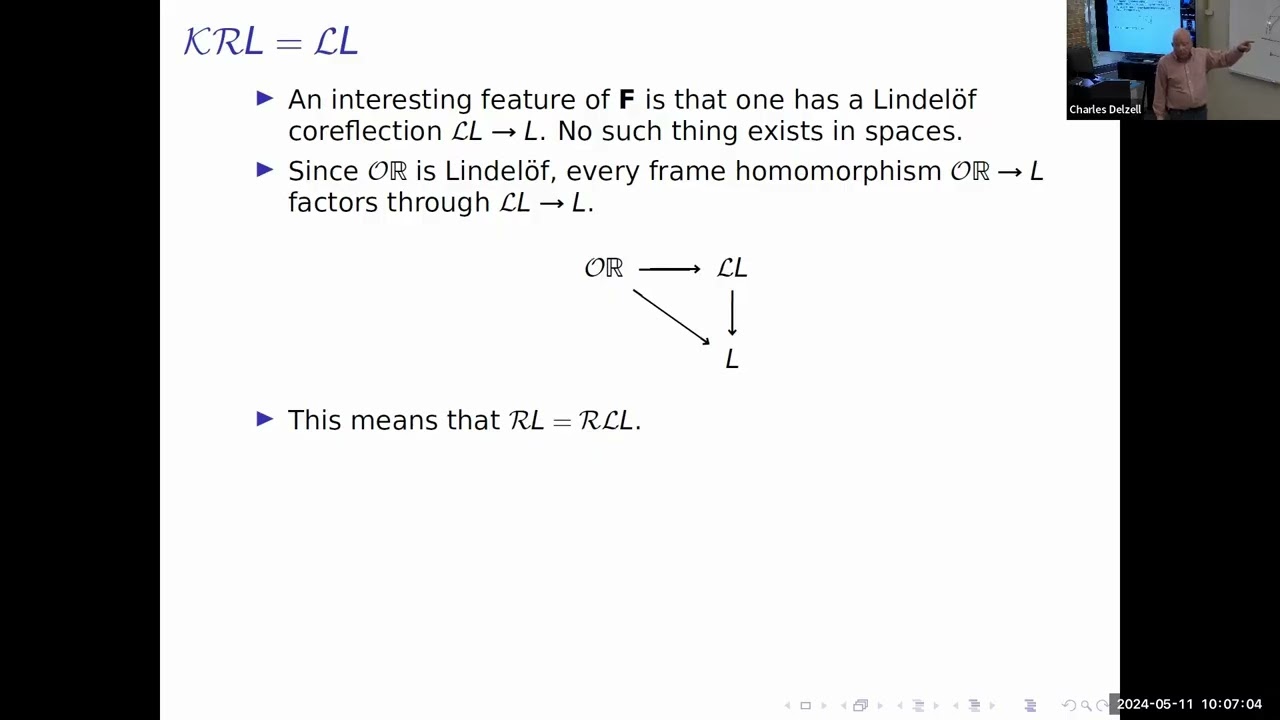
- Discussion of fixed objects and Lindelöf frames
- Characterizations of R(L) objects
- Pointwise suprema and their role in R(L)
- Introduction to uniform frames and definitions
- Construction of functors U and J
- Main theorem: adjunction between uF and W
- Fixed objects and coreflectivity/reflectivity
- Completeness and completion of uniform frames
- Conclusion and final remarks
Cited Sources
- OAL-RAG 2024 Abstracts — Provided in the video description as a link to the properly rendered abstract of the talk.
Concurring Sources
- OAL-RAG 2024 Abstracts — The abstract provided in the description aligns with the content of the talk, confirming the main results and definitions.
Contribution & Novelties
The talk presents a novel extension of the Yosida adjunction to uniform frames, introducing new functors U and J and establishing an adjunction between the categories uF and W. This provides a framework for studying uniform continuity in point-free topology and offers new characterizations of when a subobject of UL is all of UL. The results have implications for the theory of lattice-ordered groups and uniform spaces.
Pour aller plus loin :
- Yosida representation theorem — This theorem is foundational for the talk, connecting lattice-ordered groups with functions on a compact space.
- Pointfree topology — The talk operates within the framework of point-free topology, which studies topological spaces via their lattices of open sets.
- Uniform spaces — The concept of uniformity is central to the talk, and this article provides background on uniform spaces and their completions.
137 words
Radar Profile
The radar profile shows high scores in quantity, quality, and technical level, indicating a dense and rigorous presentation. The fiabilite_globale is also high, reflecting the expertise of the speakers and the mathematical rigor. The talk is highly specialized, which may limit its accessibility to a broader audience.