Proactive fire management under climate change in U.S. national parks in California
Keywords
Summary
190 words
Critical Evaluation
Value of the Information & Strength of the Argument
The presentation provides valuable insights into the intersection of climate change and fire management, offering a concrete methodology for prioritizing proactive fire management actions. The argumentation is solid, grounded in peer-reviewed research and official data, and the speaker clearly explains the scientific basis for his conclusions. He effectively communicates the urgency of adapting fire management to a changing climate, while also acknowledging uncertainties and the need for scenario-based planning.
Scientific Rigor, Source Quality, Title Accuracy
The talk demonstrates high scientific rigor, with references to IPCC reports, peer-reviewed studies, and official data sources. The speaker is a lead author for IPCC reports and has held senior positions in the National Park Service and the White House, lending credibility to his statements. The title accurately reflects the content, which focuses on proactive fire management strategies in California national parks under climate change. The presentation is well-structured and the methods are clearly explained, though some technical details are simplified for a general audience.
169 words
Title / Content Match
The title accurately reflects the content, which focuses on proactive fire management strategies in California national parks under climate change.
Quality & Reliability
8/10
The speaker is a highly credible expert with extensive experience in climate change science and fire management, and the talk is based on peer-reviewed research and official data. However, the presentation is a seminar talk, not a peer-reviewed publication, and some details are simplified.
Key Moments
Markers derived by PSI from the transcript: the creator did not define chapters.
- Introduction of Dr. Patrick Gonzalez and his credentials.
- Discussion on the natural role of wildfire in temperate ecosystems.
- Overview of global fire patterns and the impact of human activities.
- History of fire suppression policy in the U.S. and its consequences.
- Evidence of climate change impacts on wildfire, including detection and attribution.
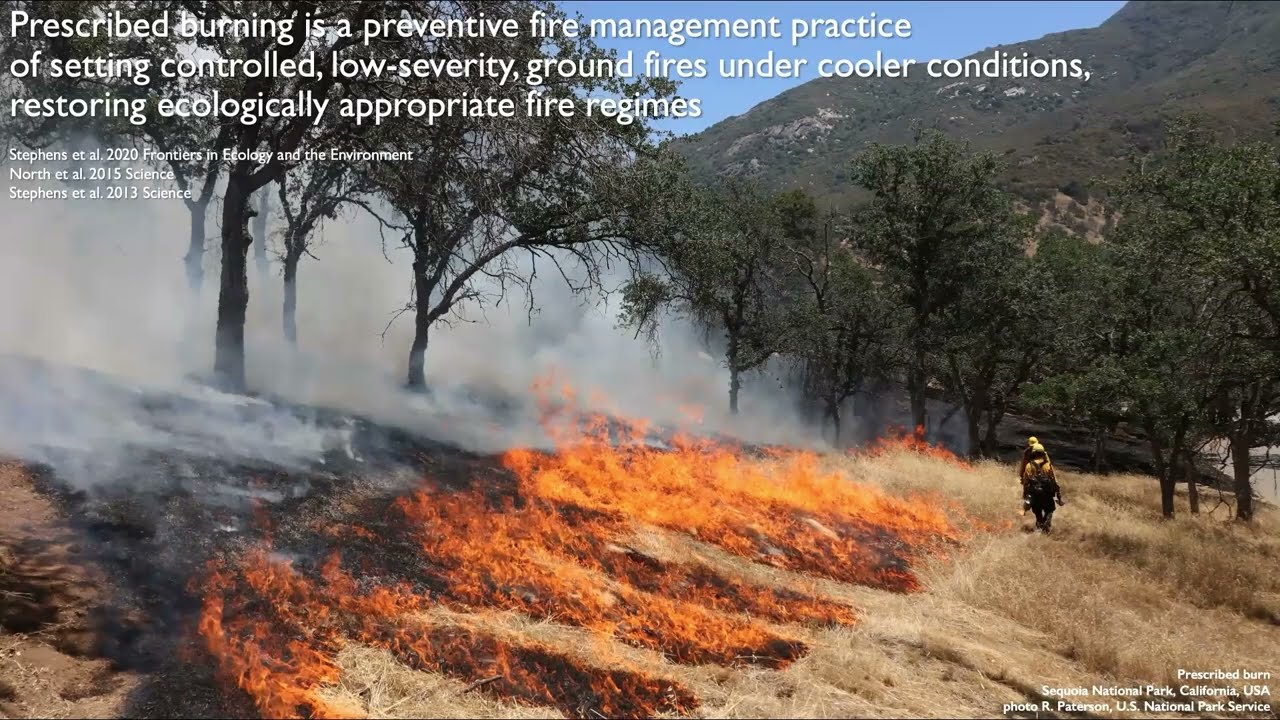
- Introduction of fire management solutions: managed wildfire and prescribed burning.
- Research objectives and study areas in California national parks.
- Methodology: spatial analysis of climate, vegetation, and fire data.
- Explanation of fire return interval departure (FRID) as a prioritization tool.
- Results for Yosemite National Park: temperature and precipitation trends.
Cited Sources
Concurring Sources
- Abatzoglou & Williams (2016) — Supports the finding that climate change has increased burned area in the Western US.
- Yocom et al. (2023) — Referenced in the talk regarding the fire deficit in the Western US.
Contribution & Novelties
The talk presents a novel approach to integrating climate change projections into fire management planning, using fire return interval departure (FRID) as a metric to identify areas where proactive management is most needed. The research provides a practical framework for resource managers to prioritize actions under future climate scenarios.
Pour aller plus loin :
- Fire return interval departure (FRID) — A key metric used in the talk to assess fire regime deviation.
- Climate change and wildfire in the Western US — A foundational study on the influence of climate change on burned area.
- National Park Service Fire Management — Official information on fire management practices in national parks.
108 words
Radar Profile
The radar profile shows high scores in information quantity, quality, and reliability, with a slightly lower score in technical level, indicating a presentation that is scientifically robust but accessible to a non-specialist audience.