Dr. Noah Fierer, January 21, 2026
Keywords
Summary
114 words
Critical Evaluation
Value of the Information & Strength of the Argument
The talk provides valuable insights into soil microbial ecology, challenging common assumptions about bacterial growth rates. The argumentation is solid, based on a combination of literature, observational evidence, and a novel experimental approach. Fierer clearly explains the methodology and its limitations, such as the potential acceleration of growth due to soil slurries. He also contextualizes his findings within broader ecological principles, such as the trade-off between growth rate and substrate affinity. The presentation is well-structured, moving from hypothesis to evidence to implications, and effectively communicates the significance of slow-growing oligotrophs.
Scientific Rigor, Source Quality, Title Accuracy
The scientific rigor is high, with references to peer-reviewed studies and the presenter’s own research. The methodology is described in sufficient detail, and limitations are acknowledged. The title is not informative, but the content is scientifically robust. The talk does not cite specific sources in the description, but the presenter mentions several studies and researchers by name. The adequacy between title and content is poor, as the title only gives the speaker’s name and date, not the topic.
183 words
Title / Content Match
The title is generic (name and date), but the content is a detailed scientific seminar on soil microbial ecology, which is not reflected in the title.
Quality & Reliability
9/10
Presentation by a leading microbial ecologist, based on peer-reviewed research and novel experimental data, with clear methodology and acknowledgment of limitations.
Key Moments
Markers derived by PSI from the transcript: the creator did not define chapters.
- Introduction of the speaker and the topic of soil microbial ecology.
- Posing the question: what is the average generation time of bacteria in soil?
- Discussion of copiotrophs vs. oligotrophs and the metabolic trade-off.
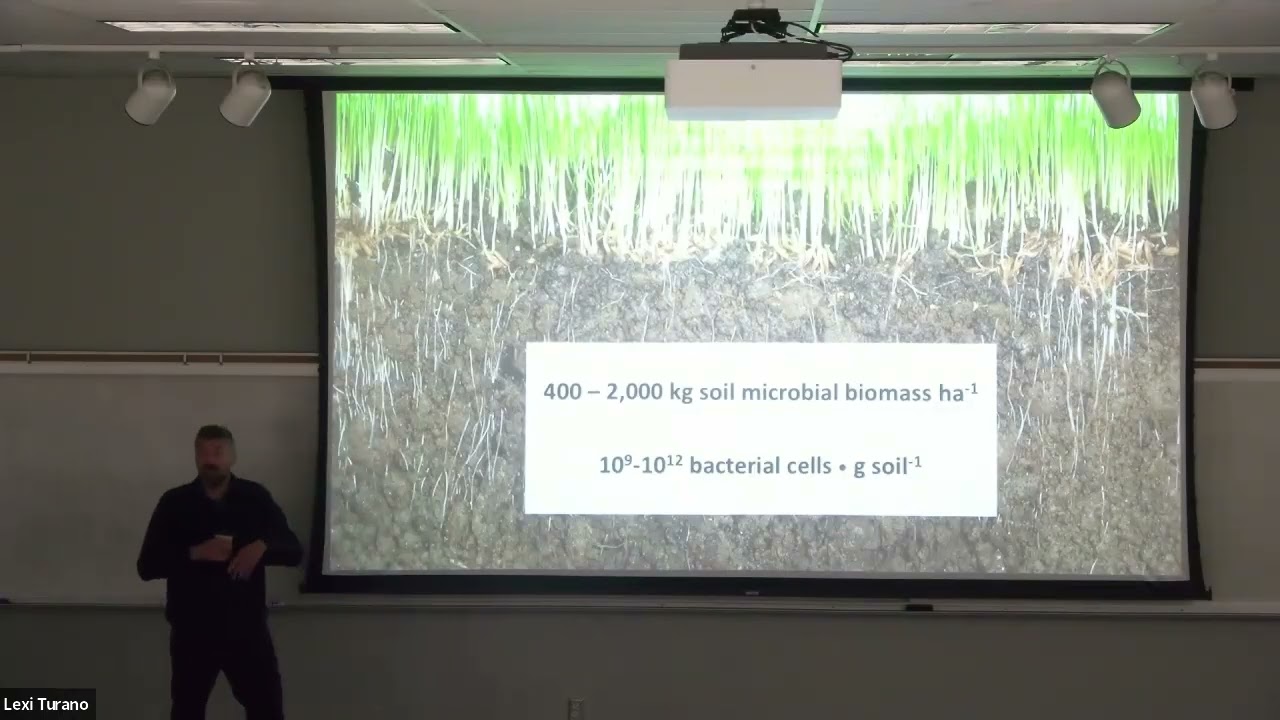
- Anecdotal evidence: biomass, cell size, dormancy.
- Introduction of the deuterated water method to measure generation times.
- Results: generation times of 20-90 days in three soils.
- Implications: biomass not equal to growth, low temporal turnover.
- Difficulty of culturing oligotrophs and the role of metagenomics.
- Case study: Dormibacteraeota phylum in deeper soils.
- Metagenomic analysis of Dormibacteraeota and its oligotrophic adaptations.
Cited Sources
- No specific sources cited in the video description — The presenter mentions several studies and researchers, but no direct URLs are provided.
Concurring Sources
- Fierer, N. (2017). Embracing the unknown: disentangling complex microbial communities. Nature Reviews Microbiology. — Discusses the importance of studying uncultured microbes and the role of metagenomics.
Contribution & Novelties
This talk presents novel empirical data on soil bacterial generation times, a fundamental but poorly quantified parameter. The use of deuterated water to estimate in situ generation times is innovative and provides a method for future studies. The emphasis on oligotrophic bacteria and their ecological significance challenges the traditional focus on fast-growing copiotrophs. The case study of Dormibacteraeota highlights the vast uncultured microbial diversity and the potential of metagenomics to study it.
Pour aller plus loin :
- Oligotroph — Definition and ecological context.
- Deuterium oxide — Properties and use in metabolic studies.
- Metagenomics — Techniques for studying uncultured microbes.
99 words
Radar Profile
The radar profile shows high scores in all dimensions, indicating a well-rounded and reliable scientific presentation. The lowest score is in 'niveau_technique' (8), which is still high, reflecting the advanced but accessible nature of the content.
💬 No comments were provided for analysis.