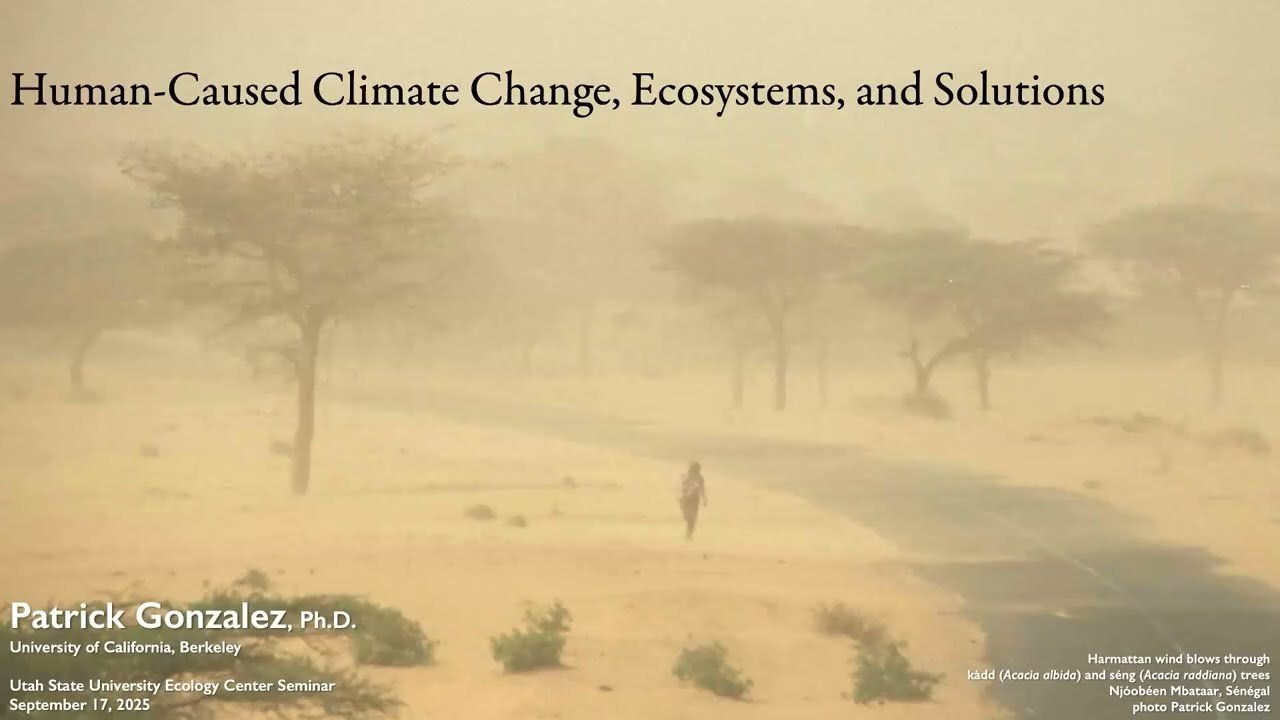
Dr. Patrick Gonzalez, September 17, 2025
Keywords
Summary
166 words
Critical Evaluation
Value of the Information & Strength of the Argument
The presentation provides a comprehensive overview of climate change impacts on ecosystems, backed by the speaker’s expertise and references to IPCC reports. The argumentation is solid, using detection and attribution methods to establish causality. The speaker effectively communicates complex scientific concepts, such as attribution analysis and biome shifts, with clear examples. The value lies in synthesizing a large body of research into a coherent narrative, though some details are simplified for a general audience.
Scientific Rigor, Source Quality, Title Accuracy
The speaker is a lead author for the IPCC, lending high credibility. He references specific studies, including his own peer-reviewed research, and uses data from the IPCC. The title is minimal but accurate, as the content is a seminar by Dr. Gonzalez. The presentation is scientifically rigorous, though it does not provide full methodological details for each claim, which is typical for a seminar format.
154 words
Title / Content Match
The title is minimal, but the content matches the speaker and date, focusing on climate change impacts on ecosystems.
Quality & Reliability
8/10
The speaker is a recognized expert, and the content is based on IPCC reports and peer-reviewed studies. However, the presentation is a summary without detailed methodological exposition, and some claims are simplified for a general audience.
Key Moments
Markers derived by PSI from the transcript: the creator did not define chapters.
- Introduction: dead tree in Africa as first sign of climate change
- Explanation of carbon imbalance and global temperature rise
- Attribution analysis: human influence on warming
- Impacts on national parks: heating and aridity
- Ecological impacts: extinctions, glacier retreat, wildfire
- Biome shifts and species loss
- Future projections and risks under different emission scenarios
Cited Sources
- IPCC Sixth Assessment Report — Referenced as the basis for many findings on impacts, adaptation, and vulnerability.
- Gonzalez et al. (2018) - Climate change and American national parks — Study analyzing climate change patterns in US national parks.
- Gonzalez et al. (2010) - Tree mortality in the Sahel — Research on tree mortality and species loss in the Sahel.
Concurring Sources
- IPCC AR6 WG1 — Provides the physical science basis for climate change, supporting the attribution claims.
- US National Climate Assessment — Assesses climate change impacts in the US, consistent with the talk's findings.
Contribution & Novelties
The talk synthesizes a wide range of research on climate change impacts, emphasizing attribution and the disproportionate effects on protected areas. It provides a clear framework for understanding the scientific basis of climate policy targets.
Pour aller plus loin :
- IPCC AR6 WG2 — Comprehensive assessment of impacts, adaptation, and vulnerability.
- Detection and attribution of climate change — Overview of the scientific methods used to attribute changes to human causes.
- Biome shifts under climate change — General information on how climate change affects biomes.
84 words
Radar Profile
The radar profile shows high scores in quantity, quality, and reliability, with a slightly lower technical level, reflecting a comprehensive yet accessible presentation.