Screening of "the big 5"
Keywords
Summary
193 words
Critical Evaluation
Value of the Information & Strength of the Argument
The presentation provides a broad overview of screening recommendations for five major cancers, which is valuable for clinicians. The argumentation is based on established guidelines and epidemiological data, but the lack of specific citations and the garbled transcription weaken the overall rigor. The presenter does not delve into the evidence behind each recommendation, but he does mention some key studies, such as the NLST for lung cancer screening. The discussion of risk factors and screening intervals is clinically relevant and practical.
Scientific Rigor, Source Quality, Title Accuracy
The scientific rigor is moderate. The presenter relies on general knowledge and guidelines, but no specific sources are cited in the video or description. The title is vague but accurately reflects the content. The transcription is heavily garbled, which may be due to audio quality or speech recognition errors, making it difficult to verify the accuracy of the information. The lack of citations and the poor transcription reduce the overall reliability.
167 words
Title / Content Match
The title is vague but accurately reflects the content, which covers screening for five major cancers.
Quality & Reliability
6/10
The presentation is based on established screening guidelines and epidemiological data, but the transcription is heavily garbled, making it difficult to verify specific claims. No sources are cited in the video or description.
Key Moments
Markers derived by PSI from the transcript: the creator did not define chapters.
- Introduction and overview of the presentation on screening for the big 5 cancers.
- Discussion of breast cancer epidemiology and risk factors.
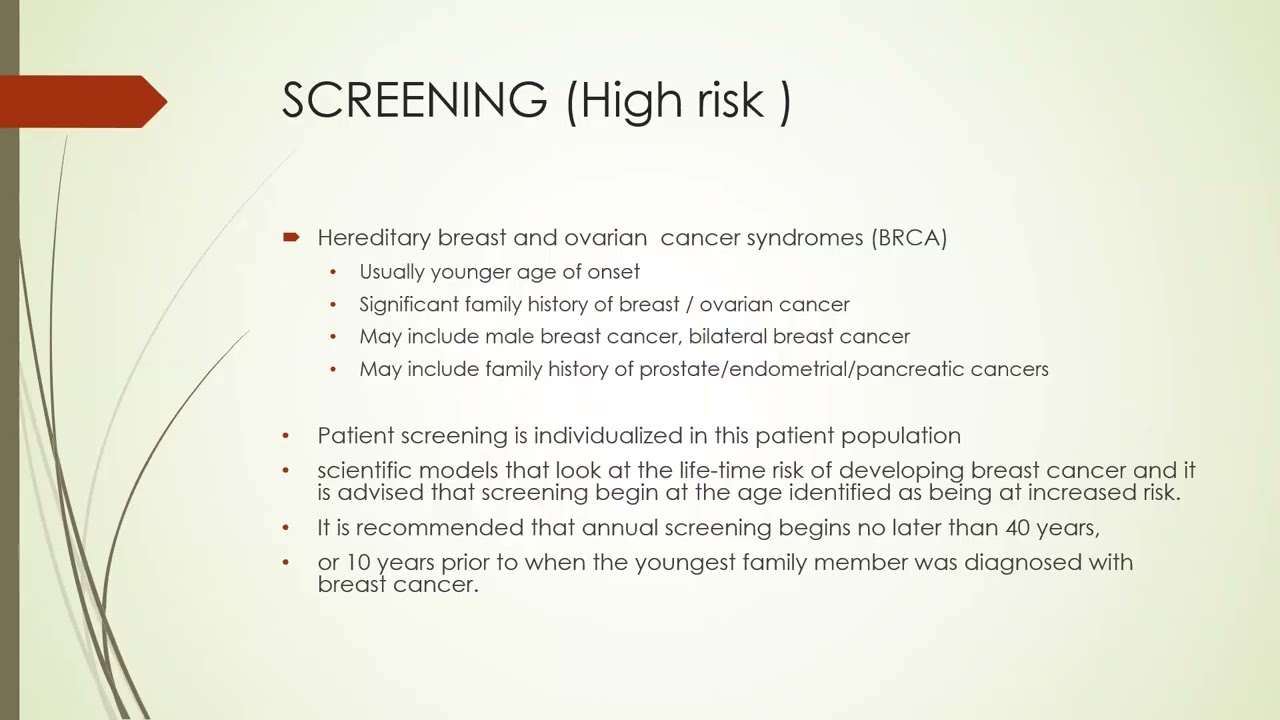
- Breast cancer screening guidelines and modalities.
- Prostate cancer epidemiology and screening recommendations.
- Cervical cancer screening and HPV vaccination.
- Lung cancer screening with low-dose CT.
- Colorectal cancer screening and risk factors.
- Summary and concluding remarks.
Contribution & Novelties
The presentation offers a concise summary of screening recommendations for five major cancers, which is useful for clinicians in South Africa. It highlights the importance of early detection and discusses risk-adapted screening strategies. However, it does not present new research or novel insights.
Pour aller plus loin :
- US Preventive Services Task Force — Official recommendations for cancer screening.
- National Cancer Institute — Comprehensive information on cancer screening and research.
- World Health Organization — Global cancer statistics and screening guidelines.
- BRCA1 and BRCA2 — Genetic mutations associated with breast and ovarian cancer risk.
- PSA test — Biomarker used for prostate cancer screening.
102 words
Radar Profile
The radar profile shows a balanced distribution across the four dimensions, with slightly higher scores in quantity of information and technical level, indicating a comprehensive but not deeply rigorous presentation.