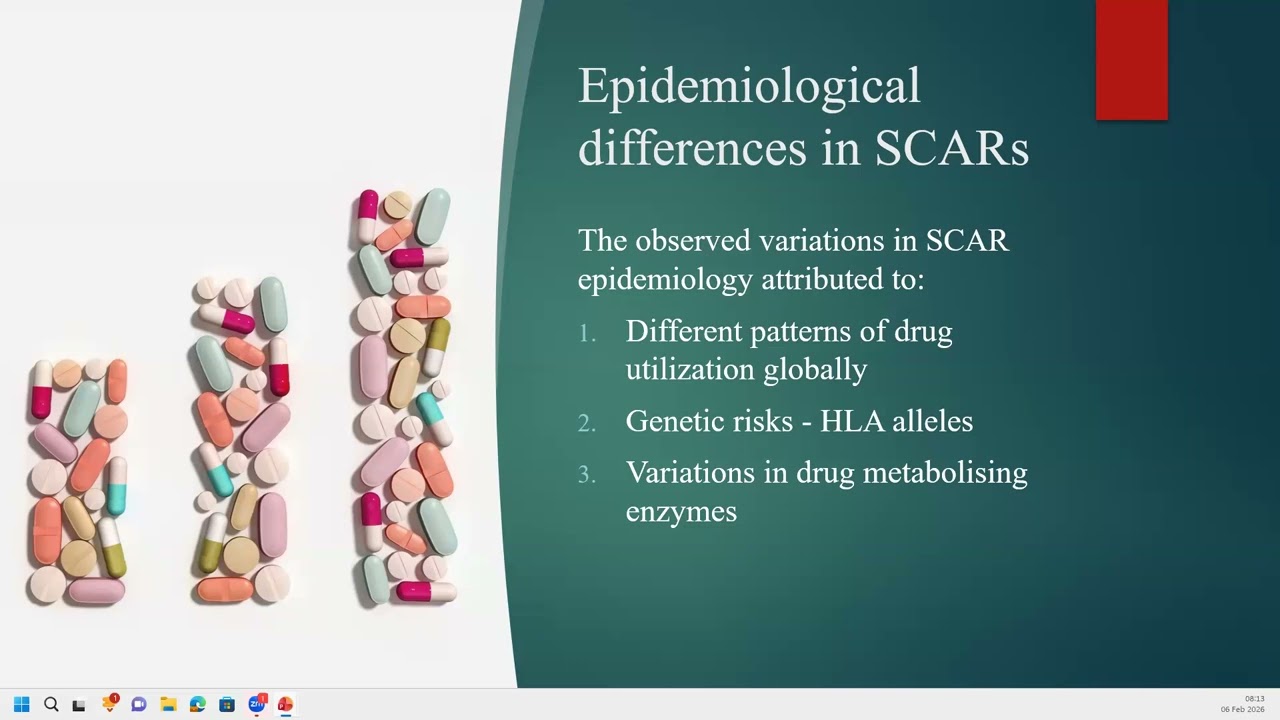
Severe Cutaneous Adverse Reactions - SCARS
Keywords
Summary
151 words
Critical Evaluation
Value of the Information & Strength of the Argument
The presentation offers a thorough and well-structured overview of SCARs, covering essential aspects from definition to management. The argumentation is solid, based on established medical knowledge and supported by references to specific studies and scoring systems. The speaker effectively explains complex pathophysiological mechanisms, such as the role of HLA alleles and viral reactivation, and provides practical guidance for diagnosis and treatment. The inclusion of local data from South Africa adds relevance, though the lack of explicit citations to primary literature may limit the ability to verify specific claims.
Scientific Rigor, Source Quality, Title Accuracy
The presentation demonstrates scientific rigor by referencing established scoring systems (SCORTEN, RegiSCAR) and discussing evidence-based management options. However, it does not explicitly cite specific studies or sources, which reduces its verifiability. The title accurately reflects the content, and the presentation is well-organized. The speaker mentions local studies, but without detailed references, the audience cannot easily access the original data. Overall, the scientific quality is good, but the lack of explicit citations is a limitation.
177 words
Title / Content Match
The title accurately reflects the content, which focuses on severe cutaneous adverse reactions (SCARs).
Quality & Reliability
7/10
The presentation is a comprehensive review of severe cutaneous adverse reactions (SCARs), covering definitions, epidemiology, pathophysiology, clinical presentations, diagnostic tools, and management. It is based on established medical knowledge and includes references to specific studies and scoring systems. However, it lacks explicit citations to primary literature and is presented as an academic meeting talk, which may limit its depth and verifiability.
Key Moments
Markers derived by PSI from the transcript: the creator did not define chapters.
- Introduction and learning outcomes
- Definition of SCARs and comparison with non-SCARs
- Epidemiology of SJS/TEN, DRESS, AGEP, and GBFDE
- Pathophysiology: immune mechanisms, HLA alleles, and viral reactivation
- Clinical presentation of SJS/TEN and diagnostic criteria
- Clinical presentation of DRESS and RegiSCAR criteria
- Clinical presentation of AGEP and GBFDE
- Determining the culprit drug and causality assessment tools
- Management principles and specific treatments
Cited Sources
- SCORTEN — Mentioned as a scoring system to assess severity and predict mortality in SJS/TEN.
- RegiSCAR — Mentioned as a diagnostic tool for DRESS.
- Naranjo scale — Mentioned as a causality assessment tool for adverse drug reactions.
Concurring Sources
- WHO definition of adverse drug reactions — The definition of adverse drug reactions aligns with the WHO's standard definition.
Contribution & Novelties
The presentation provides a comprehensive and up-to-date overview of SCARs, integrating epidemiology, pathophysiology, and management. It highlights the importance of genetic predisposition (HLA alleles) and viral reactivation in the development of these reactions. The inclusion of local data from South Africa adds a regional perspective, which is valuable for clinicians in similar settings. The talk emphasizes the need for early recognition and withdrawal of the culprit drug to improve outcomes.
Pour aller plus loin :
- HLA-B*1502 and carbamazepine-induced Stevens-Johnson syndrome — Discusses the genetic association and clinical implications.
- RegiSCAR study group — Provides criteria and research on severe cutaneous adverse reactions.
- SCORTEN score — A practical tool for assessing severity in SJS/TEN.
112 words
Radar Profile
The radar profile shows high scores in quantity and quality of information, with moderate technical level and reliability. This indicates a comprehensive and well-structured presentation, though the lack of explicit citations may slightly reduce its reliability.
💬 No comments were provided for analysis.