Why is advanced HIV still associated with such poor outcomes in 2025?
Keywords
Summary
214 words
Critical Evaluation
Value of the Information & Strength of the Argument
The presentation provides valuable insights into the ongoing burden of advanced HIV disease and its associated mortality. The MITS study offers a novel approach to accurately determine causes of death, addressing the limitations of incomplete medical records. The preliminary data, showing high rates of advanced HIV, treatment default, and preventable deaths, are compelling. The Advanced HIV SA study adds a comprehensive surveillance framework, combining epidemiological analysis, clinical data, and enhanced diagnostics. The argumentation is logical and evidence-based, with clear explanations of methodologies and limitations. The speakers effectively highlight the gaps in current care and the potential for improved diagnostics and prevention strategies. The value is high for clinicians and public health officials, providing actionable insights to improve outcomes.
Scientific Rigor, Source Quality, Title Accuracy
The presentation demonstrates scientific rigor through detailed methodology descriptions and acknowledgment of limitations. The MITS methodology is validated, and the Advanced HIV SA study uses robust data linkage and laboratory techniques. The sources are primarily the presenters’ own ongoing research, with references to national and international HIV statistics. The title accurately reflects the content, focusing on the persistent poor outcomes of advanced HIV. The presentation is well-structured and credible, though the preliminary nature of the data and lack of peer-reviewed publication temper the overall reliability.
218 words
Title / Content Match
The title accurately reflects the content, which focuses on the persistent poor outcomes of advanced HIV in 2025, presenting two studies investigating causes of death and severe infections.
Quality & Reliability
8/10
The video presents preliminary data from two ongoing studies (MITS and Advanced HIV SA) conducted by clinical researchers. The methodology is described in detail, and the data, while preliminary, is derived from systematic surveillance and laboratory analyses. The presentation is balanced, acknowledging limitations and the need for further research. However, the lack of peer-reviewed publication and the preliminary nature of the findings temper the reliability score.
Key Moments
Markers derived by PSI from the transcript: the creator did not define chapters.
- Introduction to the session and the two studies on advanced HIV mortality.
- Dr Hall introduces the MITS study and its methodology.
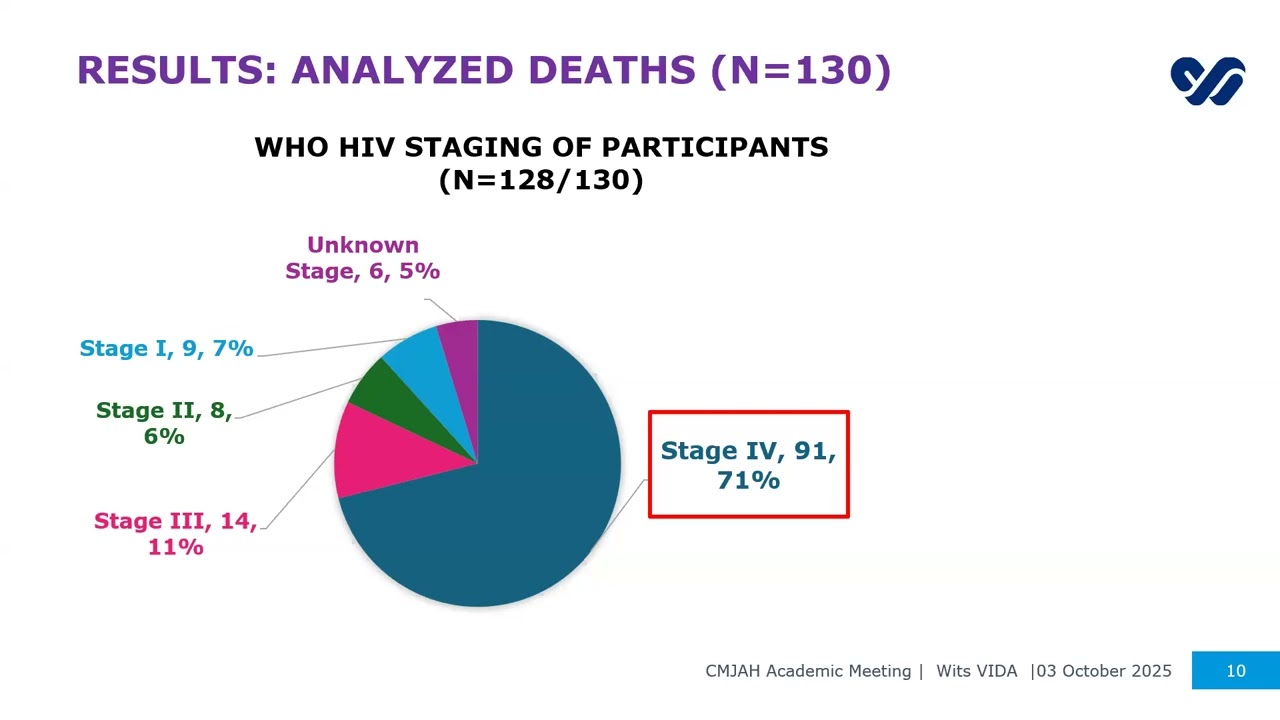
- Preliminary findings from MITS: 71% advanced HIV, high rates of TB and cryptococcosis.
- Discussion of gaps in HIV care and the role of MITS in identifying preventable deaths.
- Dr Prendergast introduces the Advanced HIV SA study and its three-tiered approach.
- Preliminary data from Advanced HIV SA: 20% advanced HIV, high in-hospital mortality, diagnostic challenges.
- Discussion of enhanced diagnostics and future directions.
Cited Sources
- CHAMPS network — Mentioned as the network where MITS methodology has been applied for over 10 years.
- UNAIDS 95-95-95 goals — Referenced in the context of HIV treatment targets.
- South African HIV statistics — Referenced for national HIV prevalence and mortality data.
Concurring Sources
- WHO guidelines on advanced HIV disease — Supports the high mortality and need for improved management.
- UNAIDS global HIV statistics — Provides global context on HIV-related deaths.
Contribution & Novelties
This presentation provides novel insights into the causes of death and severe infections in advanced HIV, using innovative methodologies like minimally invasive tissue sampling and enhanced diagnostics. It highlights the ongoing high mortality and preventable deaths, emphasizing the need for improved care and diagnostics.
Pour aller plus loin :
- Minimally invasive tissue sampling (MITS) — Background on the technique.
- Advanced HIV disease management — WHO guidelines on managing advanced HIV.
- Cryptococcal meningitis — A key opportunistic infection mentioned in the presentation.
81 words
Radar Profile
The radar profile shows high scores in quantity and quality of information, reflecting the detailed presentation of two studies. The technical level is moderate, suitable for a clinical audience. The overall reliability is high, though the preliminary nature of the data prevents a perfect score.