What to think about AI in medicine?
Keywords
Summary
157 words
Critical Evaluation
Value of the Information & Strength of the Argument
The talk provides a solid, accessible introduction to AI, demystifying common misconceptions and explaining core concepts like machine learning, neural networks, and transformers. The argumentation is logical and builds from simple examples to more complex ideas, effectively illustrating how AI systems learn and why they are powerful. The speaker’s expertise is evident, and he communicates complex ideas in an engaging manner. However, the talk lacks depth on the medical applications promised in the title, and the discussion of AI in medicine is superficial. The value lies in its educational content for a general audience, but it does not offer new insights for experts.
Scientific Rigor, Source Quality, Title Accuracy
The talk is scientifically rigorous in its explanations, but it does not cite specific sources or references. The speaker mentions the transformer paper ‘Attention is All You Need’ but does not provide a citation. The title ‘What to think about AI in medicine?’ is somewhat misleading, as the talk focuses more on AI fundamentals than on medical applications. The content is accurate and up-to-date, but the lack of sources limits its scholarly value. The talk is an opinion/expert overview rather than a research presentation.
202 words
Title / Content Match
The title suggests a focus on AI in medicine, but the talk primarily covers AI fundamentals with only a brief mention of medical implications. The title is somewhat broader than the content.
Quality & Reliability
7/10
The speaker is a recognized AI expert, and the content is technically accurate and well-explained. However, the talk is a general overview with limited depth on medical applications, and no specific sources are cited.
Key Moments
Markers derived by PSI from the transcript: the creator did not define chapters.
- Introduction: Professor Rosman begins his talk on AI, acknowledging the early hour and his excitement about the topic.
- Definition of AI: Rosman explains the history of AI, from its origins in the 1950s to the current machine learning paradigm.
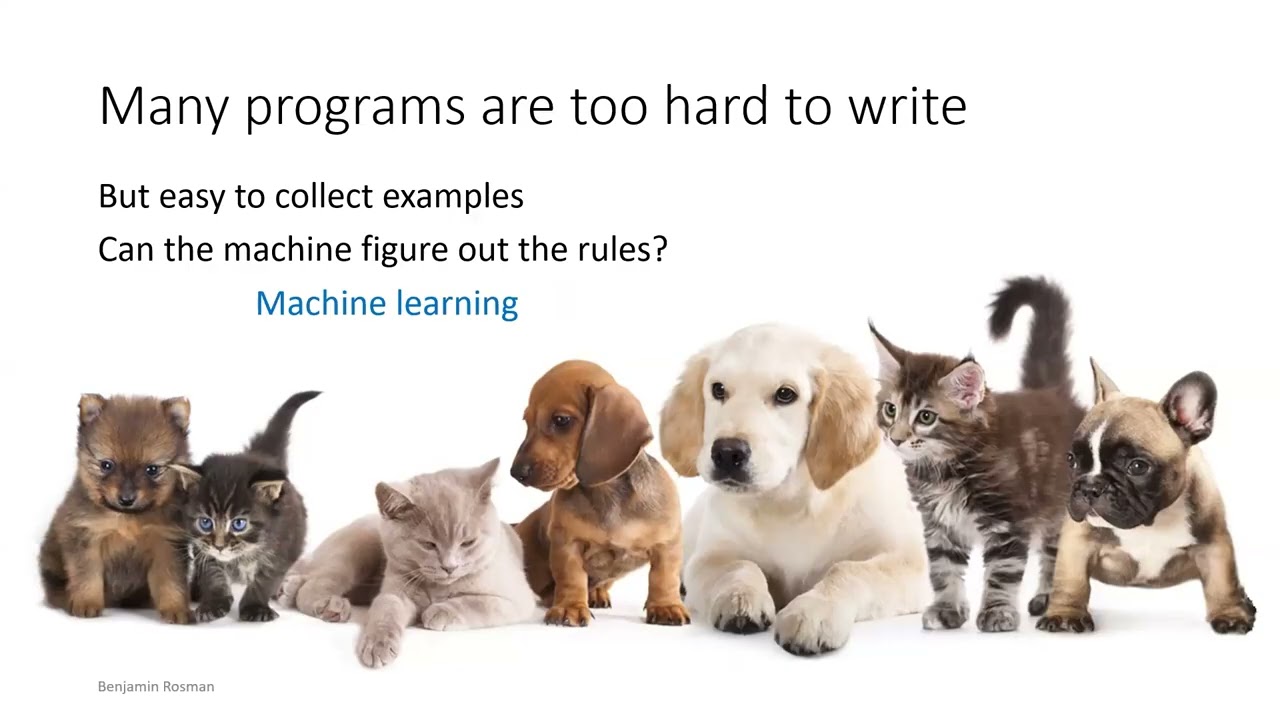
- Machine learning basics: Using the cat vs. dog example, he illustrates how machines learn from data rather than explicit rules.
- Neural networks: He draws an analogy to the brain, explaining how artificial neurons and synaptic weights work.
- Training process: He describes how networks adjust weights based on errors, using simple calculus.
- Scale of models: He compares the number of parameters in GPT-3.5 and GPT-4 to the human brain's synapses.
- Language models: He explains how transformers and attention mechanisms revolutionized AI, citing the 'Attention is All You Need' paper.
- Generative AI: He shows examples of AI-generated images and text, highlighting their capabilities and limitations.
- AI in medicine: He briefly touches on potential applications and challenges, acknowledging his limited expertise in the field.
- Conclusion: He summarizes key points and opens the floor for questions.
Contribution & Novelties
The talk provides a clear and engaging introduction to AI for a medical audience, bridging the gap between technical concepts and practical understanding. It emphasizes the shift from symbolic AI to machine learning and the importance of data-driven approaches. The speaker’s analogy between neural networks and the brain helps demystify AI for non-experts.
Pour aller plus loin :
- Attention Is All You Need — The seminal paper introducing the transformer architecture, foundational to modern AI.
- Machine Learning — Overview of machine learning concepts and methods.
- Neural Network — Explanation of artificial neural networks and their biological inspiration.
97 words
Radar Profile
The radar profile shows balanced scores across all dimensions, with slightly higher scores in information quantity and quality, reflecting the talk's comprehensive yet accessible nature. The technical level is moderate, suitable for a general audience, and the reliability is good due to the speaker's expertise.