A TFT Crash Course
Keywords
Summary
147 words
Critical Evaluation
Value of the Information & Strength of the Argument
The presentation offers high practical value for clinicians, providing a structured approach to interpreting TFTs and managing common thyroid abnormalities. The argumentation is solid, grounded in clinical experience and supported by reference to large studies, such as a meta-analysis of nearly 22,000 patients linking higher TSH levels to increased cardiovascular events. The case-based format effectively illustrates the diagnostic reasoning process, and the presenter clearly explains the rationale behind each step, from initial differential diagnosis to treatment decisions. The emphasis on avoiding unnecessary tests and consults is valuable and evidence-based.
Scientific Rigor, Source Quality, Title Accuracy
The scientific rigor is high, as the content aligns with established endocrinology guidelines and literature. However, the presentation does not include explicit citations or references to specific studies, relying instead on the presenter’s expertise and general medical knowledge. The title accurately reflects the content, which is a crash course on TFT interpretation. The presentation is well-structured and clinically relevant, though the lack of formal references may limit its utility for those seeking to verify specific claims.
180 words
Title / Content Match
The title accurately reflects the content, which is a crash course on interpreting thyroid function tests.
Quality & Reliability
8/10
Presentation by an endocrinology fellow at an academic meeting, based on clinical expertise and established medical knowledge. Includes a real patient case and references to large studies (e.g., meta-analysis of 22,000 patients). No formal citations provided, but content aligns with standard endocrinology practice.
Key Moments
Markers derived by PSI from the transcript: the creator did not define chapters.
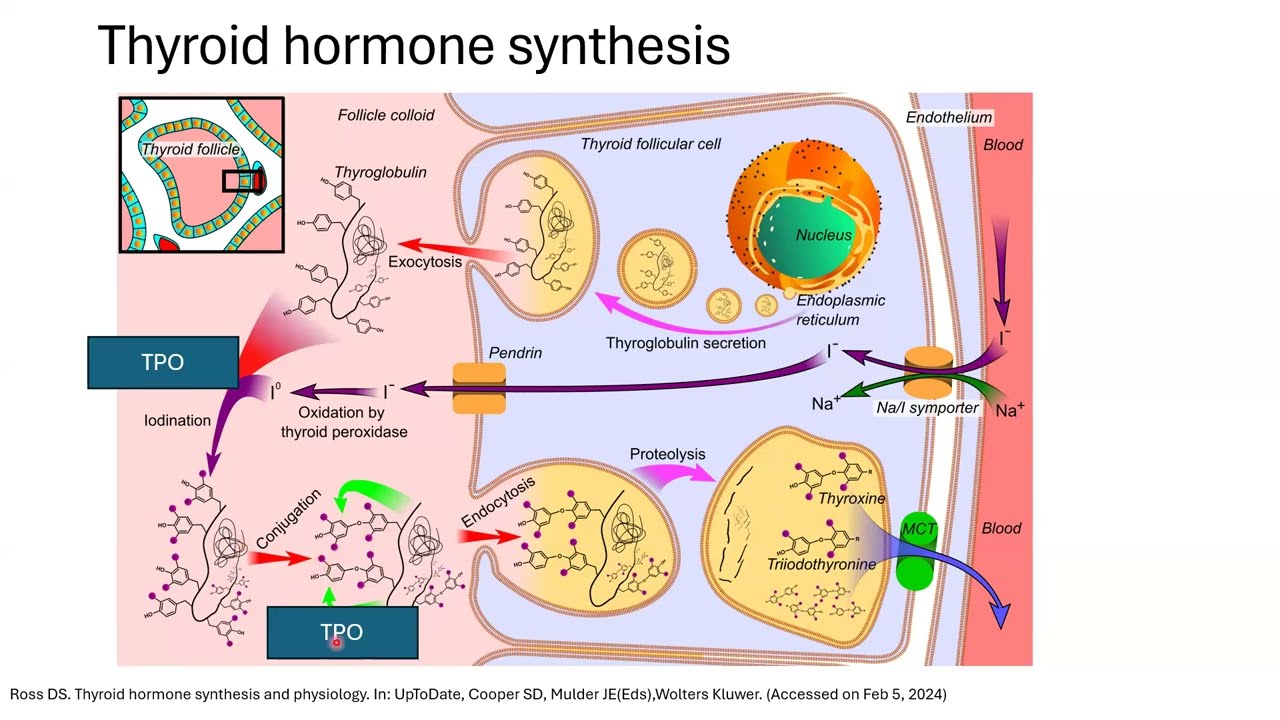
- Introduction to the thyroid axis and hormone synthesis
- Clinical case presentation: 59-year-old male with rapidly enlarging goiter
- Differential diagnosis: thyroiditis vs Graves' disease
- Interpretation of thyroid antibodies and their clinical utility
- Subclinical hypothyroidism: epidemiology, progression, and cardiovascular risks
- When to treat subclinical hypothyroidism and when to order thyroid ultrasound
Contribution & Novelties
The presentation provides a practical, case-based approach to interpreting thyroid function tests, emphasizing common pitfalls and appropriate test ordering. It offers a clear framework for distinguishing thyroiditis from true hyperthyroidism and for managing subclinical hypothyroidism. The discussion on the natural history of subclinical hypothyroidism and its cardiovascular implications is particularly useful.
Pour aller plus loin :
- Thyroid function tests - Wikipedia — Overview of TFTs and their interpretation.
- Subclinical hypothyroidism - UpToDate — Comprehensive clinical review (subscription required).
- American Thyroid Association guidelines — Official guidelines on thyroid disease management.
89 words
Radar Profile
The radar profile shows high scores in information quantity, quality, and reliability, with a slightly lower technical level, indicating a presentation that is comprehensive and trustworthy but not overly technical, suitable for a broad medical audience.