The Impact of Asymptomatic STIs on Penile Mucosal Immunity
Keywords
Summary
168 words
Critical Evaluation
Value of the Information & Strength of the Argument
The presentation provides valuable insights into a relatively understudied area: the impact of asymptomatic STIs on male genital mucosal immunity. The use of multiple methodologies (barrier function measurements, histology, flow cytometry, spatial transcriptomics) strengthens the argument. The presenter logically connects the observed changes (increased moisture, reduced tight junction proteins, immune cell infiltration, altered gene expression) to potential mechanisms for increased HIV susceptibility. However, the argumentation is somewhat limited by the lack of detailed statistical analysis and the small sample size implied by the study’s challenges. The presenter acknowledges limitations, such as recruitment issues during COVID, which adds credibility.
Scientific Rigor, Source Quality, Title Accuracy
The presentation is based on original research, but no specific external sources are cited within the talk. The title accurately reflects the content. The methodology appears rigorous, with the use of established techniques and novel approaches like spatial transcriptomics. However, the lack of peer-reviewed publication details and the absence of citations make it difficult to verify the findings independently. The presenter mentions collaborations with Mayo Clinic, which lends some credibility. Overall, the scientific rigor is moderate, with potential for bias due to the presenter’s involvement in the study.
201 words
Title / Content Match
The title accurately reflects the content, focusing on the impact of asymptomatic STIs on penile mucosal immunity.
Quality & Reliability
7/10
Presentation of original research with detailed methodology, but limited peer-reviewed context and no external verification.
Key Moments
Markers derived by PSI from the transcript: the creator did not define chapters.
- Introduction to the topic and background on asymptomatic STIs and HIV risk.
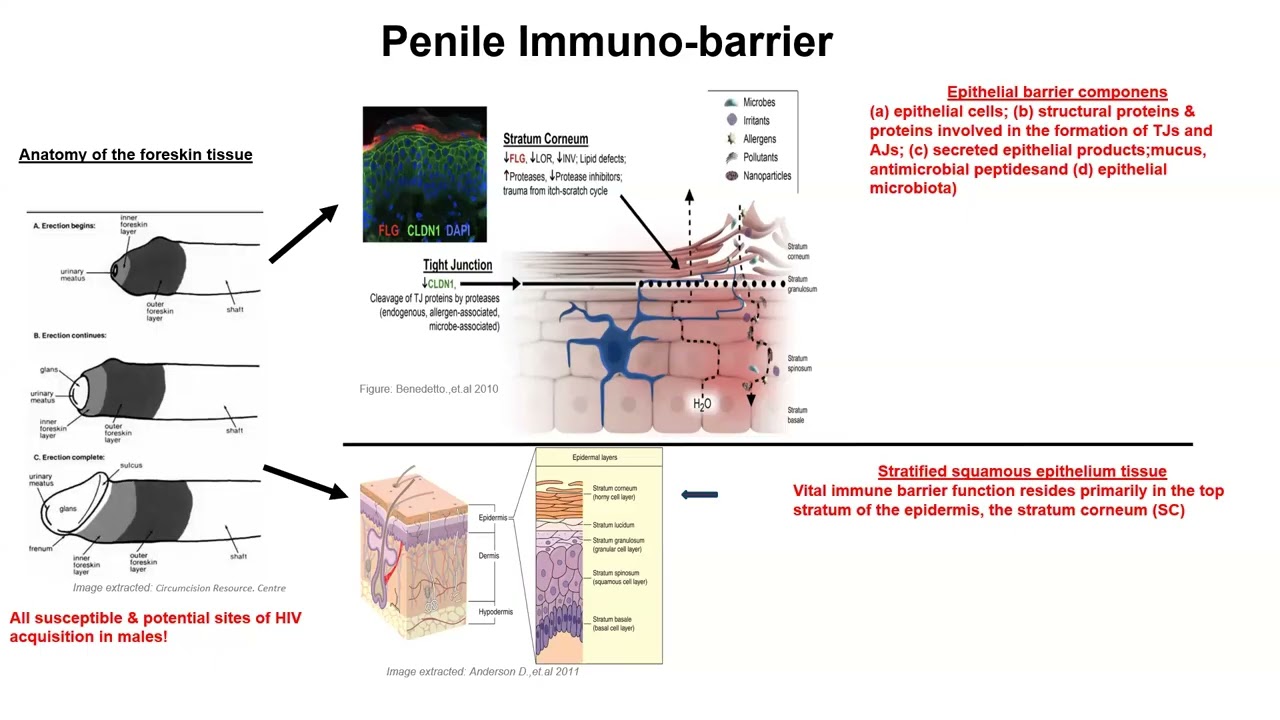
- Overview of the penile anatomy and immune environment.
- Study design and methods for measuring barrier function.
- Results on barrier function and tight junction protein expression.
- Histological analysis of immune cell infiltration.
- Flow cytometry results on T cell subsets.
- Spatial transcriptomics findings and conclusions.
Contribution & Novelties
This study provides novel insights into the effects of asymptomatic STIs on the penile mucosal immune microenvironment, particularly highlighting differential responses between inner and outer foreskin. The use of spatial transcriptomics in this context is innovative and reveals compartment-specific gene expression changes. The findings suggest that asymptomatic STIs may increase HIV susceptibility through multiple mechanisms, including barrier disruption and immune activation.
Pour aller plus loin :
- HIV and STI co-infection — Overview of HIV and STI interactions.
- Foreskin and HIV susceptibility — Study on foreskin biology and HIV risk.
- Mucosal immunology — Overview of mucosal immune responses.
97 words
Radar Profile
The radar profile shows high scores in quantity of information and technical level, reflecting the detailed methodology and data presented. Quality of information and overall reliability are moderate, indicating the need for further validation. The presentation is strong in technical depth but may lack broader context.