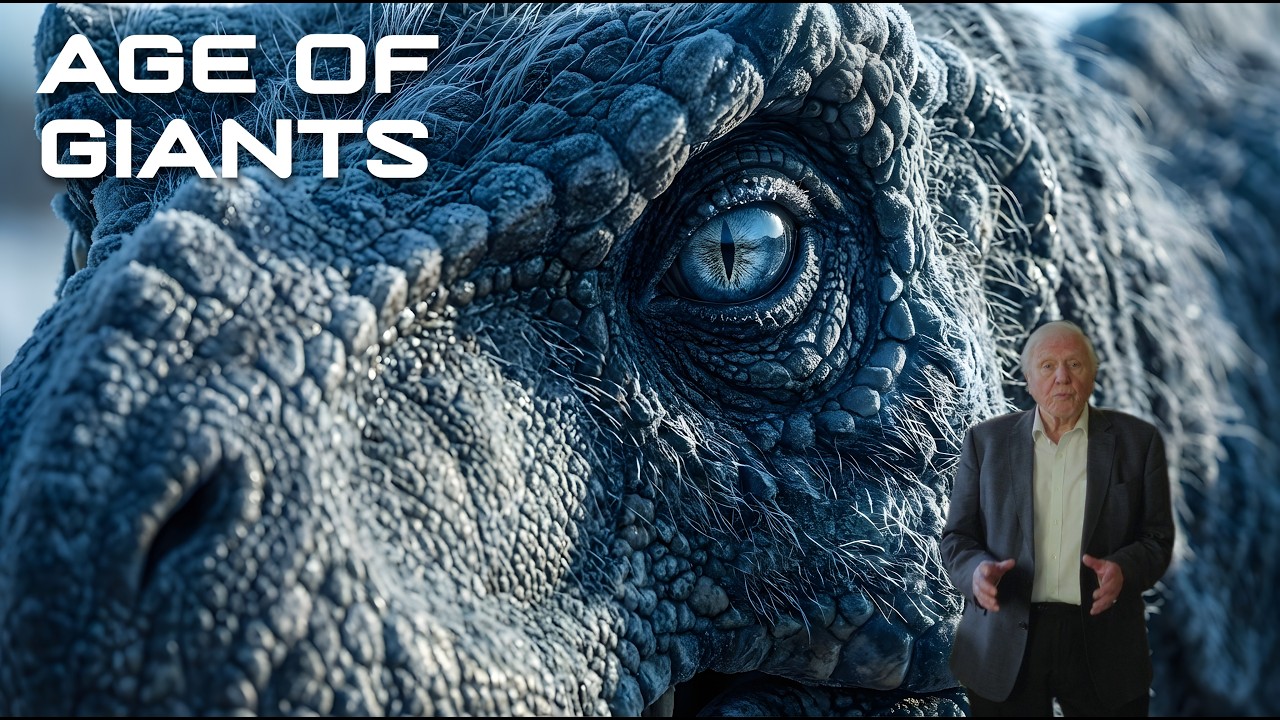
Jurassic Wild - Giants That Ruled the Land | Full Documentary
Keywords
Summary
111 words
Critical Evaluation
The documentary provides a visually engaging and broadly accurate overview of Jurassic life, but it suffers from a lack of scientific rigor. It makes general claims about reptilian dominance and gigantism without citing specific studies or fossil evidence. The narrative is compelling but often vague, using terms like ‘some species’ and ‘many reptiles’ without naming examples. The absence of named dinosaurs (e.g., Brachiosaurus, Allosaurus) and specific time periods reduces its educational value for viewers seeking concrete knowledge. The discussion of gigantism factors is plausible but oversimplified, omitting nuances like the role of bird-like air sacs in sauropods. The documentary also fails to address recent scientific debates, such as the warm-blooded vs. cold-blooded metabolism of dinosaurs. The production quality is high, with impressive reconstructions, but the content remains at a popular science level. The title accurately reflects the content, and the documentary does not mislead, but it does not offer new insights for informed audiences. The lack of sources and expert interviews is a significant weakness. Overall, it serves as an entertaining introduction but not a rigorous scientific resource.
178 words
Title / Content Match
The title accurately reflects the content, focusing on giant reptiles of the Jurassic.
Quality & Reliability
6/10
The documentary provides a broad overview of Jurassic ecosystems and gigantism, but lacks specific citations, dates, or named species, and relies on generic reconstructions. The content is scientifically plausible but not rigorously sourced.
Key Moments
Markers derived by PSI from the transcript: the creator did not define chapters.
- Introduction to the Jurassic world and the dominance of reptiles.
- Discussion of Pangaea breakup and climate changes.
- Overview of Jurassic flora and its role in supporting giant herbivores.
- Explanation of reptilian advantages: eggs, skin, metabolism.
- Marine reptiles and the oceans of the Jurassic.
- Pterosaurs and the aerial realm.
- Factors behind gigantism: energy efficiency, size as protection, abundant food.
- Skeletal adaptations and growth patterns.
- Predator-prey arms race and ecosystem balance.
- Daily life and environmental challenges.
- Volcanic activity and sea level changes.
- Isolation and diversification of species.
- Limits of size and risks.
- Legacy of Jurassic giants and conclusion.
Contribution & Novelties
The documentary synthesizes known paleontological knowledge into a cinematic narrative, emphasizing the ecological and evolutionary drivers of gigantism. It does not present new research but offers a comprehensive overview for a general audience.
Pour aller plus loin :
- Sauropoda — Overview of the giant long-necked dinosaurs.
- Theropoda — The group of bipedal carnivorous dinosaurs.
- Pterosaur — Flying reptiles of the Mesozoic.
- Mesozoic — The era encompassing the Jurassic.
- Dinosaur physiology — Discussion of metabolic and thermal biology.
77 words
Radar Profile
The radar profile shows moderate scores across all dimensions, indicating a balanced but not exceptional documentary. It provides a decent amount of information with acceptable quality, but lacks technical depth and strong reliability.