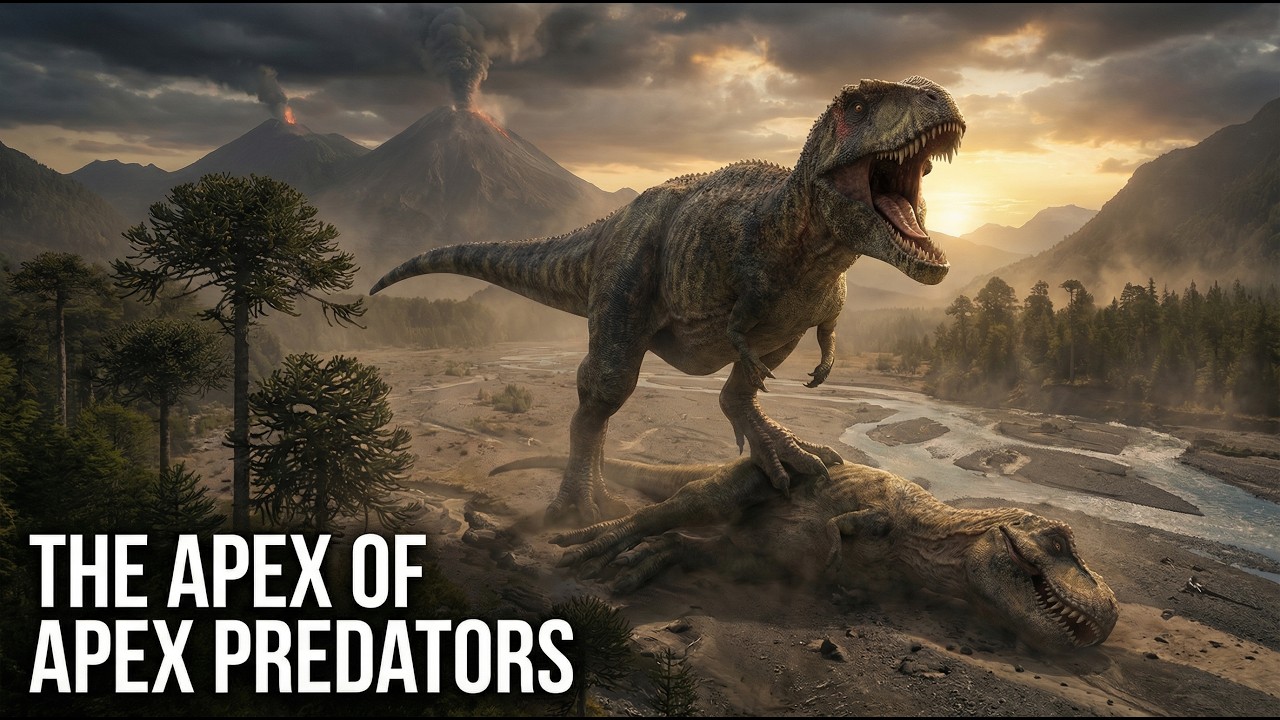
The Apex Predator Even T. Rex Feared | Full Documentary
Keywords
Summary
151 words
Critical Evaluation
The documentary provides a broad overview of the evolutionary history of large theropod dinosaurs, focusing on the transition from slicing predators to crushing predators like T. rex. It correctly highlights that T. rex was not the first giant predator and that earlier ecosystems were dominated by different types of carnivores. The discussion of hunting strategies, such as the endurance-based pursuit of sauropods by slicing predators, is plausible and supported by some fossil evidence. However, the documentary often presents speculative scenarios as established fact, without citing specific studies or fossil discoveries. For instance, it claims that early tyrannosaurs were ‘smarter hunters’ due to enhanced senses, but this is an interpretation that requires more evidence. The title suggests that there was a predator that T. rex feared, but the content does not clearly identify one; it mentions that T. rex may have faced competition from other large theropods and marine predators, but does not provide a definitive answer. The documentary also lacks discussion of the latest research on T. rex’s bite force and its potential rivals, such as Spinosaurus or Giganotosaurus, which are only briefly mentioned. The production quality is high, with engaging narration and visuals, but the scientific rigor is moderate. The lack of citations and the tendency to anthropomorphize animals (’they were calculated killers’) detract from its credibility. Overall, it serves as an accessible introduction to dinosaur ecology but should be supplemented with more rigorous sources.
236 words
Title / Content Match
The title is somewhat sensational but the content does discuss predators that may have rivaled T. rex, though it focuses more on earlier slicing predators than a specific one feared by T. rex.
Quality & Reliability
7/10
The documentary presents a plausible narrative based on paleontological concepts, but lacks specific citations and may oversimplify complex ecological dynamics. The information is generally accurate but not deeply sourced.
Key Moments
Markers derived by PSI from the transcript: the creator did not define chapters.
- Introduction to the Late Jurassic world and the dominance of slicing predators.
- Discussion of early tyrannosaurs as small, marginal hunters.
- Analysis of hunting strategies of slicing predators against sauropods.
- Exploration of how environmental changes favored crushing bite forces.
- Examination of potential rivals to T. rex, including other theropods and marine predators.
- Conclusion summarizing the evidence and the question of T. rex's supremacy.
Contribution & Novelties
The documentary offers a synthesis of existing paleontological knowledge, emphasizing the ecological context of T. rex’s rise. It highlights the importance of hunting strategies and environmental pressures in shaping predator evolution. However, it does not present new research or original findings.
Pour aller plus loin :
- Tyrannosaurus rex — Overview of T. rex anatomy and ecology.
- Allosaurus — Example of a slicing predator from the Late Jurassic.
- Sauropoda — The giant herbivores that were the primary prey of slicing predators.
80 words
Radar Profile
The radar profile shows moderate scores across all dimensions, indicating a balanced but not exceptional documentary. It provides a decent amount of information with moderate quality and technical depth, but lacks strong reliability due to the absence of citations.