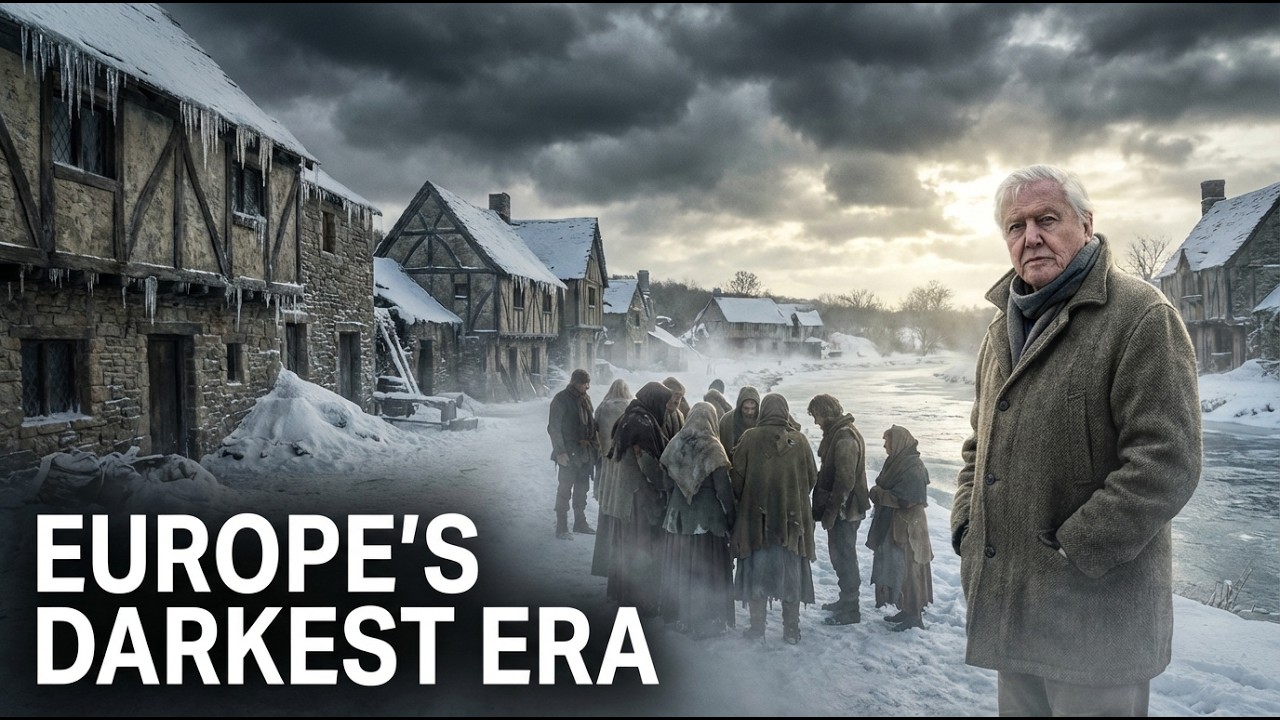
When Europe Was the Most Dangerous Place to Live | Full Documentary
Keywords
Summary
162 words
Critical Evaluation
The documentary provides a compelling narrative of a dark period in European history, effectively conveying the severity of the Great Famine and the Black Death. It successfully integrates climate science with historical events, explaining how the Little Ice Age contributed to agricultural failures. However, the presentation lacks rigorous sourcing; it does not cite specific historical documents or academic studies, which weakens its scholarly credibility. The argumentation is largely descriptive rather than analytical, and it occasionally oversimplifies complex causal relationships, such as attributing social collapse primarily to climate without fully considering other factors like political instability or economic structures. The documentary’s strength lies in its vivid storytelling and ability to engage the viewer, but it falls short of a rigorous scientific analysis. The title accurately reflects the content, and the narrative is coherent. Overall, it serves as an accessible introduction to the topic but should be supplemented with more authoritative sources for a deeper understanding.
154 words
Title / Content Match
The title accurately reflects the content, which focuses on the period of the Great Famine and the Black Death in Europe.
Quality & Reliability
6/10
The documentary presents a narrative synthesis of historical events, but lacks explicit citations to primary sources or academic references. It relies on general historical knowledge and may oversimplify complex causal relationships.
Key Moments
Markers derived by PSI from the transcript: the creator did not define chapters.
- Introduction to the climate shift and the end of the Medieval Warm Period.
- Description of the early signs of the Little Ice Age and its impact on agriculture.
- The onset of the Great Famine in 1315, with continuous rain and crop failures.
- Social breakdown and desperate measures during the famine, including crime and abandonment.
- Transition to the Black Death and its devastating impact on Europe.
- Long-term consequences and the reshaping of European society.
Contribution & Novelties
The documentary synthesizes known historical and climatic data into a narrative that emphasizes the interconnectedness of climate, disease, and society. It provides a broad overview that may be useful for general audiences. However, it does not present new research or original insights.
Pour aller plus loin :
- Little Ice Age — Provides a comprehensive overview of the climatic period.
- Great Famine of 1315–1317 — Detailed historical account of the famine.
- Black Death — Overview of the pandemic and its effects.
80 words
Radar Profile
The radar profile shows moderate scores across all dimensions, indicating a balanced but not exceptional documentary. It provides a decent amount of information but lacks depth in technical detail and source reliability.