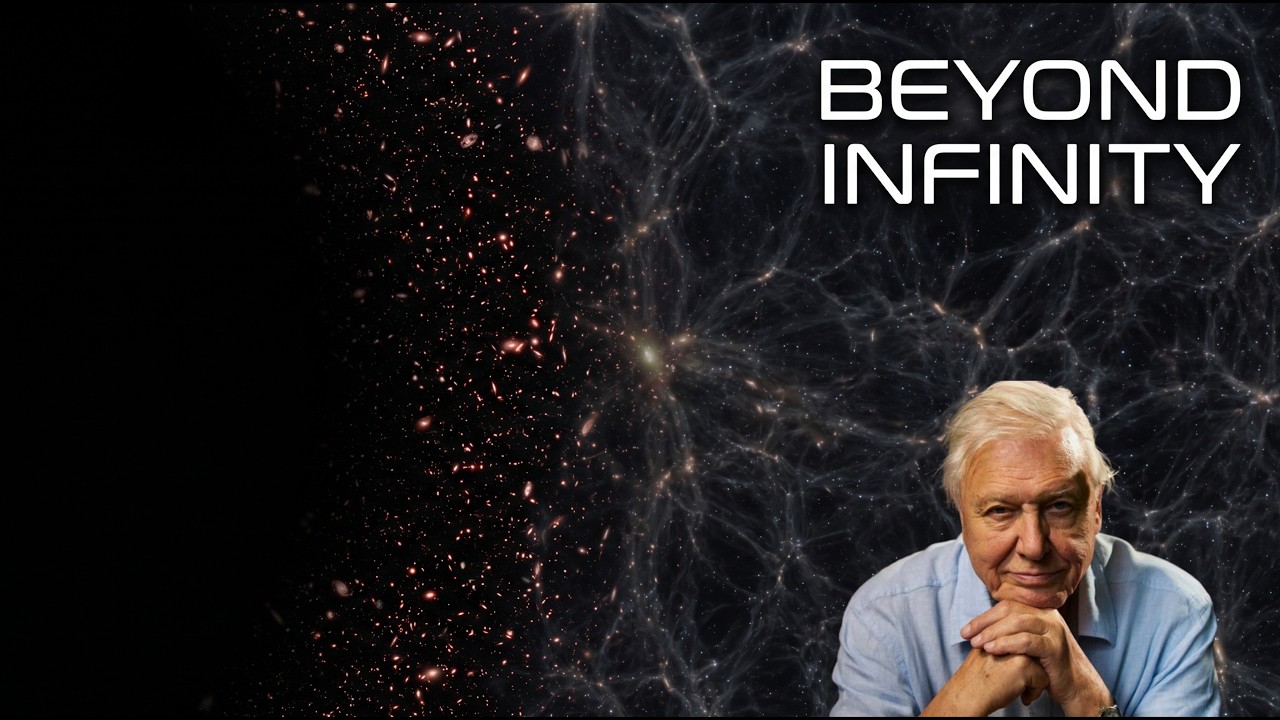
Sir David Attenborough: The True Scale of the Universe From Earth | Full Documentary Movie
Keywords
Summary
151 words
Critical Evaluation
The documentary provides a visually engaging and conceptually accurate overview of cosmic scales, from Earth to the observable universe. The information is generally correct: Earth’s diameter, the astronomical unit, light-year distances, the size of the Milky Way, and the existence of the cosmic web are all presented accurately. The use of comparisons (e.g., 1 million Earths in the Sun) helps convey scale effectively. However, the documentary lacks scientific rigor in several aspects. It does not cite specific sources or studies, and the narration is generic, with no mention of the scientific method or uncertainties. The title misleadingly attributes the documentary to Sir David Attenborough, which is a significant credibility issue, as his voice is not present. The content is more of a popular science overview than a rigorous scientific analysis. The visuals, while impressive, are likely artistic renderings rather than actual images, which could mislead viewers about the true appearance of celestial objects. The documentary also includes some speculative elements, such as the Oort cloud’s boundaries, without acknowledging the uncertainty. Overall, it serves as an accessible introduction to cosmic scales but lacks the depth and sourcing expected of a scientific documentary. The adéquation between title and content is poor, which detracts from its reliability. The public comments, if any, are not provided, so no analysis of audience reception is possible.
220 words
Title / Content Match
The title suggests a David Attenborough documentary, but the actual content is a generic space documentary with AI narration, not featuring Attenborough. This mismatch is significant.
Quality & Reliability
6/10
The documentary provides accurate astronomical facts (distances, sizes) and uses a narrative style with visualizations, but lacks citations to specific scientific sources and includes some speculative elements (e.g., Oort cloud boundaries). The presence of David Attenborough's name in the title is misleading as he is not the narrator.
Key Moments
Markers derived by PSI from the transcript: the creator did not define chapters.
- Introduction to Earth's scale and the journey outward.
- Explanation of the astronomical unit and Earth's orbit.
- Overview of the solar system's planets and their distances.
- Discussion of the Sun's size and the concept of light travel time.
- Journey to the Moon and its significance.
- Exploration of the outer solar system and the Oort cloud.
- Introduction to interstellar space and light-years.
- The Milky Way galaxy and our place within it.
- Local Group and Andromeda galaxy.
- Galaxy clusters and the cosmic web.
- The edge of the observable universe and the role of telescopes.
Cited Sources
- James Webb Space Telescope — Mentioned as a modern observatory revealing deep regions of the universe.
- Hubble Space Telescope — Mentioned as a tool for observing distant galaxies.
Concurring Sources
- NASA - Solar System Exploration — Provides accurate data on planetary distances and sizes, consistent with the documentary.
- European Space Agency - Our Universe — Offers information on cosmic scales and the structure of the universe, aligning with the documentary's content.
Dissenting Sources
- David Attenborough's official filmography — The documentary is not listed as a David Attenborough production, contradicting the title's implication.
Contribution & Novelties
The documentary offers a cinematic and accessible visualization of cosmic scales, effectively using comparisons to convey the vastness of space. It synthesizes known astronomical facts into a coherent narrative, making it a useful educational resource for general audiences. However, it does not present new scientific findings or original research.
Pour aller plus loin :
- Scale of the Universe — Provides a detailed overview of cosmic scales and the observable universe.
- Light-year — Explains the unit of distance used in astronomy.
- Cosmic web — Discusses the large-scale structure of the universe, including the cosmic web.
94 words
Radar Profile
The radar profile shows moderate scores across all dimensions, with a slight peak in quantity of information and a dip in technical level. This suggests a documentary that provides a broad overview but lacks depth and technical rigor, suitable for general audiences rather than specialists.