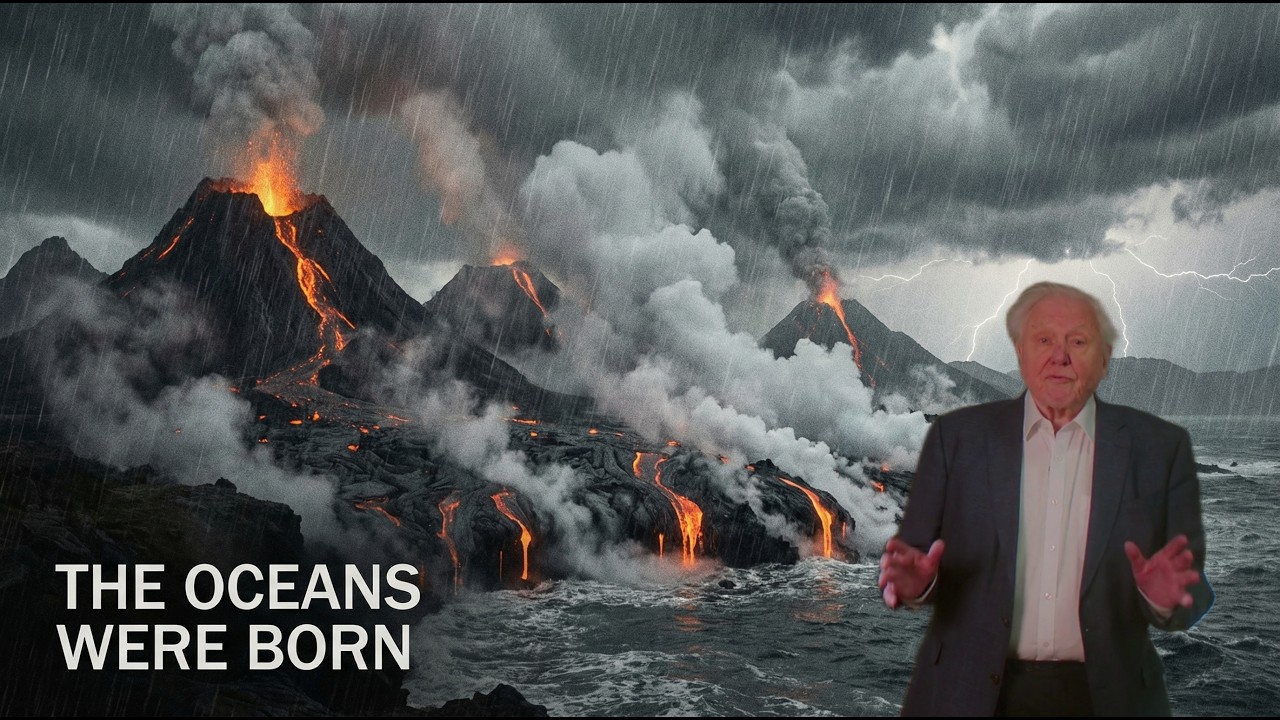
The Era of Endless Rain | How Earth’s Oceans Were Born (Full Documentary)
Keywords
Summary
165 words
Critical Evaluation
The documentary provides a comprehensive and engaging overview of the processes that led to the formation of Earth’s oceans. It correctly emphasizes the importance of the Hadean and Archean eons, the role of volcanic outgassing, and the gradual cooling of the planet. The narrative is scientifically plausible and aligns with current understanding of planetary formation. However, the lack of explicit references to scientific literature or specific studies weakens its credibility as a rigorous scientific source. The content is presented in a dramatic, storytelling style, which may oversimplify complex processes and omit nuances. For instance, the exact duration of the ’endless rain’ is not specified, and the mechanisms of water delivery (comets vs. volcanic outgassing) are only briefly mentioned. The documentary also does not address alternative hypotheses or ongoing debates in the scientific community. Despite these limitations, the core information is accurate and well-presented, making it a valuable educational resource for a general audience. The production quality is high, with compelling visuals and narration that enhance understanding. The adéquation between title and content is strong, as the focus is indeed on the era of rain and ocean formation. Overall, the documentary is informative and engaging, but it would benefit from more rigorous sourcing and a more critical examination of the evidence.
210 words
Title / Content Match
The title accurately reflects the content, which focuses on the prolonged period of rainfall and the formation of Earth's oceans.
Quality & Reliability
7/10
The documentary presents a plausible scientific narrative based on established concepts in planetary formation and geology, but lacks explicit citations to primary sources and includes some speculative dramatization. The information is generally consistent with current scientific understanding, but the lack of direct references and the narrative style reduce its reliability as a strictly factual source.
Key Moments
Markers derived by PSI from the transcript: the creator did not define chapters.
- Introduction to the early Earth as a molten, chaotic world.
- Description of the atmosphere and volcanic outgassing.
- Explanation of the late heavy bombardment and its effects.
- The first condensation and the beginning of rain.
- The cycle of rain and evaporation as the crust cools.
- Formation of the first stable pools of water.
- Transition to the Archean eon and the growth of oceans.
Contribution & Novelties
The documentary synthesizes existing knowledge about early Earth into a coherent narrative, emphasizing the role of prolonged rainfall in ocean formation. It provides a vivid reconstruction of the Hadean and Archean environments, making complex scientific concepts accessible to a broad audience.
Pour aller plus loin :
- Hadean Eon — Overview of the Hadean eon and its conditions.
- Late Heavy Bombardment — Details on the period of intense asteroid impacts.
- Origin of water on Earth — Discussion of hypotheses for water delivery.
81 words
Radar Profile
The radar profile shows high scores in quantity of information and fiabilité, with moderate scores in technical level and quality. This indicates a documentary that provides a substantial amount of information, but with a moderate technical depth and a need for more rigorous sourcing.