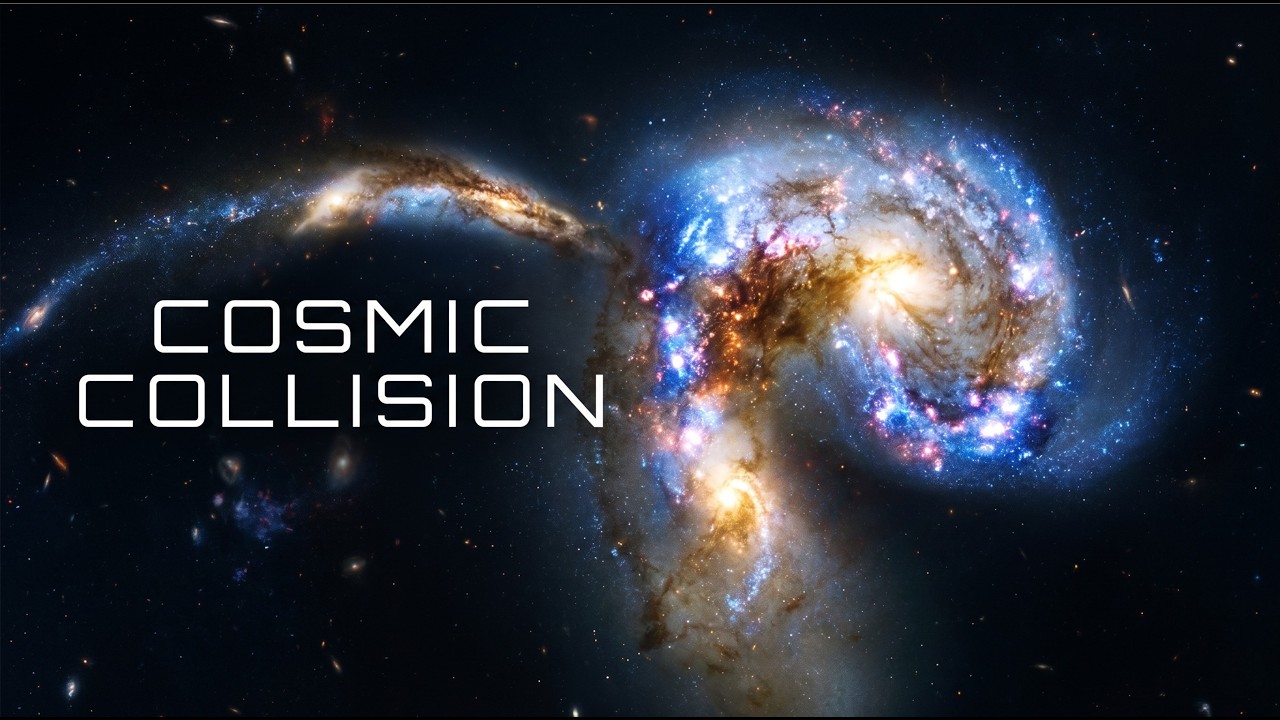
Sir David Attenborough: What Happens When Two Galaxies Collide? | Full Documentary Movie
Keywords
Summary
112 words
Critical Evaluation
The documentary provides a comprehensive and accessible overview of galactic collisions, covering key concepts such as gravitational interaction, tidal forces, starbursts, and the role of dark matter. The narration is clear and engaging, making complex astrophysical processes understandable to a general audience. However, the scientific rigor is limited by the lack of specific citations, quantitative data, and references to recent research. The content relies on well-established knowledge but does not delve into the latest findings or debates. The absence of expert interviews or direct observational evidence weakens the documentary’s authority. The title is misleading as it attributes the narration to Sir David Attenborough, but the actual narrator is not identified, which could be considered deceptive. The pacing is slow, and the visualizations, while cinematic, are often generic and not directly tied to real observations. Overall, the documentary serves as a good introductory resource but lacks the depth and precision expected from a scientific production. The public comments are not provided, so no analysis of audience reception is possible.
168 words
Title / Content Match
The title is somewhat misleading as it attributes the narration to Sir David Attenborough, but the actual narrator is not identified. The content does cover galaxy collisions as promised.
Quality & Reliability
6/10
The documentary provides a broad overview of galactic collisions, but lacks specific citations, detailed data, and references to recent research. It relies on general scientific consensus and descriptive narration, with no expert interviews or direct evidence presented.
Key Moments
Markers derived by PSI from the transcript: the creator did not define chapters.
- Introduction: The universe appears calm but is actually dynamic.
- Explanation of gravity and how galaxies move and interact.
- Discussion of dark matter halos and their role in galaxy interactions.
- Tidal forces and the formation of tidal tails and bridges.
- Starbursts and the triggering of new star formation.
- Supermassive black holes and active galactic nuclei.
- The merger process and the formation of elliptical galaxies.
- The future collision between the Milky Way and Andromeda.
- Observations from Hubble and James Webb telescopes.
- Conclusion: The universe is constantly evolving through collisions.
Cited Sources
- James Webb Space Telescope — Mentioned as a tool used to observe galaxy mergers.
- Hubble Space Telescope — Mentioned as a tool used to observe galaxy interactions.
Concurring Sources
- Galaxy merger — General scientific consensus on galaxy mergers.
- Milky Way–Andromeda collision — Predicted future collision between our galaxy and Andromeda.
Dissenting Sources
- No discordant sources found — The documentary aligns with established scientific understanding.
Contribution & Novelties
The documentary provides a cinematic and accessible overview of galactic collisions, emphasizing the role of gravity and dark matter. It synthesizes known concepts into a narrative that highlights the dynamic nature of the universe.
Pour aller plus loin :
- Galaxy merger — Provides detailed scientific background on the process.
- Milky Way–Andromeda collision — Specifics on the predicted future collision.
- Starburst galaxy — Explains the phenomenon of rapid star formation.
69 words
Radar Profile
The radar profile shows moderate scores across all dimensions, with a slight peak in quantity of information. This indicates a balanced but not deeply technical documentary, suitable for general audiences but lacking in-depth scientific rigor.