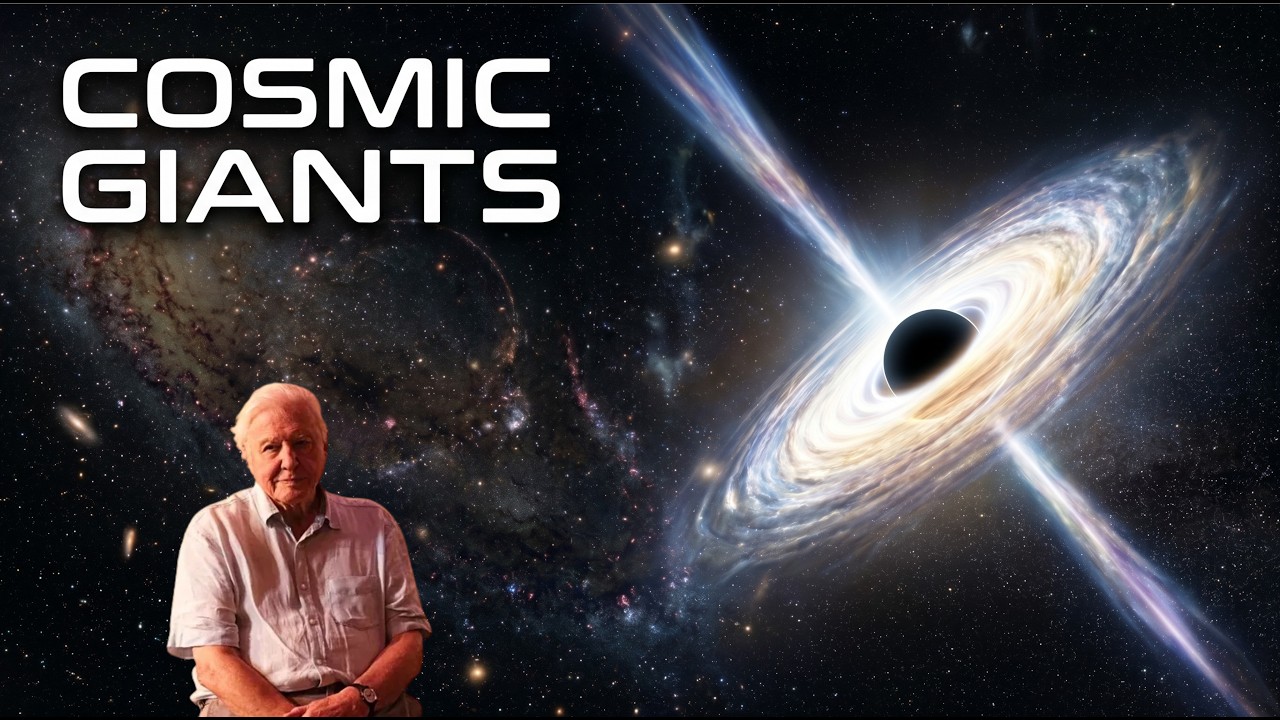
Sir David Attenborough: The Biggest and Most Powerful Objects Ever Discovered | Full Documentary
Keywords
Summary
151 words
Critical Evaluation
The documentary provides a visually engaging and accessible overview of cosmic giants, but it lacks scientific rigor and depth. The information is presented in a narrative style that prioritizes awe and wonder over factual precision. While the core concepts are accurate, the explanations are often oversimplified and lack quantitative details. For instance, the description of black holes as ‘gravitational engines’ is evocative but does not delve into the physics of accretion disks or relativistic jets. The documentary does not cite any specific scientific studies or sources, which limits its credibility as a scientific resource. The narration, though well-produced, is generic and could apply to any space documentary. The title’s reference to Sir David Attenborough is misleading, as he is not the narrator, which may mislead viewers. The content covers a broad range of topics, from the Big Bang to dark energy, but does not go into sufficient depth on any single subject. The lack of citations and the absence of any discussion of uncertainties or controversies in cosmology are significant weaknesses. The documentary would benefit from including expert interviews, specific data, and references to recent research. Overall, it serves as a basic introduction for a general audience but falls short of a rigorous scientific documentary.
205 words
Title / Content Match
The title suggests a focus on the biggest and most powerful objects, and the content covers these topics, though it also includes a lengthy introduction to the Big Bang and structure formation. The mention of Sir David Attenborough is misleading as he is not the narrator.
Quality & Reliability
6/10
The documentary presents a broad overview of cosmic structures and phenomena, but lacks specific citations, data, or references to primary sources. The content is generally accurate but simplified, with no mention of recent discoveries or controversies. The narration is engaging but does not provide depth or critical analysis.
Key Moments
Markers derived by PSI from the transcript: the creator did not define chapters.
- Introduction to the Big Bang and the origin of the universe.
- Explanation of the cosmic microwave background and recombination.
- Formation of the first stars and the cosmic dark ages.
- Role of gravity in structure formation and dark matter halos.
- Formation of galaxies and the first black holes.
- Discussion of supermassive black holes and quasars.
- Neutron stars, magnetars, and pulsars.
- Galaxy clusters and the cosmic web.
- Dark matter and dark energy.
- The largest structures in the universe and the observable universe.
Contribution & Novelties
The documentary offers a cinematic and accessible overview of cosmic giants, but it does not present new scientific findings. Its value lies in synthesizing known concepts into a narrative format.
Pour aller plus loin :
- Supermassive black hole — Provides detailed information on the formation and properties of supermassive black holes.
- Cosmic web — Explains the large-scale structure of the universe.
- Dark matter — Discusses the evidence and theories surrounding dark matter.
- Dark energy — Overview of dark energy and its role in cosmic acceleration.
85 words
Radar Profile
The radar profile shows moderate scores across all dimensions, indicating a balanced but not exceptional documentary. The highest score is in quantity of information, reflecting the broad coverage, while the lowest is in technical level, due to the simplified explanations.