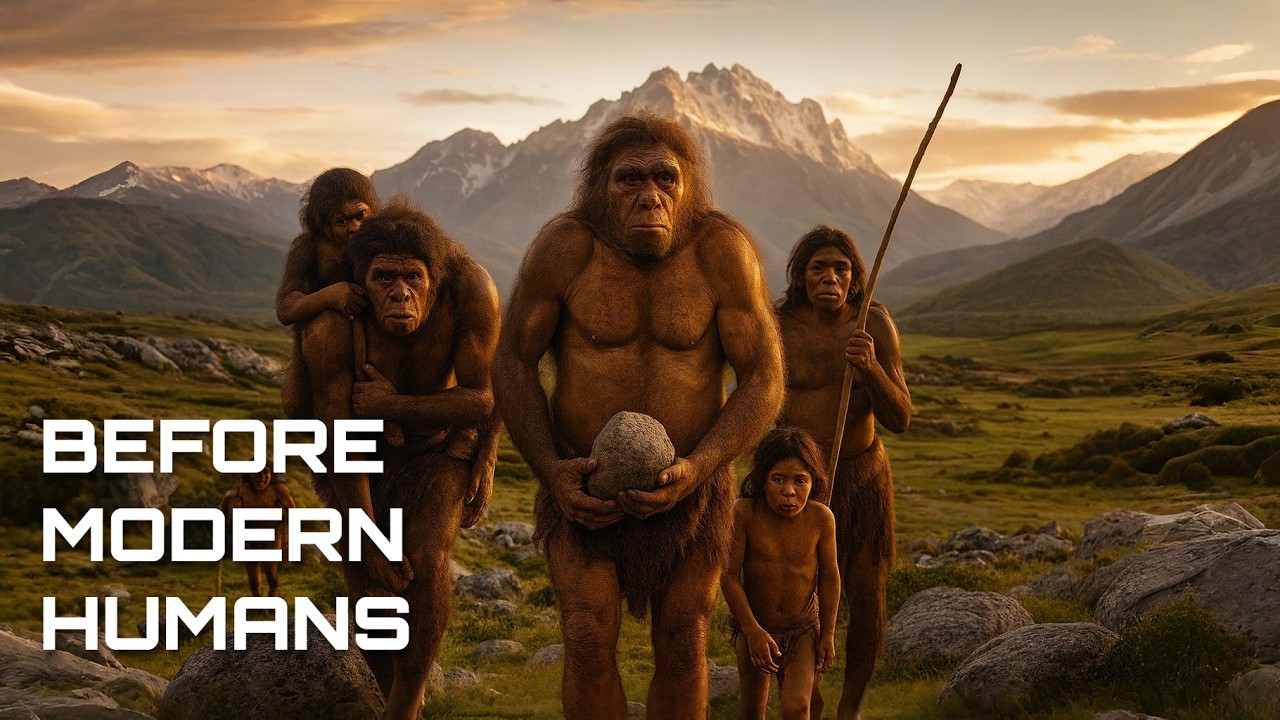
When Humans Were Not Alone – Early Human World | Full Documentary
Keywords
Summary
134 words
Critical Evaluation
The documentary offers a visually engaging and broadly accurate overview of human evolution, making it a valuable resource for general audiences. Its strength lies in its narrative flow, which connects major evolutionary milestones in a coherent story, from bipedalism to the rise of Homo sapiens. The inclusion of key fossil discoveries, such as Lucy and the Turkana Boy, grounds the narrative in real scientific evidence. However, the content is presented without specific citations or references to primary literature, which limits its utility for those seeking verifiable sources. The documentary also tends to oversimplify certain aspects, such as the exact relationships between species and the timing of key adaptations, which could lead to misconceptions. For instance, it mentions ‘Sahelanthropus chadensis’ but mispronounces it as ‘Sahilanthropus Chardensis,’ and it refers to ‘Orrorin tugenensis’ as ‘Oralopythecus,’ which is a misnomer. These inaccuracies, while minor, could confuse viewers. The use of AI narration is disclosed, and the production quality is high, with atmospheric visuals and music that enhance the storytelling. However, the lack of expert interviews or commentary from paleoanthropologists reduces the depth of analysis. The documentary does not address ongoing debates in the field, such as the exact classification of certain fossils or the role of interbreeding between modern humans and Neanderthals. Overall, it serves as an excellent introduction to human evolution but should be supplemented with more detailed and cited sources for a deeper understanding. The title accurately reflects the content, and the documentary successfully conveys the idea that Homo sapiens were not alone in the past, highlighting the diversity of hominin species. The public reception appears positive, with viewers appreciating the cinematic quality and educational value, though some may note the lack of scientific rigor.
284 words
Title / Content Match
The title accurately reflects the content, which focuses on the diversity of early human species and their world before Homo sapiens.
Quality & Reliability
6/10
The documentary provides a broad overview of early human evolution with generally accurate scientific content, but it lacks specific citations and contains some oversimplifications and potential inaccuracies (e.g., mispronunciations, minor factual simplifications). The use of AI narration is disclosed, and the production quality is high, but the absence of expert interviews or detailed references reduces its reliability for advanced audiences.
Key Moments
Markers derived by PSI from the transcript: the creator did not define chapters.
- Introduction to the earliest ancestors and the shift to bipedalism.
- Discussion of Sahelanthropus and Orrorin, the earliest known hominins.
- Focus on Australopithecus afarensis and the discovery of Lucy.
- Exploration of Australopithecus behavior, diet, and social structure.
- Transition to Homo habilis and the first stone tools.
- Overview of Homo erectus, its migration out of Africa, and use of fire.
- Discussion of Neanderthals and Denisovans, their adaptations, and interactions.
- The emergence of Homo sapiens and the eventual extinction of other hominins.
- Reflection on the legacy of early humans and the importance of cooperation.
- Conclusion summarizing the journey of human evolution.
Concurring Sources
- Smithsonian National Museum of Natural History - Human Evolution — Provides authoritative information on early human species and fossil evidence.
Dissenting Sources
- Mispronunciations and naming inaccuracies — The documentary mispronounces 'Sahelanthropus' and uses 'Oralopythecus' for 'Orrorin', which may confuse viewers seeking accurate scientific names.
Contribution & Novelties
The documentary provides a comprehensive and accessible synthesis of early human evolution, integrating fossil evidence and current scientific understanding. Its original contribution lies in its cinematic presentation that makes complex evolutionary concepts engaging for a broad audience. However, it does not present new research or unique insights beyond what is commonly known in paleoanthropology.
Pour aller plus loin :
- Human evolution on Wikipedia — Provides a detailed overview of the fossil record and evolutionary history.
- Australopithecus afarensis on Wikipedia — Specific information on Lucy’s species, including anatomy and significance.
- Neanderthal genome project — Discusses ancient DNA research and interbreeding evidence.
100 words
Radar Profile
The radar profile shows moderate scores across all dimensions, with quantity of information and reliability being relatively higher, while technical depth is lower. This suggests the documentary is informative and generally reliable for a general audience but lacks the technical rigor expected by specialists.
💬 Sur les 0 commentaires analysés, aucune tendance n'est disponible.