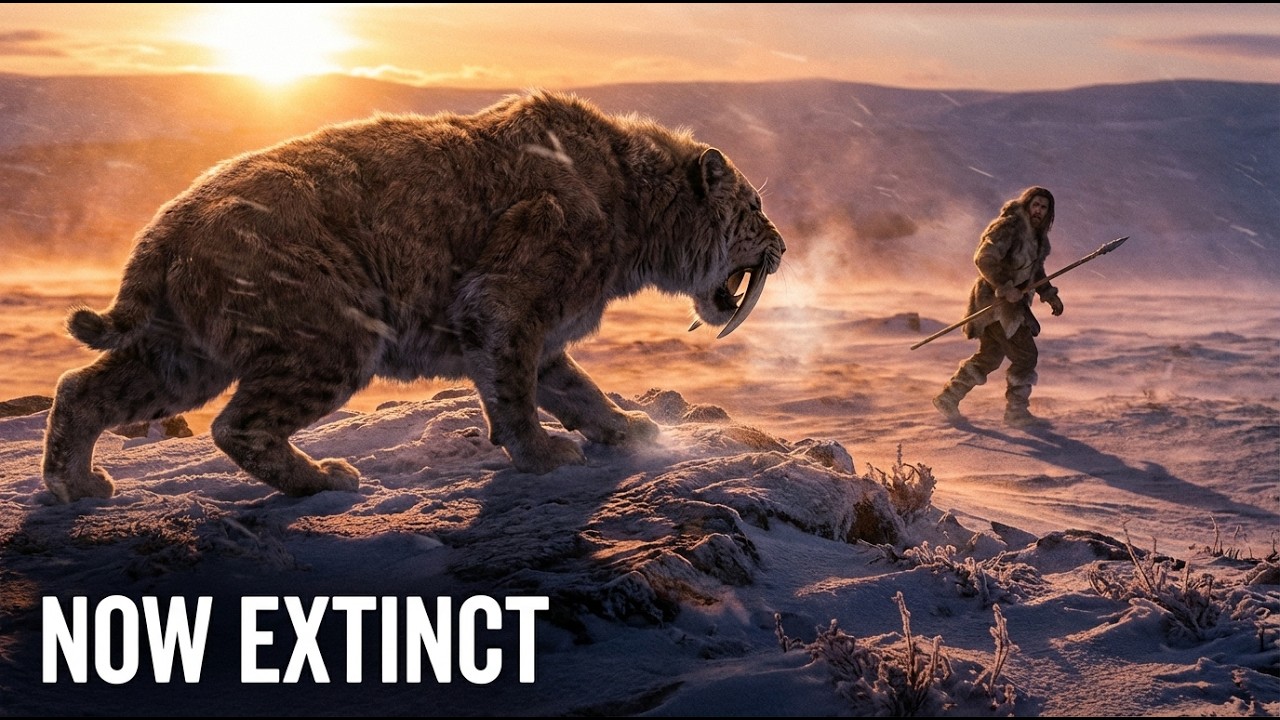
Extinct Animals That Early Humans Witnessed | Full Documentary
Keywords
Summary
146 words
Critical Evaluation
The documentary offers a compelling narrative about the coexistence of early humans and extinct megafauna, but it lacks the rigor of a scientific presentation. The information is presented in a storytelling format, which makes it accessible but sometimes oversimplifies complex ecological and evolutionary concepts. The absence of specific citations or expert interviews reduces its credibility as a scientific source. However, the core facts about megafauna and human evolution are generally accurate, and the documentary effectively conveys the challenges early humans faced. The argumentation is coherent, though it relies heavily on speculation about behaviors and interactions that are not directly evidenced. The production quality is high, with engaging visuals and narration, but the scientific depth is limited. The title accurately reflects the content, and the documentary serves as a good introduction for a general audience, though it may not satisfy viewers seeking detailed scientific analysis. Overall, it is a well-made popular science documentary with moderate scientific value.
156 words
Title / Content Match
The title accurately reflects the content, which focuses on animals that coexisted with early humans, though the documentary also covers broader ecological context.
Quality & Reliability
6/10
The documentary presents a narrative overview of prehistoric megafauna and early human interactions, referencing scientific research and fossil evidence but lacking specific citations or expert interviews. The information is generally accurate but simplified for a broad audience.
Key Moments
Markers derived by PSI from the transcript: the creator did not define chapters.
- Introduction to the prehistoric world and early humans' challenges.
- Discussion of the African environment 2-3 million years ago.
- Description of predators and the dangers early humans faced.
- Exploration of early human survival strategies and cooperation.
- The role of fire and tools in human development.
- Introduction to specific megafauna like woolly mammoths.
- Discussion of saber-toothed tigers and their interactions with humans.
- The extinction of megafauna and human impact.
- Conclusion and reflection on the lost world.
Contribution & Novelties
The documentary provides a narrative synthesis of known paleontological and anthropological research, offering a vivid reconstruction of early human environments. It emphasizes the ecological pressures that shaped human evolution, a perspective that is often underappreciated in popular media.
Pour aller plus loin :
- Megafauna - Wikipedia — Provides an overview of megafauna and extinction events.
- Human evolution - Smithsonian — Comprehensive resource on early humans and their environments.
- Pleistocene megafauna extinction - Britannica — Discusses the causes of megafauna extinction.
80 words
Radar Profile
The radar profile shows moderate scores across all dimensions, indicating a balanced but not exceptional documentary. The highest score is in information quantity, reflecting the broad coverage of topics, while the lowest is in technical level, as the content is simplified for a general audience.