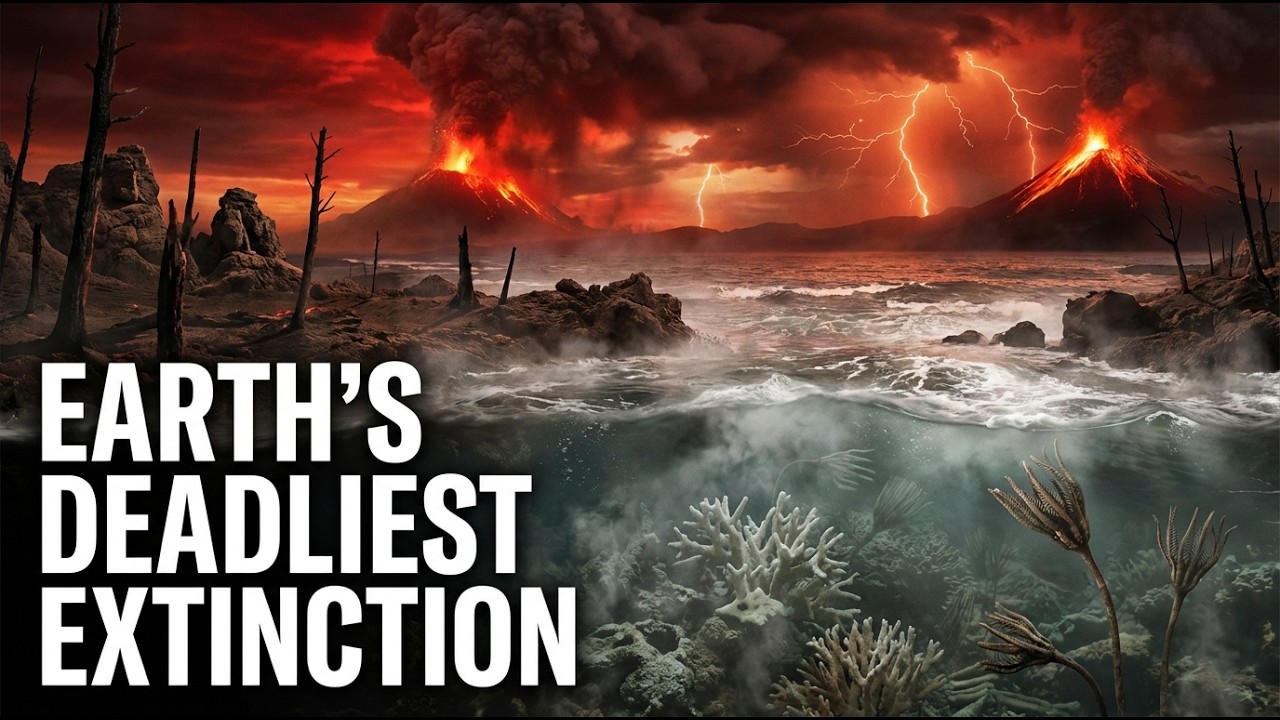
What Earth Looked Like After the Deadliest Extinction | Full Documentary For Sleep
Keywords
Summary
145 words
Critical Evaluation
The documentary provides a comprehensive and engaging overview of the Permian-Triassic extinction and its aftermath, suitable for a general audience interested in Earth’s history. It successfully synthesizes a wide range of scientific evidence, including volcanic activity, climate change, ocean chemistry, and fossil records, to paint a vivid picture of the catastrophic event and its long-term consequences. The narrative is well-structured, progressing from the causes to the immediate effects, the prolonged recovery, and the eventual return of complex life. The scientific accuracy is generally high, with accurate descriptions of the Siberian Traps, ocean anoxia, and the role of greenhouse gases. However, the documentary lacks explicit references to specific studies or researchers, which would enhance its credibility for a more scientifically literate audience. Some statements, such as the claim that hydrogen sulfide weakened the ozone layer, are presented as fact but are still debated in the scientific community. Additionally, the documentary’s dramatic tone and focus on the ’terrifying’ aspects may oversimplify the complexity of the extinction event and recovery processes. The title and content are well-aligned, as the film indeed focuses on the aftermath and recovery. Overall, the documentary is a valuable educational resource, but it could benefit from more explicit sourcing and a more nuanced discussion of scientific uncertainties.
208 words
Title / Content Match
The title accurately reflects the content, focusing on the aftermath of the Permian extinction and the Earth's recovery.
Quality & Reliability
7/10
The documentary presents a scientifically grounded narrative of the Permian-Triassic extinction, relying on established geological and paleontological evidence. It accurately describes volcanic activity, ocean anoxia, and ecosystem collapse. However, it lacks direct citations to specific studies or researchers, and some dramatic language may oversimplify complex processes.
Key Moments
Markers derived by PSI from the transcript: the creator did not define chapters.
- Introduction to the Permian extinction and its severity.
- Description of Siberian Traps volcanic eruptions and their global impact.
- Explanation of ocean anoxia and its effects on marine life.
- Discussion of the collapse of terrestrial ecosystems and the loss of forests.
- Evidence of hydrogen sulfide and its potential role in the extinction.
- Description of the ecological vacuum and the dominance of microbial mats.
- Analysis of the recovery period in the Early Triassic and the persistence of hardy species.
- Discussion of the long-term recovery of ecosystems and the return of biodiversity.
Contribution & Novelties
The documentary provides a compelling narrative of the aftermath of the Permian-Triassic extinction, emphasizing the prolonged recovery and the concept of ecological vacuum. It synthesizes multiple lines of evidence to illustrate the severity of the event and the slow rebuilding of life.
Pour aller plus loin :
- Permian–Triassic extinction event — Comprehensive overview of the extinction, its causes, and consequences.
- Siberian Traps — Details on the volcanic province and its role in the extinction.
- Ocean anoxia — Explanation of anoxic events and their impact on marine life.
87 words
Radar Profile
The radar profile shows a balanced performance across all dimensions, with slightly higher scores in quantity and quality of information, indicating a well-researched documentary. The technical level is moderate, making it accessible to a general audience while still providing scientific depth.