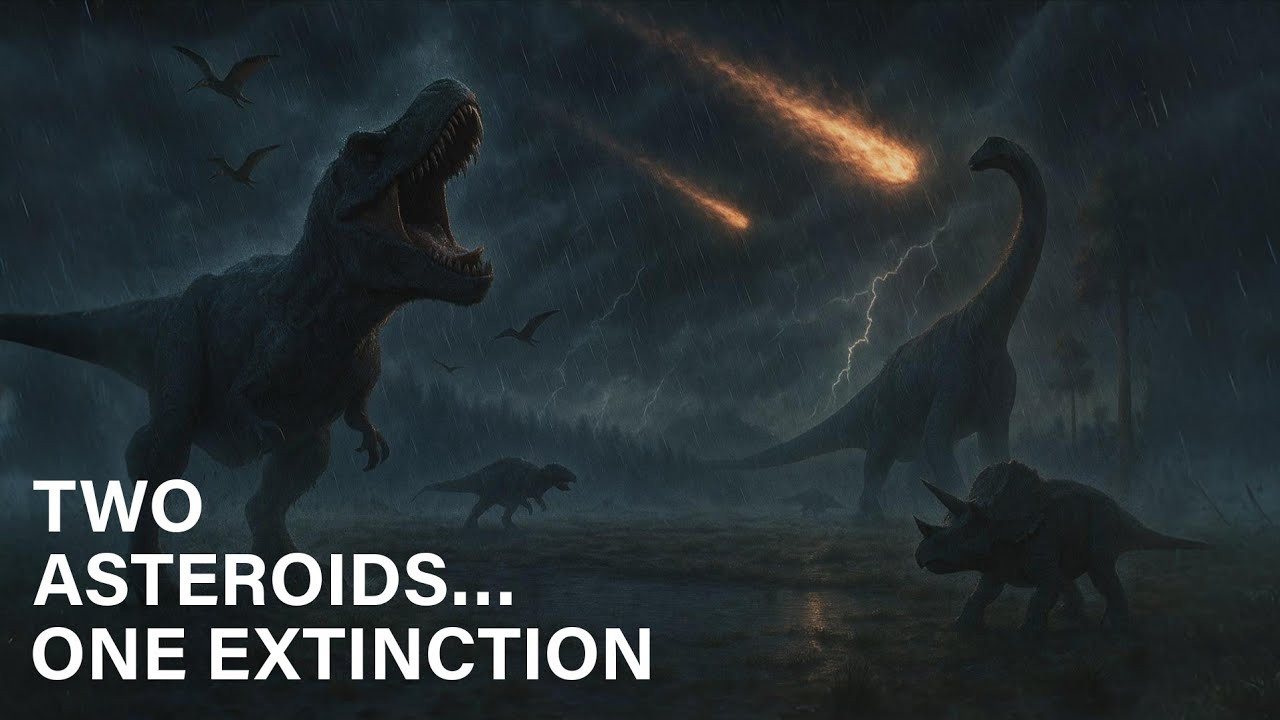
When Two Asteroids Struck Earth: The True Story of Dinosaur Extinction | Full Documentary
Keywords
Summary
156 words
Critical Evaluation
The documentary provides a compelling and accessible overview of the double impact hypothesis for the dinosaur extinction. It effectively sets the scene with a rich description of the Cretaceous world, making the narrative engaging for a general audience. The scientific content is largely accurate, covering the key evidence for the Chicxulub impact, such as the iridium layer and shocked quartz, and introduces the Boltysh crater as a potential second impact site. However, the documentary falls short in its treatment of scientific rigor. It does not cite specific studies or researchers, and the evidence for the double impact is presented as more definitive than it currently is in the scientific community. The multiple impact hypothesis remains a topic of ongoing research, with some scientists arguing that the Boltysh crater may have formed significantly later than Chicxulub. The documentary also engages in some speculative dramatization, particularly in its descriptions of the immediate aftermath of the impacts, which may overstate the certainty of certain events. The production quality is high, with impressive visuals and a dramatic score, but this comes at the expense of scientific nuance. The title accurately reflects the content, and the documentary does not mislead viewers about its focus. Overall, it serves as a good introduction to the topic, but viewers seeking a more rigorous scientific analysis would need to consult primary literature.
223 words
Title / Content Match
The title accurately reflects the content, focusing on the double impact theory and dinosaur extinction.
Quality & Reliability
6/10
The documentary presents a plausible narrative of the double impact hypothesis, but lacks detailed scientific citations and contains some speculative dramatization. The core science is accurate but simplified.
Key Moments
Markers derived by PSI from the transcript: the creator did not define chapters.
- Introduction to the late Cretaceous world and its ecosystems.
- Description of the asteroid belt and the origins of the two asteroids.
- Discussion of the Chicxulub impact and its immediate effects.
- Introduction of the Boltysh crater and the multiple impact hypothesis.
- Analysis of the global environmental consequences, including tsunamis and impact winter.
- Explanation of the collapse of food chains and the extinction of non-avian dinosaurs.
- Survival of mammals and birds, and the rise of new ecosystems.
- Reflection on the legacy of the extinction and the evolution of life.
Cited Sources
- Chicxulub crater — Mentioned as the primary impact site in Mexico.
- Boltysh crater — Discussed as a possible second impact site in Ukraine.
Concurring Sources
- Chicxulub crater — Supports the occurrence of a major impact at the K-Pg boundary.
- Boltysh crater — Provides evidence for a possible second impact around the same time.
Dissenting Sources
Contribution & Novelties
The documentary synthesizes existing research on the multiple impact hypothesis, presenting it in an engaging narrative format. It highlights the Boltysh crater as a key piece of evidence, which is often overshadowed by Chicxulub. The documentary also emphasizes the role of secondary effects, such as tsunamis and global cooling, in the extinction event.
Pour aller plus loin :
- Chicxulub crater — Comprehensive overview of the primary impact structure.
- Boltysh crater — Details on the potential second impact site.
- Cretaceous–Paleogene extinction event — Context on the extinction event and its causes.
90 words
Radar Profile
The radar profile shows moderate scores across all dimensions, with relatively higher scores in quantity of information and lower in technical level. This suggests a documentary that provides a broad overview but lacks deep scientific detail.
💬 Sur les 0 commentaires analysés, aucune tendance n'est disponible.