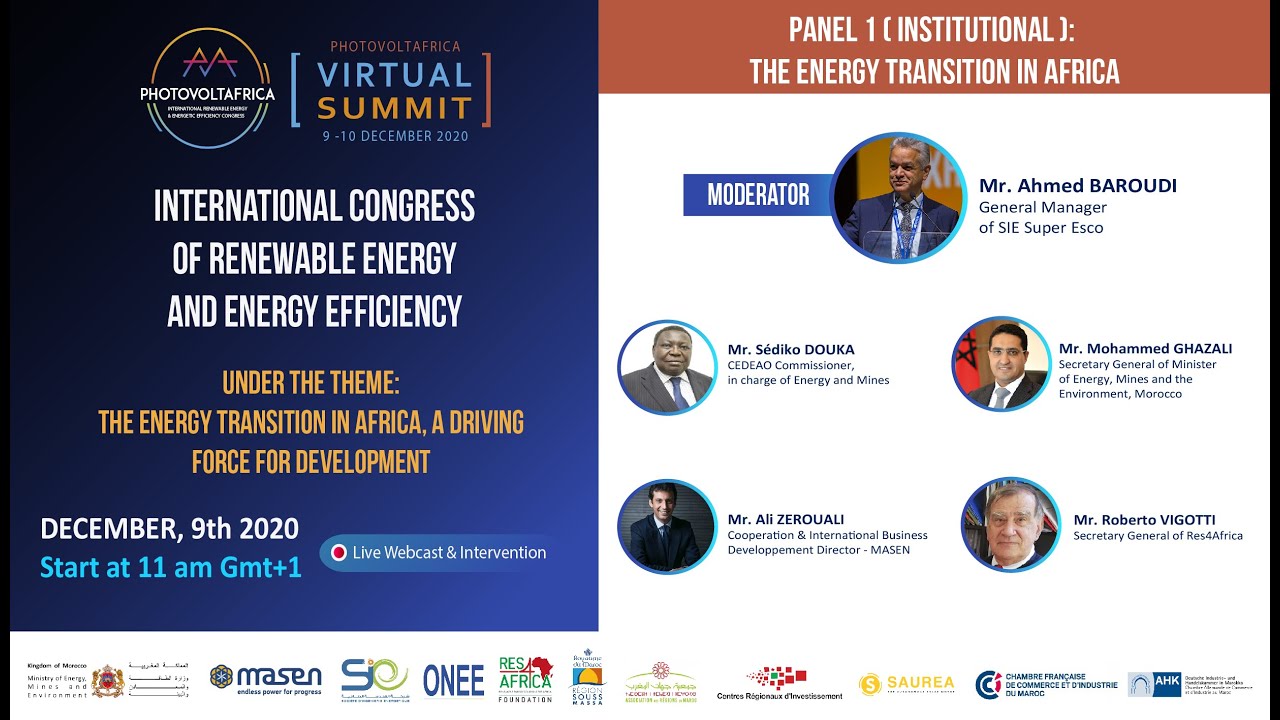
Photovoltafrica Virtual Summit 2020: PANEL 1 (INSTITUTIONAL) - The Energy transition in Africa
Keywords
Summary
169 words
Critical Evaluation
Value of the Information & Strength of the Argument
The panel provides valuable insights into the institutional perspectives on energy transition in Africa. The speakers present coherent arguments based on their official roles and experiences. Douka’s argument emphasizes the need for a gradual transition, prioritizing energy access and affordability before shifting to renewables. Ouhmed showcases Morocco’s concrete achievements and policy framework, providing a model for other African countries. Zerouali makes a strong case for renewable energy as a driver of industrial development and competitiveness, citing the example of carbon taxes in Europe. The arguments are well-structured and supported by examples, though they rely more on qualitative assertions than quantitative data. The discussion is balanced, acknowledging the challenges while highlighting opportunities.
Scientific Rigor, Source Quality, Title Accuracy
The scientific rigor is moderate. The speakers are high-level officials, lending credibility to their statements. However, they do not cite specific reports or studies, and the data presented (e.g., percentages, capacities) is not referenced. The title accurately reflects the content, as it is indeed an institutional panel on energy transition in Africa. The video description provides some context but no additional sources. The quality of the video is acceptable, with occasional audio issues. Overall, the information is reliable but not deeply sourced.
208 words
Title / Content Match
The title accurately reflects the content: a panel discussion on energy transition in Africa, with institutional speakers.
Quality & Reliability
7/10
The panel features high-level institutional representatives (CEDEAO Commissioner, Moroccan Ministry, MASEN, Res4Africa) providing expert opinions and official data. However, the discussion is largely qualitative, with limited verifiable data and no citations to specific reports. The video is a recording of a virtual summit, and the technical quality is moderate with occasional audio issues.
Key Moments
Markers derived by PSI from the transcript: the creator did not define chapters.
- Introduction by moderator Ahmed Baroudi
- Sédiko Douka (ECOWAS) presents energy challenges in West Africa
- Discussion on the meaning of energy transition for Africa
- Mohammed Ouhmed (Morocco) details Morocco's renewable energy strategy
- Ali Zerouali (MASEN) discusses economic opportunities and carbon taxes
- Roberto Vigotti (Res4Africa) speaks on international cooperation
- Q&A session and closing remarks
Cited Sources
- Photovoltafrica official website — Mentioned in the video description as the official congress website.
- Photovoltafrica LinkedIn page — Mentioned in the video description as a social media link.
Concurring Sources
- International Energy Agency - Africa Energy Outlook 2022 — Provides data on energy access and renewable potential in Africa, aligning with the panel's discussion.
Contribution & Novelties
The video provides a unique platform for institutional voices from West Africa and Morocco to discuss energy transition, offering insights into regional strategies and cooperation. It highlights the differing perspectives on the applicability of the term ’energy transition’ to Africa, emphasizing the need for a just transition that prioritizes energy access. The discussion also underscores the economic opportunities presented by renewable energy for industrial development and competitiveness.
Pour aller plus loin :
- Energy transition in Africa — Overview of energy challenges and opportunities in Africa.
- ECOWAS Centre for Renewable Energy and Energy Efficiency (ECREEE) — Regional body promoting renewable energy in West Africa.
- Moroccan Agency for Sustainable Energy (MASEN) — Official site of Morocco’s renewable energy agency.
- Res4Africa Foundation — Organization promoting renewable energy in Africa.
126 words
Radar Profile
The radar profile shows high scores in quantity and quality of information, reflecting the depth of institutional expertise. The technical level is moderate, as the discussion is policy-oriented rather than technical. The overall reliability is good, but the lack of cited sources slightly reduces the score.