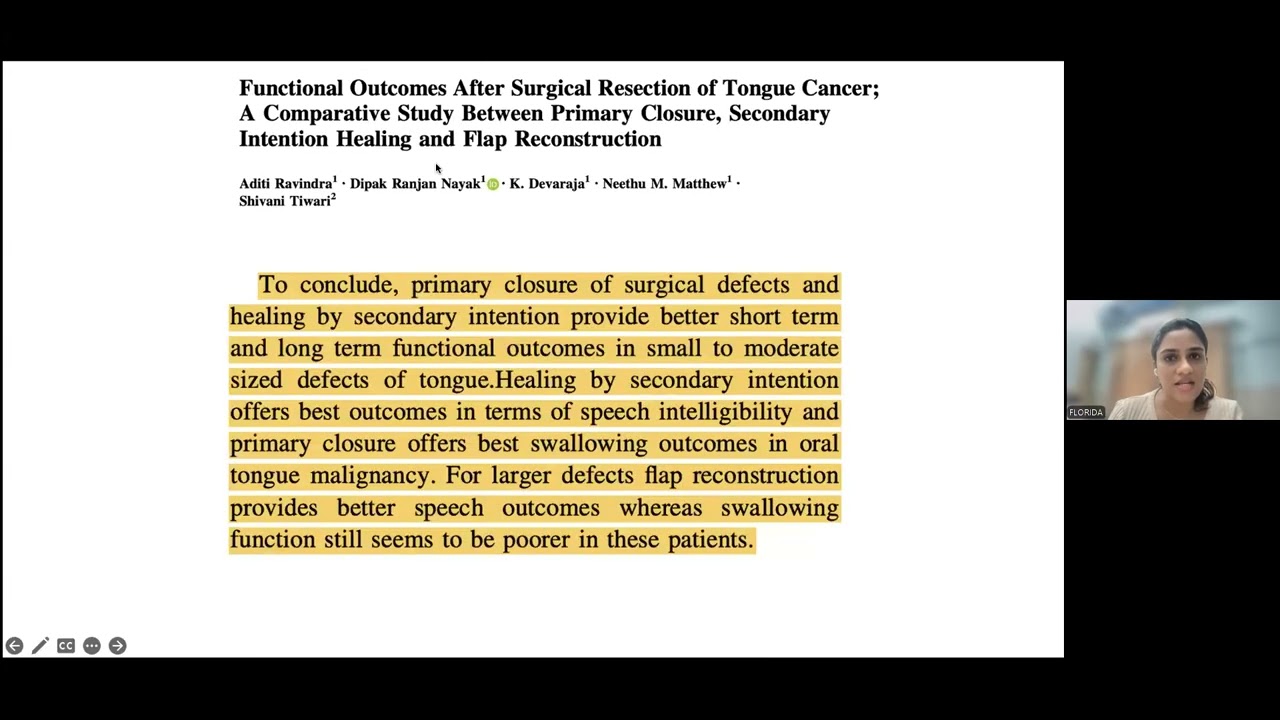
Diagnosis & management of Early Oral Cancers - Dr Florida Sarin
Keywords
Summary
235 words
Critical Evaluation
Value of the Information & Strength of the Argument
The lecture provides high-value information by synthesizing evidence from multiple studies, including retrospective analyses, meta-analyses, and randomized controlled trials. It offers specific data points (e.g., survival rates, margin thresholds, nodal metastasis rates) that are clinically actionable. The argumentation is solid, as the speaker consistently supports recommendations with cited studies, such as the comparison of surgery versus radiotherapy, the role of elective neck dissection, and the utility of sentinel node biopsy. The presentation is well-structured, moving logically from diagnosis to primary management to neck management, and it acknowledges controversies (e.g., frozen section, depth of invasion) with balanced discussion. However, some claims lack direct citation in the transcript, and the reliance on retrospective data for certain recommendations is acknowledged.
Scientific Rigor, Source Quality, Title Accuracy
The scientific rigor is high, with references to landmark studies and meta-analyses, including the Ellis study from the NCDB, the D’Cruz trial on elective neck dissection, and the Hasegawa and Goyal trials on sentinel node biopsy. The speaker also cites the AJCC 8th edition and NCCN guidelines, indicating alignment with current standards. The quality of sources is generally good, though not all are explicitly named in the transcript, and some are described vaguely (e.g., ‘a study by…’). The title accurately reflects the content, which is a focused lecture on early oral cancers. The presentation is suitable for a professional medical audience, but the speaker does not explicitly address potential conflicts of interest or limitations of the cited studies.
250 words
Title / Content Match
The title accurately reflects the content, which focuses on diagnosis and management of early oral cancers.
Quality & Reliability
8/10
The presentation is a structured expert lecture by a head and neck surgeon, referencing multiple peer-reviewed studies and meta-analyses. It includes specific data (e.g., survival rates, margin thresholds) and aligns with established guidelines (NCCN, AJCC). However, it is a single expert's synthesis without direct citation of all sources in the video, and some claims lack explicit references in the transcript.
Key Moments
Markers derived by PSI from the transcript: the creator did not define chapters.
- Introduction and welcome by moderator Dr. Poonam Joshi, introducing speaker Dr. Florida Sarin.
- Definition of early oral cancers (stage I and II) and diagnostic methods including biopsy.
- Role of imaging: CT, MRI, PET for staging and treatment planning.
- Comparison of surgery vs radiotherapy for primary tumor, citing studies showing better survival with surgery.
- Surgical approaches: intraoral, cheek flap, mandibulotomy; indications for marginal vs segmental mandibulectomy.
- Types of glossectomy and reconstruction options for early defects.
- Importance of surgical margins: 5 mm pathological margin, shrinkage considerations, and management of close margins.
- Debate on frozen section for margin assessment; evidence suggests limited benefit.
- Management of the neck: elective neck dissection vs wait-and-watch; evidence from trials.
- Extent of neck dissection: selective vs modified radical; nodal yield and lymph node ratio.
- Sentinel node biopsy as an alternative to elective neck dissection; evidence from randomized trials.
- Histopathological adverse factors, especially depth of invasion, and their impact on prognosis and adjuvant therapy.
- Discussion on tumors with depth of invasion less than 3 mm and whether neck dissection is needed.
Cited Sources
- Ellis et al. NCDB study on early oral cavity cancers — Cited in the context of comparing radiotherapy vs surgery for early oral cancers, showing lower 5-year overall survival with RT.
- Justin Soder et al. retrospective study — Cited to compare outcomes of surgery alone, radiation alone, and combination, showing improved survival with surgery.
- James Brown paper on routes of tumor entry into mandible — Cited to explain patterns of mandibular invasion and guide marginal vs segmental resection.
- Maneli Atal classification of glossectomy defects — Cited to classify tongue defects and recommend reconstructive options.
- Meta-analysis on margins for oral squamous cell carcinoma — Cited to establish 5 mm as minimum acceptable pathological margin.
- Tata study on surgical margins — Cited to recommend 5.5 mm minimum margin for buccal alveolar cancers.
- Royal College of Pathologists classification of margins — Cited to define clear, close, and involved margins.
- Study on adjuvant treatment for positive/close margins — Cited to show twofold increase in recurrence with close margins and benefit of adjuvant therapy.
- Sidi Atal et al. retrospective study — Cited to discuss local control with close margins and postoperative radiotherapy.
- Aloc Patup study on frozen section — Cited to show no significant improvement in final margins or survival with frozen section.
- Mustafa Bulbun meta-analysis on frozen section — Cited to show that revising margins to clear does not equate to initially negative margins.
- Study on gross vs frozen examination — Cited to suggest gross examination is a well-tolerated alternative to frozen section.
- D'Cruz trial on elective neck dissection — Cited as seminal paper showing survival benefit of elective neck dissection over wait-and-watch.
- Randomized controlled trial confirming benefit of elective neck dissection — Cited to support upfront elective neck dissection even for small tumors.
- Gory Madam paper on neck dissection levels — Cited to describe patterns of nodal metastasis and predictors of level V involvement.
- Study on selective vs modified radical neck dissection — Cited to show no significant difference in disease-specific survival but better functional outcomes with selective dissection.
- Hasegawa et al. randomized trial on sentinel node biopsy — Cited to show non-inferiority of sentinel node biopsy compared to elective neck dissection.
- Goyal et al. phase III trial on sentinel node biopsy — Cited to show similar survival outcomes and better functional outcomes with sentinel node biopsy.
- Krammer et al. NCDB study on sentinel node biopsy — Cited to show reduced hospital stay and equivalent overall survival with sentinel node biopsy.
- NCCN guidelines — Cited as incorporating sentinel node biopsy as an alternative in 2014.
- AJCC 8th edition — Cited for inclusion of depth of invasion as a prognostic factor.
- NCDB study on depth of invasion and radiotherapy — Cited to show that depth of invasion alone should not dictate radiotherapy.
- International collaborative study on depth of invasion — Cited to show association of depth of invasion with adverse outcomes and that it should not be sole indicator for PORT.
Concurring Sources
- D'Cruz et al. (2015) NEJM - Elective versus therapeutic neck dissection in node-negative oral cancer — This randomized trial supports the survival benefit of elective neck dissection, as cited in the lecture.
- Hasegawa et al. (2019) - Sentinel node biopsy vs elective neck dissection in early oral cancer — This trial demonstrates non-inferiority of sentinel node biopsy, aligning with the lecture's recommendation.
- AJCC 8th edition staging manual — Includes depth of invasion as a staging criterion, as mentioned in the lecture.
Dissenting Sources
- Some studies suggest that close margins (1-5 mm) may not require adjuvant therapy if no other adverse features — The lecture cites studies showing benefit of adjuvant therapy for close margins, but other evidence may be more conservative.
- Frozen section analysis is debated; some studies show benefit in reducing positive margins — The lecture cites evidence against routine frozen section, but some surgeons advocate its use in specific scenarios.
Contribution & Novelties
The lecture provides a comprehensive, evidence-based update on the management of early oral cancers, synthesizing recent trials and meta-analyses. It emphasizes the shift towards sentinel node biopsy as a less morbid alternative to elective neck dissection, supported by randomized data. It also clarifies the role of depth of invasion in guiding adjuvant therapy, cautioning against its use as a sole indicator. The discussion on surgical margins and the debate over frozen section offers practical insights for clinicians.
Pour aller plus loin :
- Sentinel lymph node biopsy in oral cancer — Overview of the technique and its applications.
- Elective neck dissection — Explanation of types and indications.
- Depth of invasion in oral cancer — Review on the prognostic significance of DOI.
- AJCC staging system — Official resource on staging, including 8th edition changes.
132 words
Radar Profile
The radar profile shows high scores in quantity and quality of information, reflecting the comprehensive coverage of evidence. The technical level is high, indicating a specialized audience. The global reliability is strong, but the moderate score in fiabilite_globale suggests some reliance on retrospective data and expert opinion.
💬 Sur les 0 commentaires analysés, aucune tendance n'a pu être dégagée.