Current/Emerging Practices on Management of Neck in Oral Cavity Carcinoma (Panel)- Dr Poonam Joshi
Keywords
Summary
186 words
Critical Evaluation
Value of the Information & Strength of the Argument
The discussion provides valuable insights into the practical decision-making of experienced oncologists regarding neck management in oral cavity cancer. The panelists present a balanced view, acknowledging the limitations of current imaging modalities and the evidence base for elective neck dissection. They reference key trials like D’Cruz and Hutcherson, and meta-analyses, to support their arguments. The argumentation is generally sound, with panelists building on each other’s points and addressing nuances such as depth of invasion and tumor subsite. However, some arguments rely on anecdotal experience and lack rigorous statistical backing, and the discussion occasionally lacks depth on certain emerging techniques like sentinel node biopsy.
Scientific Rigor, Source Quality, Title Accuracy
The panel demonstrates a good understanding of the literature, citing pivotal studies such as the D’Cruz trial and the Hutcherson study, as well as meta-analyses. However, specific citations are not systematically provided, and some claims are made without direct reference. The title accurately reflects the content, which is a panel discussion on current practices. The discussion is scientifically rigorous in its reliance on established evidence, but the lack of formal citations and the informal nature of the panel reduce its overall scientific rigor.
201 words
Title / Content Match
The title accurately reflects the content, which is a panel discussion on current and emerging practices for managing the neck in oral cavity carcinoma.
Quality & Reliability
7/10
Panel discussion by experienced oncologists, referencing key trials (D'Cruz, Hutcherson) and meta-analyses, but lacking detailed citations and with some informal reasoning.
Key Moments
Markers derived by PSI from the transcript: the creator did not define chapters.
- Introduction and overview of the panel discussion on neck management in oral cavity carcinoma.
- Discussion on imaging for neck nodes, with panelists agreeing that imaging is dictated by the primary tumor.
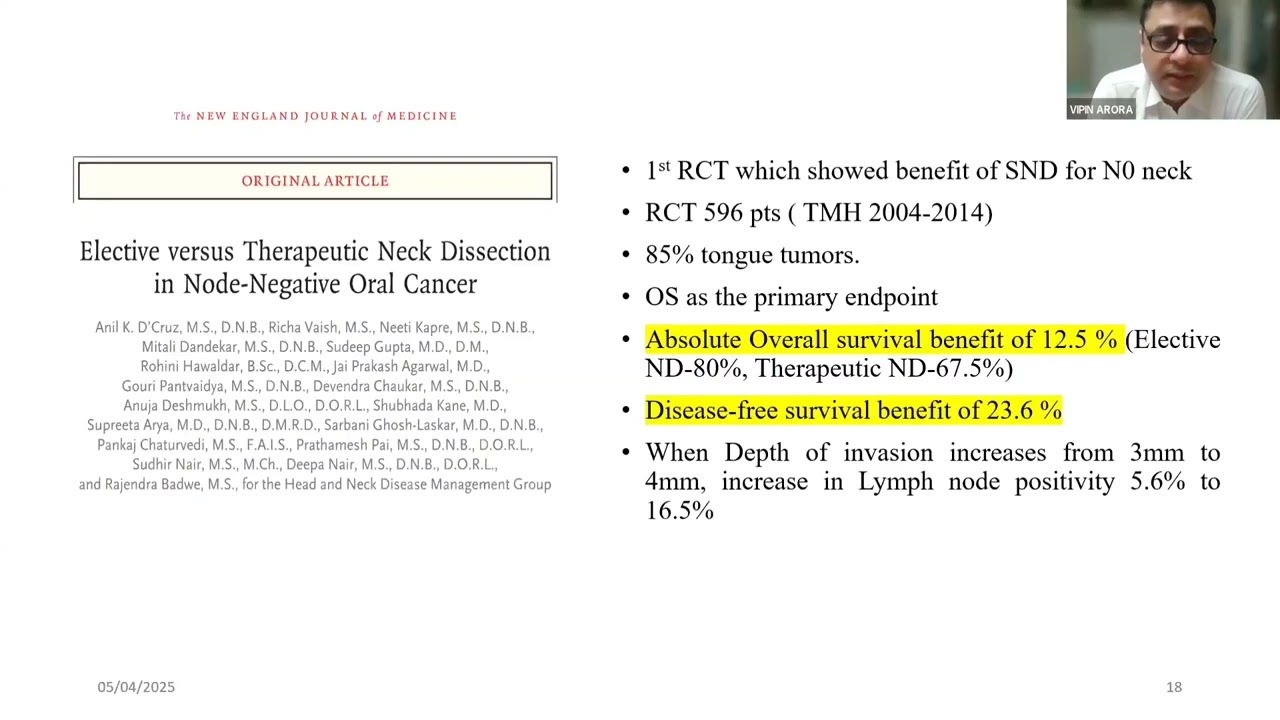
- Debate on elective versus therapeutic neck dissection, with emphasis on the D'Cruz trial.
- Consideration of depth of invasion as a factor in deciding for neck dissection.
- Discussion on in-continuity versus discontinuous neck dissection, with panelists sharing their practices.
- Exploration of non-surgical management of the neck, with panelists generally favoring surgery.
- Discussion on the extent of neck dissection and patterns of lymph node metastasis.
- Consideration of sentinel node biopsy as an alternative to elective neck dissection.
- Panelists summarize their approaches and conclude the discussion.
Cited Sources
- D'Cruz et al. Elective versus therapeutic neck dissection in node-negative oral cancer (N Engl J Med 2015) — Cited as the key randomized trial establishing the benefit of elective neck dissection.
- Hutcherson et al. (same trial) - survival benefit in early tumors — Cited to support elective neck dissection even in early tumors.
- Meta-analysis by De Bondt et al. (2007) on imaging accuracy — Cited as showing high accuracy of ultrasound-guided FNA but criticized for including N+ necks.
- Study by Sora and Pankaser showing low sensitivity of US-guided FNA in N0 neck — Cited to highlight limitations of imaging in N0 neck.
- European Archives of Oto-Rhino-Laryngology (2021) review comparing imaging modalities — Cited to show wide range of sensitivity/specificity across studies.
- Shah et al. (1981) on patterns of cervical lymph node metastasis — Cited as foundational for understanding lymphatic drainage patterns.
- Gopalakrishnan Iyer et al. randomized study comparing surgery vs chemoradiotherapy — Cited to show surgery is superior for oral cavity cancers.
Concurring Sources
- D'Cruz et al. (2015) NEJM — Supports elective neck dissection for N0 oral cavity cancer.
- Hutcherson et al. (2016) JAMA Otolaryngology — Shows survival benefit of elective neck dissection even in early tumors.
Dissenting Sources
- De Bondt et al. (2007) meta-analysis on imaging — The panel criticizes this meta-analysis for including N+ necks, leading to overestimation of imaging accuracy.
Contribution & Novelties
The panel provides a practical, expert consensus on current practices for managing the neck in oral cavity carcinoma, emphasizing the role of elective neck dissection and the limitations of imaging. It highlights the ongoing debate on depth of invasion and the potential of sentinel node biopsy. The discussion offers valuable insights for clinicians, though it does not present novel research.
Pour aller plus loin :
- Elective neck dissection for N0 oral cavity cancer: a systematic review and meta-analysis — Relevant meta-analysis supporting elective neck dissection.
- Sentinel lymph node biopsy in oral cavity cancer: a systematic review — Overview of sentinel node biopsy utility.
- D’Cruz et al. NEJM 2015 — Key trial on elective vs therapeutic neck dissection.
117 words
Radar Profile
The radar profile shows high scores in technical level and information quality, reflecting the expert panel's depth. However, the quantity of information is moderate, and the overall reliability is slightly lower due to the informal nature and lack of formal citations.
💬 Sur les 0 commentaires analysés, aucune tendance n'est disponible.