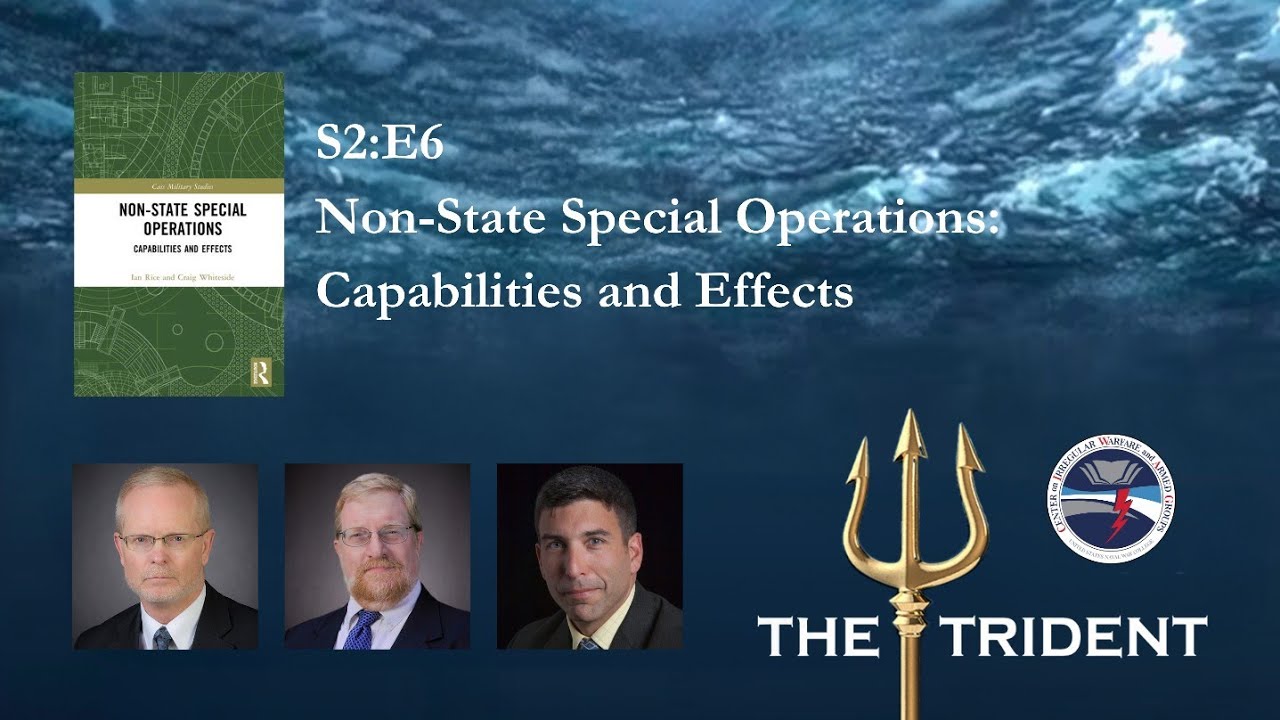
The Trident Episode 20 - Non-state Special Operations: Capabilities and Effects
Keywords
Summary
208 words
Critical Evaluation
Value of the Information & Strength of the Argument
The podcast provides valuable insights into a relatively under-researched area of irregular warfare. The speakers present a clear and coherent argument for the existence and importance of non-state special operations, supported by historical and contemporary examples. The three-tier test offers a useful analytical framework, and the typology helps organize the discussion. The argumentation is solid, with the speakers acknowledging limitations and potential counterarguments, such as the risk of selection bias. The discussion is well-structured and builds logically from definition to application.
Scientific Rigor, Source Quality, Title Accuracy
The podcast demonstrates scientific rigor through the expertise of the speakers and the reference to a forthcoming book. The sources cited are primarily the book itself and the speakers’ own research, which is appropriate for an expert discussion. The title accurately reflects the content, and the discussion stays on topic. The podcast does not present unverified claims as fact, and the speakers are careful to distinguish between their hypotheses and established knowledge.
168 words
Title / Content Match
The title accurately reflects the content, which focuses on the capabilities and effects of non-state special operations.
Quality & Reliability
8/10
The podcast features two senior academics with relevant expertise and discusses a peer-reviewed book. The argument is structured and evidence-based, but it is primarily an expert discussion rather than a formal study.
Key Moments
Markers derived by PSI from the transcript: the creator did not define chapters.
- Introduction of guests and topic
- Inspiration for the book and research question
- Definition of non-state special operations and the three-tier test
- Distinction between special operations forces and special operations
- Examples of non-state special operations: IRA, Hamas, Islamic State
- Typology of violent non-state actors: militants, mercenaries, criminals, cults
- Discussion of the strategic effects and risks of non-state special operations
- The role of technology and democratization in enabling non-state special operations
- Conclusion and implications for international security
Cited Sources
- The Trident Podcast Episode 20 — Official page for the podcast episode, including citation information.
Concurring Sources
- The ISIS Reader: Milestone Texts of the Islamic State Movement — Referenced as a previous work by Craig Whiteside, providing background on his expertise.
Contribution & Novelties
The podcast introduces a novel framework for understanding special operations conducted by non-state actors, challenging the traditional state-centric view. The three-tier test and typology provide a structured way to analyze these operations, which is a significant contribution to the field of irregular warfare studies. The discussion also highlights the growing importance of non-state actors in modern conflict, offering a fresh perspective on asymmetric warfare.
Pour aller plus loin :
- Special operations — Provides a general overview of special operations, useful for context.
- Irregular warfare — Explains the broader concept of irregular warfare, relevant to the podcast’s theme.
- Violent non-state actor — Defines the term and its significance in international security.
110 words
Radar Profile
The radar profile shows high scores in quantity and quality of information, reflecting the depth of the discussion. The technical level is moderately high, suitable for an informed audience. The overall reliability is strong due to the expertise of the speakers and the academic basis of the content.
💬 No comments were provided for analysis.