Nuclear chemistry lecture 25#youtube #youtubeshorts #scientist #chemistryclass #chemistrylecture
Keywords
Summary
152 words
Critical Evaluation
Value of the Information & Strength of the Argument
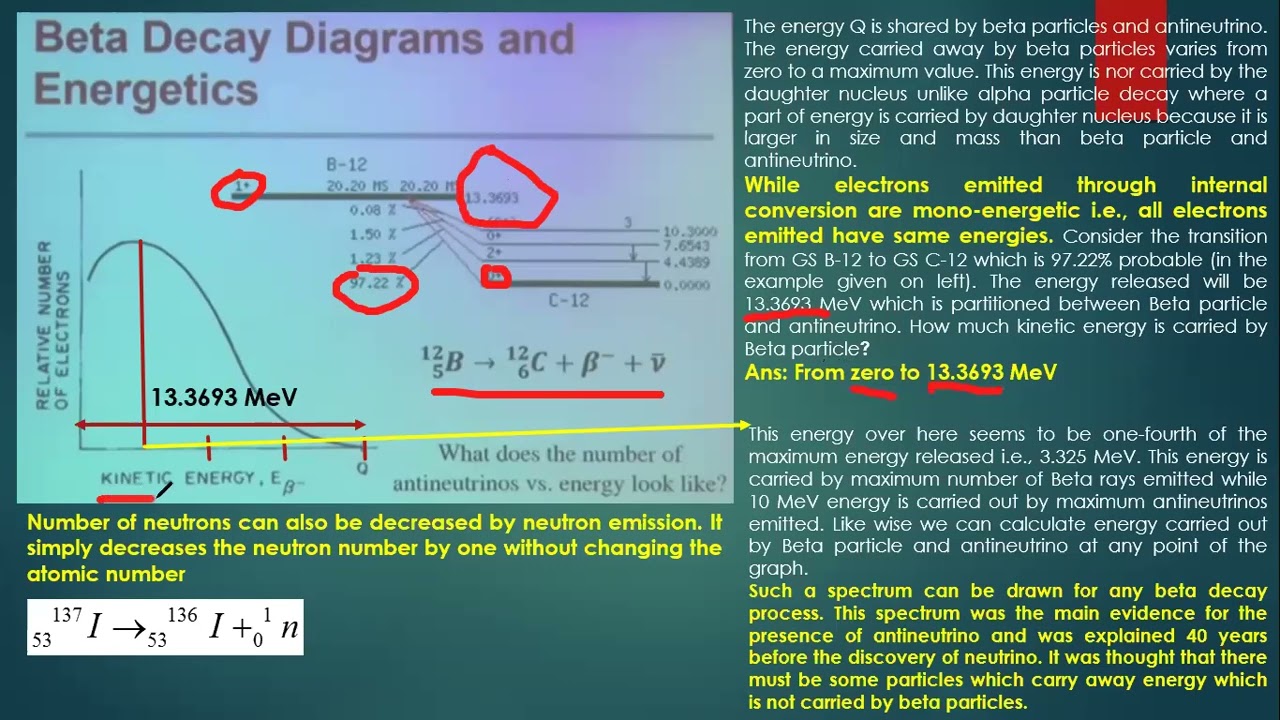
The lecture provides a clear and detailed explanation of beta decay, including the energy distribution and the role of antineutrinos. The argumentation is logical, building from the basic question of why beta particles are emitted to the experimental evidence for antineutrinos. The use of examples like boron-12 decay and the beta spectrum helps illustrate the concepts. However, the presentation is somewhat informal, with digressions and motivational comments, which may detract from the scientific rigor.
Scientific Rigor, Source Quality, Title Accuracy
The lecture does not cite specific sources, but it references well-known concepts and applications such as carbon dating and cobalt-60 therapy. The title is generic and does not accurately reflect the specific content on beta decay, but it is not misleading. The scientific content appears accurate, though the lack of citations reduces the overall rigor.
144 words
Title / Content Match
The title is generic and does not reflect the specific content on beta decay, but it is not misleading.
Quality & Reliability
6/10
The lecture provides a detailed explanation of beta decay, including the role of antineutrinos, energy distribution, and applications like carbon dating and cobalt-60 therapy. However, it lacks citations to primary sources, and the presentation is informal with some digressions.
Key Moments
Markers derived by PSI from the transcript: the creator did not define chapters.
- Introduction to beta decay and the question of how beta particles are emitted from the nucleus.
- Explanation of neutron-rich nuclei undergoing beta decay to achieve stability.
- Discussion of the Q value and energy calculation using mass difference.
- Example of radium beta decay and carbon-14 dating application.
- Explanation of the beta energy spectrum and its role in discovering the antineutrino.
- Discussion of cobalt-60 use in cancer therapy and its decay scheme.
- Student question about energy distribution and concluding remarks.
Contribution & Novelties
The lecture offers a thorough explanation of beta decay, particularly the energy distribution and the historical evidence for antineutrinos. It connects theoretical concepts to practical applications like carbon dating and cancer therapy.
Pour aller plus loin :
- Beta decay - Wikipedia — Provides a comprehensive overview of beta decay processes.
- Antineutrino - Wikipedia — Discusses the discovery and properties of neutrinos and antineutrinos.
- Carbon-14 dating - Wikipedia — Explains the principles and applications of carbon dating.
- Cobalt-60 - Wikipedia — Details the production and medical uses of cobalt-60.
88 words
Radar Profile
The radar profile shows moderate scores across all dimensions, with slightly higher scores in information quantity and technical level, indicating a substantive but not highly rigorous presentation.