Nuclear chemistry lecture 26#youtube #youtubeshorts #scientist #chemistryclass
Keywords
Summary
148 words
Critical Evaluation
Value of the Information & Strength of the Argument
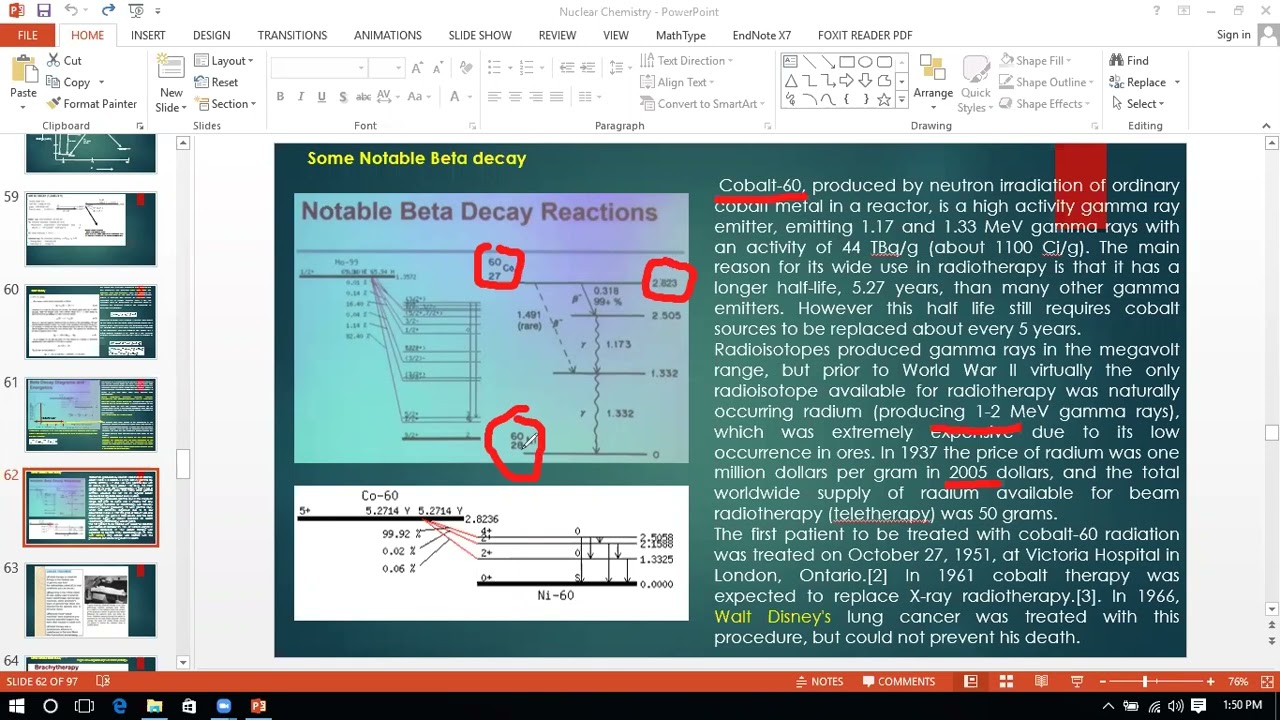
The lecture provides a clear explanation of the energy distribution in beta decay, using the example of boron-12 to carbon-12. The instructor correctly notes that the daughter nucleus receives negligible kinetic energy due to its large mass, and that the energy is shared between the beta particle and the antineutrino. He demonstrates how to calculate the total energy released using mass differences and the factor 931 MeV/amu. The argumentation is logically structured, with step-by-step reasoning and graphical illustrations. However, the lecture lacks formal citations and relies on the instructor’s authority. The discussion of cobalt-60 is informative, explaining its production and decay scheme, and its use in radiotherapy due to its long half-life and high-energy gamma rays. The instructor’s explanation of the gamma ray energies (1.17 and 1.33 MeV) as differences between nuclear states is accurate. Overall, the content is valuable for students learning nuclear chemistry, but the lack of sources and the informal delivery reduce its scientific rigor.
Scientific Rigor, Source Quality, Title Accuracy
The lecture does not cite any external sources, and the instructor does not reference specific textbooks or research papers. The content appears to be based on standard nuclear chemistry knowledge, but without citations, it is difficult to verify the accuracy of specific values and claims. The title is generic and does not accurately reflect the specific topics covered, which are beta decay energy distribution and cobalt-60. The lecture is part of a series, so the title may be intended for organizational purposes, but it does not provide clear information about the content. The instructor’s teaching style is informal, with frequent asides and questions to the audience, which may be engaging for students but reduces the overall scientific rigor.
291 words
Title / Content Match
The title is generic and does not reflect the specific content of the lecture, which focuses on beta decay energy and cobalt-60.
Quality & Reliability
6/10
The lecture provides a detailed explanation of beta decay energy distribution and the use of cobalt-60 in radiotherapy, but lacks formal citations and has a conversational, informal tone.
Key Moments
Markers derived by PSI from the transcript: the creator did not define chapters.
- Introduction and question about energy distribution in beta decay
- Explanation of energy sharing between beta particle and antineutrino
- Graph of beta particle energy spectrum and complementary antineutrino spectrum
- Discussion of cobalt-60 production and decay scheme
- Calculation of energy release in cobalt-60 decay using mass differences
- Explanation of gamma ray energies (1.17 and 1.33 MeV) from nuclear transitions
- Use of cobalt-60 in radiotherapy and its advantages over radium
- Conclusion and preview of next lecture
Contribution & Novelties
The lecture provides a clear pedagogical explanation of beta decay energy distribution, which is often misunderstood by students. It emphasizes the continuous spectrum of beta particle energies and the complementary antineutrino spectrum, using the example of boron-12. The discussion of cobalt-60 in radiotherapy is practical, linking nuclear physics to medical applications. The instructor’s step-by-step calculation of energy release using mass differences is useful for problem-solving.
Pour aller plus loin :
- Beta decay - Wikipedia — Provides a comprehensive overview of beta decay, including energy distribution and antineutrinos.
- Cobalt-60 - Wikipedia — Details the production, decay, and uses of cobalt-60, especially in radiotherapy.
- Nuclear medicine - Wikipedia — Explains the broader context of radioactive isotopes in medical treatment.
117 words
Radar Profile
The radar profile shows a balanced performance across information quantity, quality, technical level, and reliability, with a slight dip in reliability due to lack of citations. The lecture is informative and technically sound but could benefit from more rigorous sourcing.