Nuclear chemistry lecture 24#youtube #youtubeshorts #scientist #chemistryclass #chemistrylecture
Keywords
Summary
169 words
Critical Evaluation
Value of the Information & Strength of the Argument
The lecture provides valuable insights into the practical application of decay diagrams and energy calculations in nuclear chemistry. The instructor walks through specific numerical examples, showing how to compute the kinetic energy of alpha particles and gamma ray energies from excited state transitions. The argumentation is logical and step-by-step, making complex concepts accessible. However, the presentation is somewhat disorganized, with frequent digressions and student interactions that may distract from the core content. The scientific reasoning is sound, but the lack of formal structure and reliance on verbal explanations without visual aids (beyond the shared screen) limits the overall impact.
Scientific Rigor, Source Quality, Title Accuracy
The scientific rigor is moderate: the instructor demonstrates a good grasp of nuclear decay processes and provides accurate explanations of decay series and half-life calculations. However, no external sources are cited, and the content is presented in a conversational, informal manner. The title accurately reflects the content, which is a nuclear chemistry lecture. The lack of citations and the informal delivery reduce the perceived reliability, but the core scientific content is correct.
186 words
Title / Content Match
The title accurately reflects the content, which is a nuclear chemistry lecture covering decay diagrams, half-life calculations, and decay series.
Quality & Reliability
6/10
The lecture is a live classroom session with interactive problem-solving, but the audio is partially unclear and the content is presented in a conversational manner without formal citations. The scientific explanations are generally accurate, but the lack of structured presentation and references reduces the overall reliability score.
Key Moments
Markers derived by PSI from the transcript: the creator did not define chapters.
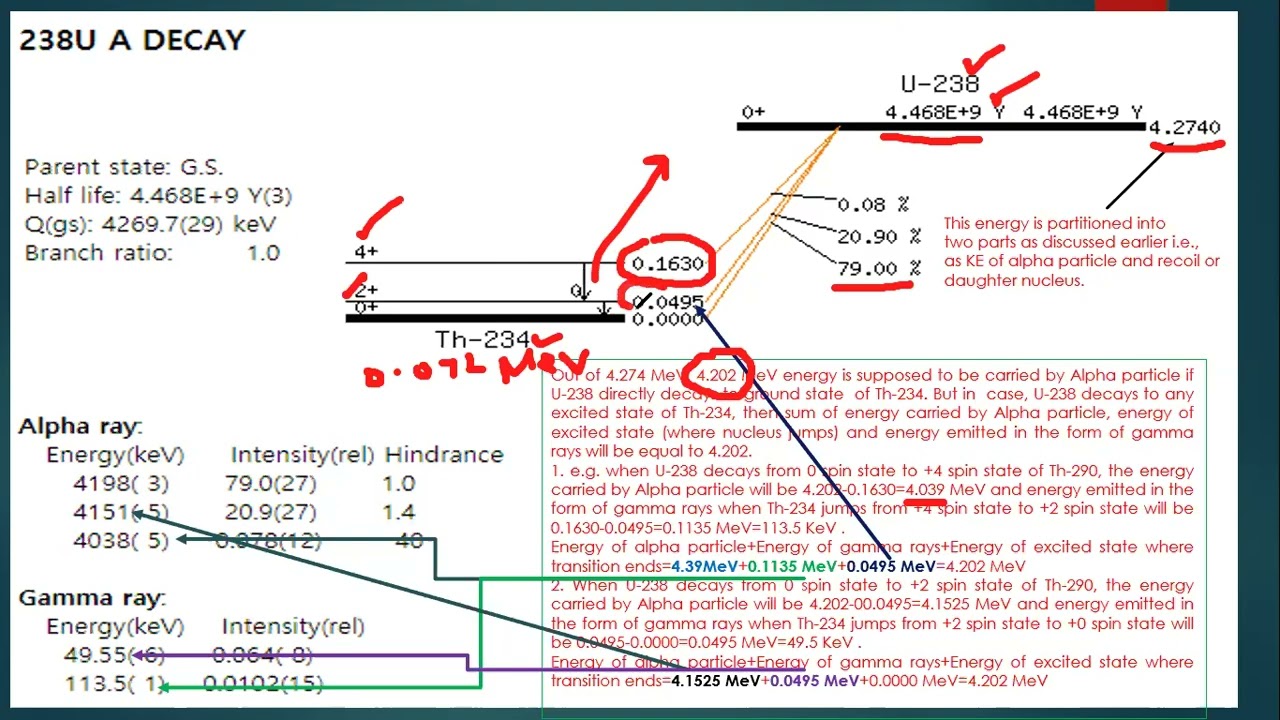
- Discussion of the decay diagram for U-238 to Th-234, including branching ratios and excited states.
- Explanation of how energy is distributed among alpha particle kinetic energy, daughter nucleus kinetic energy, and gamma rays.
- Calculation of alpha particle kinetic energy for different excited states and gamma ray energies.
- Introduction to using U-238 half-life for dating the age of the Earth via lead-206 accumulation.
- Construction of the decay series from U-238 to Pb-206, listing all intermediate nuclides.
- Explanation of beta decay, including the conversion of a neutron to a proton and the emission of a beta particle and antineutrino.
- Discussion of the historical puzzle of energy conservation in beta decay and the prediction of the neutrino.
Contribution & Novelties
The lecture provides a practical, step-by-step approach to understanding nuclear decay diagrams and energy calculations, which is valuable for students. It emphasizes the construction of decay series and the application of half-life in geochronology. The interactive format allows for immediate clarification of doubts.
Pour aller plus loin :
- Radioactive decay — Overview of decay processes.
- Uranium-238 — Details on U-238 decay chain.
- Neutrino — History and properties of neutrinos.
69 words
Radar Profile
The radar profile shows moderate scores across all dimensions, with a slight peak in quantity of information and a dip in technical level. This indicates a lecture that provides a good amount of content but at a relatively introductory level, suitable for beginners.