Nuclear chemistry lecture 28#study #learning #stem #viral #trending
Keywords
Summary
153 words
Critical Evaluation
Value of the Information & Strength of the Argument
The lecture provides a detailed explanation of nuclear decay processes, including formulas and criteria for different modes. The argumentation is logical, building on previous lectures and using examples like sodium-22. However, the presentation is somewhat disorganized, with frequent asides and corrections, which may hinder clarity. The instructor demonstrates a good understanding of the subject but does not always present the information in a structured manner.
Scientific Rigor, Source Quality, Title Accuracy
The lecture appears to be based on standard nuclear chemistry textbooks, but no specific sources are cited. The title is generic and includes hashtags, which is common for educational YouTube videos. The content is accurate overall, though there are minor errors, such as stating atomic number ranges incorrectly (30 vs 50). The lack of citations and the informal style reduce the scientific rigor.
143 words
Title / Content Match
The title is generic and includes hashtags, but the content matches the topic of nuclear chemistry lecture.
Quality & Reliability
6/10
The lecture provides a structured explanation of nuclear decay processes, including electron capture, internal conversion, and isomeric transitions, with formulas and examples. However, the presentation is informal, lacks visual aids, and contains some errors (e.g., atomic number ranges). The content is based on standard nuclear chemistry principles, but no sources are cited.
Key Moments
Markers derived by PSI from the transcript: the creator did not define chapters.
- Introduction and recap of beta decay energy formula
- Explanation of positron emission formula and comparison with beta decay
- Introduction to electron capture and its energy formula
- Discussion on when electron capture occurs and its competition with positron emission
- Example of sodium-22 decay via electron capture and positron emission
- Explanation of X-ray emission following electron capture
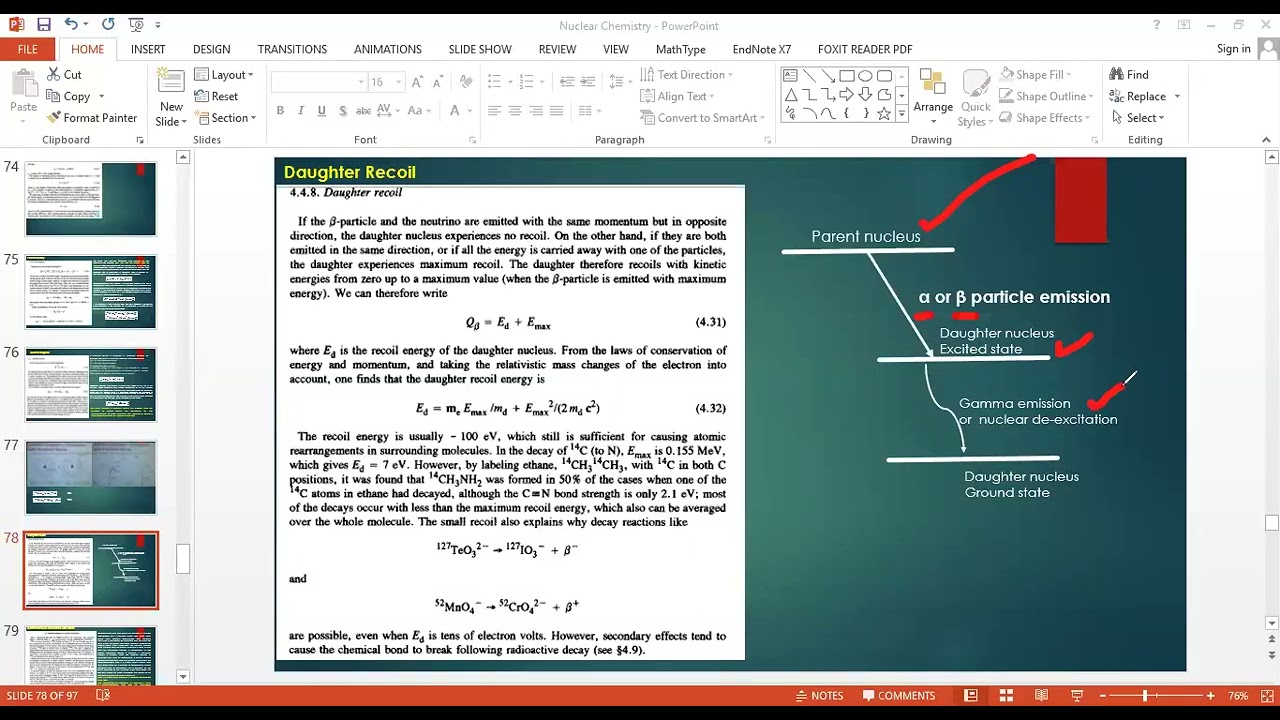
- Discussion on daughter recoil and momentum conservation in beta decay
- Introduction to gamma emission and internal conversion
- Detailed explanation of internal conversion and selection rules
- Explanation of isomeric transitions and metastable states
Contribution & Novelties
The lecture provides a comprehensive overview of nuclear decay processes, particularly focusing on electron capture and internal conversion, which are often less emphasized in introductory courses. It clarifies the criteria for electron capture vs positron emission and explains the mechanism of internal conversion in detail.
Pour aller plus loin :
- Electron capture — Wikipedia article on electron capture, providing background and examples.
- Internal conversion — Wikipedia article on internal conversion, explaining the process and its applications.
- Isomeric transition — Wikipedia article on nuclear isomerism and isomeric transitions.
87 words
Radar Profile
The radar profile shows balanced scores across all dimensions, with a slight emphasis on technical level and information quality. This indicates a lecture that is informative but not exceptionally rigorous in sourcing or presentation.