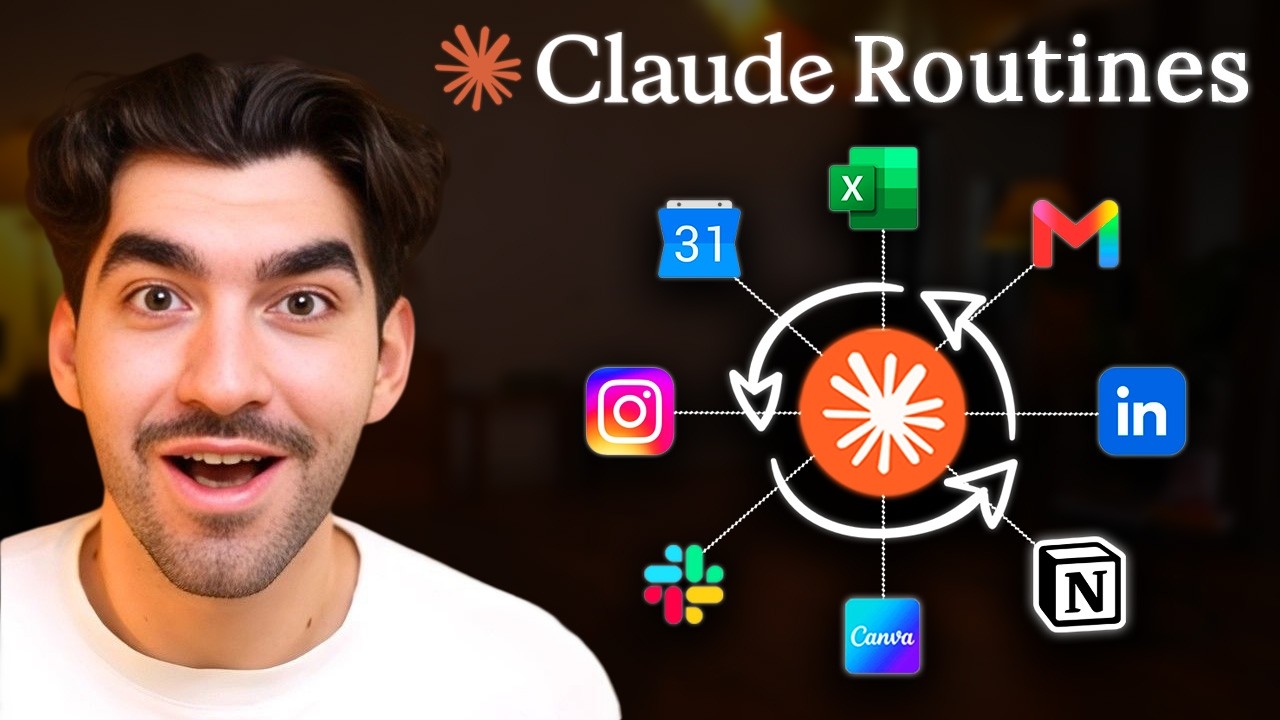
Claude IA fait maintenant TOUT à votre place
Keywords
Summary
133 words
Critical Evaluation
The video offers a clear and practical introduction to Claude’s routines, a feature that enables users to automate tasks through natural language instructions. The creator’s approach is methodical: he first distinguishes between time-based (‘alarm’) and event-based (‘doorbell’) routines, then breaks down the anatomy of a routine into instructions, workspace, and connectors. This conceptual framework is helpful for beginners and sets the stage for the live demonstrations. The first demo, creating an email triage routine, is particularly effective: it shows how to set up a routine that summarizes important emails and marks promotions as read, delivering the summary to Slack. The demonstration is realistic and the result is impressive, achieved in under a minute. The second demo, generating content with Canva, is less detailed but still illustrates the versatility of routines. The creator also introduces a five-part method for building routines, which adds structure to the process. He emphasizes the importance of the workspace for personalization and the role of connectors as the ‘arms’ of the assistant. The concept of a ‘virtual employee’ by stacking routines is innovative and forward-looking. However, the video has some limitations. It is promotional in nature, with multiple calls to action and affiliate links, which may bias the presentation. The technical depth is moderate: while it explains the ‘what’ and ‘how’, it does not delve into the underlying mechanisms or potential limitations, such as the accuracy of the AI in handling complex tasks or the security implications of granting access to email and other services. The creator briefly mentions security and pricing but does not provide detailed information. The sources cited are limited to the official Claude documentation, which is appropriate but not exhaustive. The title accurately reflects the content, and the video is well-structured with clear chapters. Overall, the video is a valuable resource for those new to AI automation, offering practical guidance and inspiration. However, viewers should supplement it with more critical and technical resources to fully understand the capabilities and risks.
328 words
Title / Content Match
The title accurately reflects the content, which focuses on automating tasks with Claude's routines.
Quality & Reliability
7/10
The video provides a practical, step-by-step tutorial on using Claude's routines feature, with clear demonstrations and a structured approach. The information is accurate and aligns with official documentation, but it is primarily promotional and lacks in-depth technical details or critical analysis.
Chapters
Cited Sources
- Claude Code Routines Documentation — Official documentation for Claude's routines feature, referenced in the video description.
Concurring Sources
- Claude Code Routines Documentation — The official documentation confirms the existence and functionality of routines, aligning with the video's claims.
Contribution & Novelties
The video provides a practical, beginner-friendly introduction to Claude’s routines, a feature that allows users to automate tasks using natural language. It offers a clear conceptual framework (alarm vs. doorbell routines) and demonstrates real-world applications, such as email triage and content creation. The idea of stacking routines to create a ‘virtual employee’ is a novel approach that extends the basic use cases.
Pour aller plus loin :
- Claude AI official website — Official product page for Claude, providing details on features and capabilities.
- Anthropic’s research page — Access to Anthropic’s research publications, offering deeper insights into the underlying AI technology.
- Zapier’s guide on AI automation — A comprehensive guide on AI automation, covering tools and best practices that complement the routines concept.
122 words
Radar Profile
The radar profile shows high scores in quantity of information and reliability, reflecting the video's comprehensive coverage and alignment with official sources. The technical level is moderate, indicating that while it is accessible to beginners, it may not satisfy advanced users seeking deep technical details.