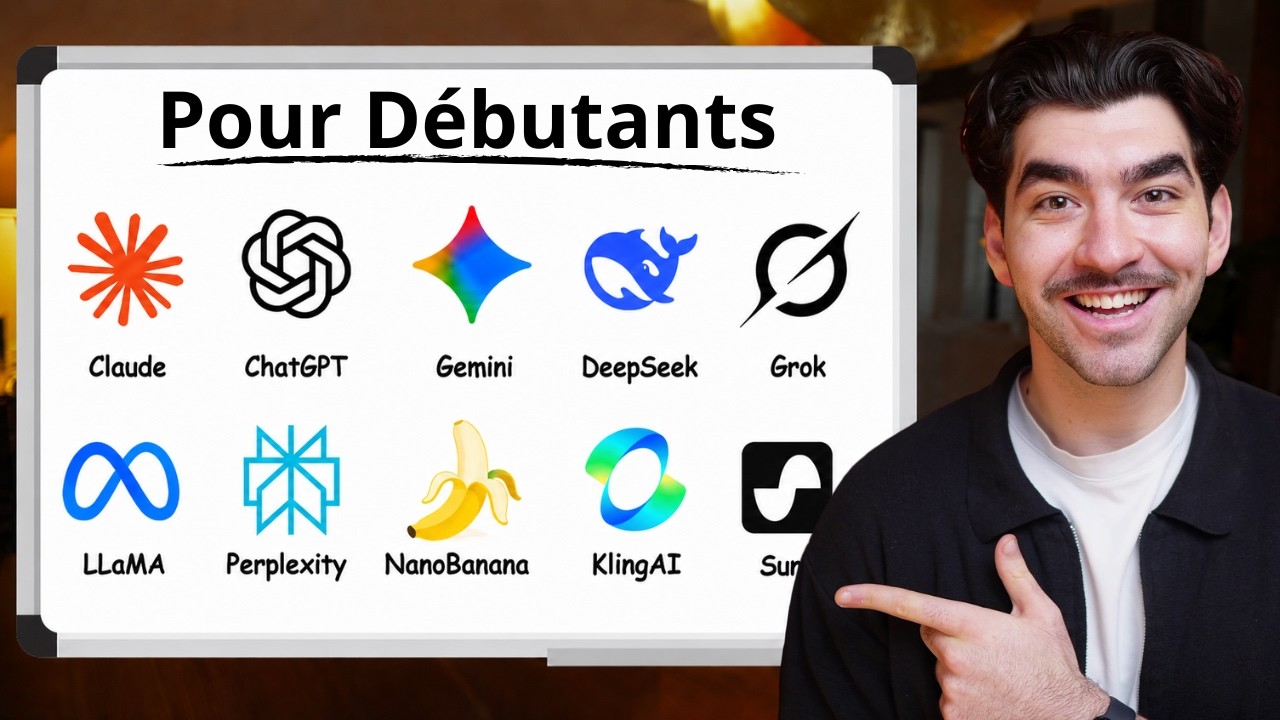
Chaque IA Expliquée en 19 Minutes
Keywords
Summary
187 words
Critical Evaluation
The video provides a valuable and accessible introduction to the landscape of AI models, effectively clarifying the common confusion between applications and underlying models. The analogy of a car body and engine is pedagogically effective, making the concept tangible for a general audience. The explanation of how LLMs work—predicting the next word—is simplified but accurate, and the discussion of parameters, context window, and reasoning models provides a solid foundation for understanding model differences.
However, the video’s technical depth is limited. It does not delve into the specifics of training processes, architectural differences (e.g., transformer architecture), or the nuances of model evaluation. The creator’s background as an entrepreneur rather than a researcher may explain this, but it means the content is more suited for beginners than for those seeking a rigorous technical understanding.
The information presented is generally accurate, but some claims could be seen as oversimplified or potentially misleading. For instance, the statement that models “do not memorize information” is a simplification; they do encode patterns from training data, which can lead to memorization of specific facts. The discussion of Grok’s “less filtered” nature is subjective and could be interpreted as endorsing a lack of safety measures, which is a contentious issue.
The video’s strength lies in its clear structure and practical comparisons, which help viewers understand the strengths and weaknesses of each tool. The inclusion of specific use cases and the creator’s personal recommendations add practical value. However, the lack of citations or references to primary sources weakens its scientific credibility. The video relies on the creator’s expertise and general knowledge, which is acceptable for a popular science format but not for an academic audience.
The adéquation between title and content is good; the video indeed explains various AIs in a concise manner. The title’s promise of “each AI” is somewhat ambitious, as it covers only a selection of major tools, but it does provide a broad overview.
Overall, the video is a useful educational resource for beginners, but it should be complemented with more detailed and cited sources for a deeper understanding. The creator’s engaging style and clear explanations make it an effective starting point for anyone looking to navigate the AI landscape.
365 words
Title / Content Match
The title accurately reflects the content: a broad explanation of various AI tools and their underlying models in a concise format.
Quality & Reliability
7/10
The video provides a clear and accessible overview of major AI models and their underlying engines, but it lacks in-depth technical detail and relies on general statements. The information is accurate at a high level, but some simplifications may omit nuances. The creator is an entrepreneur in the AI space, not a researcher, which may affect depth.
Key Moments
Markers derived by PSI from the transcript: the creator did not define chapters.
- Introduction: the analogy of AI apps as car bodies and models as engines.
- Explanation of how AI models work: training on data and predicting next words.
- Discussion of what makes some AIs smarter: parameters, context window, reasoning models.
- Start of the LLM section: review of ChatGPT, Gemini, Claude, Grok, DeepSeek, and others.
- Section on image generation: Nano Banana, DALL-E, etc.
- Section on video generation: Veo, Sora, KlingAI.
- Section on audio generation: Eleven Labs, Suno.
- Section on AI agents: what they are and their potential.
- Advice on choosing the right AI based on needs.
Cited Sources
- ChatGPT — Mentioned as a major AI tool with GPT models.
- Claude — Mentioned as a professional AI tool with Opus and Sonnet models.
- Gemini — Mentioned as Google's AI with integration into Google services.
- DeepSeek — Mentioned as an open-source AI model from China.
- Grok — Mentioned as AI from xAI integrated with X.
- Mistral — Mentioned as a European AI model.
- Llama — Mentioned as Meta's open-source AI model.
- Perplexity — Mentioned as an AI-powered search engine.
- Nano Banana — Mentioned as Google's image generation model.
- KlingAI — Mentioned as a video generation tool.
- Suno — Mentioned as an AI music generation tool.
- Eleven Labs — Mentioned as an AI voice generation tool.
Concurring Sources
- ChatGPT — The video's description of ChatGPT as a generalist tool aligns with its widespread use.
- Claude — The video's emphasis on Claude's coding and reasoning abilities is consistent with its reputation.
- Gemini — The video's mention of Gemini's integration with Google services is accurate.
Dissenting Sources
- Grok — The video claims Grok is 'less filtered' than other models, which is a subjective and potentially controversial statement. Some may argue that all AI models have safety measures, and Grok's approach is not necessarily less filtered but different.
Contribution & Novelties
The video provides a clear and accessible explanation of the distinction between AI applications and underlying models, which is often misunderstood. It offers a comparative overview of major AI tools, highlighting their specific strengths and use cases. The creator’s practical perspective as an entrepreneur adds value for business applications.
Pour aller plus loin :
- Transformer architecture — The foundational architecture for most modern LLMs.
- Large language model — Overview of LLMs, their training, and capabilities.
- Reinforcement learning from human feedback (RLHF) — A key technique used to align AI models with human preferences.
- OpenAI — The company behind ChatGPT and GPT models.
- Anthropic — The company behind Claude.
108 words
Radar Profile
The radar profile shows a balanced performance across all dimensions, with slightly higher scores in quantity of information and technical level, indicating a comprehensive yet accessible overview. The lower score in reliability suggests that while the information is generally accurate, it lacks depth and citations.
💬 Très positif. Sur les 30 commentaires analysés, la grande majorité exprime des remerciements et des éloges pour la clarté et la pédagogie de la vidéo, avec quelques suggestions d'amélioration comme l'ajout de Copilot.