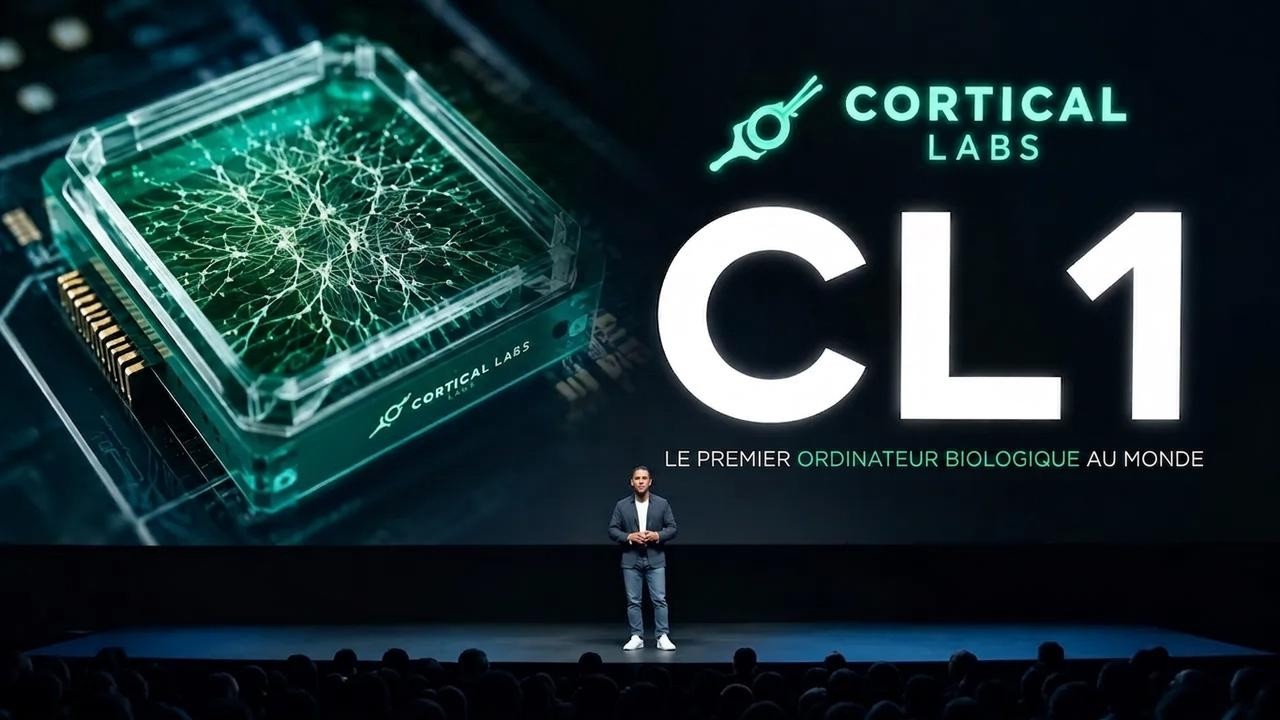
Ils ont créé une puce avec des cellules cérébrales humaines vivantes
They created a chip with living human brain cells
Keywords
Summary
127 words
Critical Evaluation
Value of the Information & Strength of the Argument
The video provides valuable insights into the current state of brain organoid research, presenting a balanced view of its potential applications and ethical dilemmas. The argumentation is generally solid, relying on expert opinions and specific examples, though it sometimes oversimplifies complex scientific concepts. The inclusion of contrasting viewpoints, such as the debate on sentience, strengthens the narrative. However, the promotional segment for an investment platform detracts from the scientific focus.
Scientific Rigor, Source Quality, Title Accuracy
The video demonstrates reasonable scientific rigor by referencing real institutions and researchers, but it lacks direct citations to peer-reviewed studies. The sources mentioned are credible, but the absence of specific references limits verifiability. The title accurately reflects the content, and the video’s structure is coherent. The description includes links to a sponsor and a Spotify podcast, but no direct scientific sources. Overall, the content is informative but could benefit from more rigorous sourcing.
158 words
Title / Content Match
The title accurately reflects the content, which focuses on brain organoids and their use in computing, though it slightly overemphasizes the 'chip' aspect.
Quality & Reliability
7/10
The video provides a broad overview of brain organoid research, citing specific institutions and researchers, but lacks direct citations to primary literature and includes a promotional segment. The information is generally accurate but simplified for a general audience.
Key Moments
Markers derived by PSI from the transcript: the creator did not define chapters.
Cited Sources
- Mintos investment platform — Sponsor segment
- AI Revolution podcast on Spotify — Promotion of related content
Concurring Sources
- Cortical Labs official website — Company behind the CL1 biological computer and Pong experiment.
- Wikipedia: Organoid — General information on organoids.
Dissenting Sources
- Neuron journal response — The video mentions a critical response in the journal Neuron regarding claims of sentience in organoids, but no specific URL is provided.
Contribution & Novelties
The video offers a compelling synthesis of recent developments in brain organoid research, particularly highlighting the work of Cortical Labs and the concept of organoid intelligence. It effectively communicates the potential of biological computing and the ethical challenges it poses.
Pour aller plus loin :
- Brain organoid — Provides background on organoid technology.
- Cortical Labs — Official site of the company featured in the video.
- Organoid intelligence — Concept proposed by Thomas Hartung.
- Free energy principle — Theoretical framework mentioned in the video.
83 words
Radar Profile
The radar profile shows high scores in information quantity and quality, with moderate technical depth and reliability. This indicates a well-rounded but not deeply technical presentation, suitable for a general audience interested in neuroscience and bioethics.