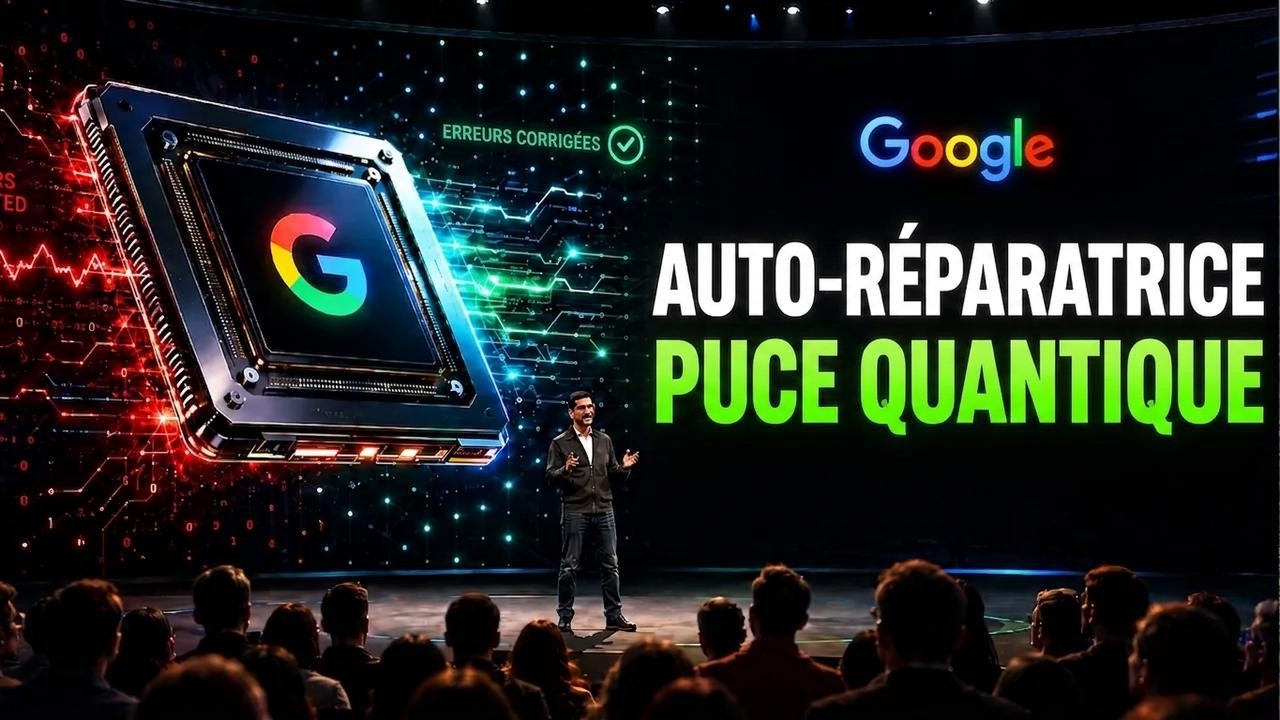
Google vient de réaliser une avancée majeure en informatique quantique
Google has just achieved a major breakthrough in quantum computing
Keywords
Summary
186 words
Critical Evaluation
Value of the Information & Strength of the Argument
The video provides valuable insights into a cutting-edge application of AI to quantum computing. It clearly explains the technical challenges of qubit calibration and how reinforcement learning can address them. The argumentation is solid, building from fundamental concepts to the specific innovation and its experimental validation. The video presents quantitative results, such as the 20% error reduction and the stability improvement factor, which strengthen its credibility. However, the presentation is somewhat one-sided, focusing on the benefits without deeply discussing potential drawbacks or alternative approaches. The inclusion of a promotional segment for an investment platform is a distraction but does not undermine the core technical content.
Scientific Rigor, Source Quality, Title Accuracy
The video demonstrates a good level of scientific rigor, accurately explaining complex concepts in quantum error correction and reinforcement learning. It references the research paper published in Nature, which is a high-quality source. The video does not cite specific sources within the video itself, but the description provides a link to the paper. The title accurately reflects the content, and the video stays on topic. The promotional segment is clearly separated and does not affect the scientific content. Overall, the video is a reliable source of information for a general audience interested in quantum computing.
215 words
Title / Content Match
The title accurately reflects the content, which focuses on Google's major advance in quantum computing, specifically the use of AI for real-time calibration.
Quality & Reliability
7/10
The video presents a detailed and technically accurate account of a recent Google research advance in quantum error correction using reinforcement learning. It correctly explains key concepts such as qubit fragility, calibration drift, quantum error correction, and the role of decoders. The claims are consistent with known results from Google's Willow chip and the AlphaQubit decoder. However, the video includes a promotional segment for an investment platform, and the presentation is somewhat sensationalized. The source is not peer-reviewed, but the underlying paper is published in Nature.
Key Moments
Markers derived by PSI from the transcript: the creator did not define chapters.
Cited Sources
- Mintos investment platform (promotional) — Promotional link in the description, not a scientific source.
- AI Revolution en Français on Spotify — Link to the channel's Spotify podcast, not a scientific source.
Concurring Sources
- Nature paper on real-time AI control of quantum processors — The video references this paper as the source of the research findings.
Contribution & Novelties
The video presents a novel application of reinforcement learning to quantum error correction, specifically for real-time calibration of qubits. This is a significant advancement as it addresses the practical challenge of calibration drift without interrupting computations. The video explains the technical details of the approach, including the use of error detection events as training signals and the scalability of the method. This contributes to the growing body of research on AI-driven quantum control.
Pour aller plus loin :
- Quantum error correction — Provides background on the fundamental concepts.
- Reinforcement learning — Overview of the machine learning paradigm used.
- Google Willow chip — Information about the specific hardware mentioned.
- AlphaQubit — Details on the neural decoder used in the research.
119 words
Radar Profile
The radar profile shows high scores in technical level and information quantity, indicating a content-rich video with deep technical explanations. The quality and reliability scores are moderate, reflecting the promotional segment and the lack of direct source citations within the video. Overall, the video is a valuable resource for those interested in the intersection of AI and quantum computing.
💬 Sur les 0 commentaires analysés, aucune tendance n'est disponible.