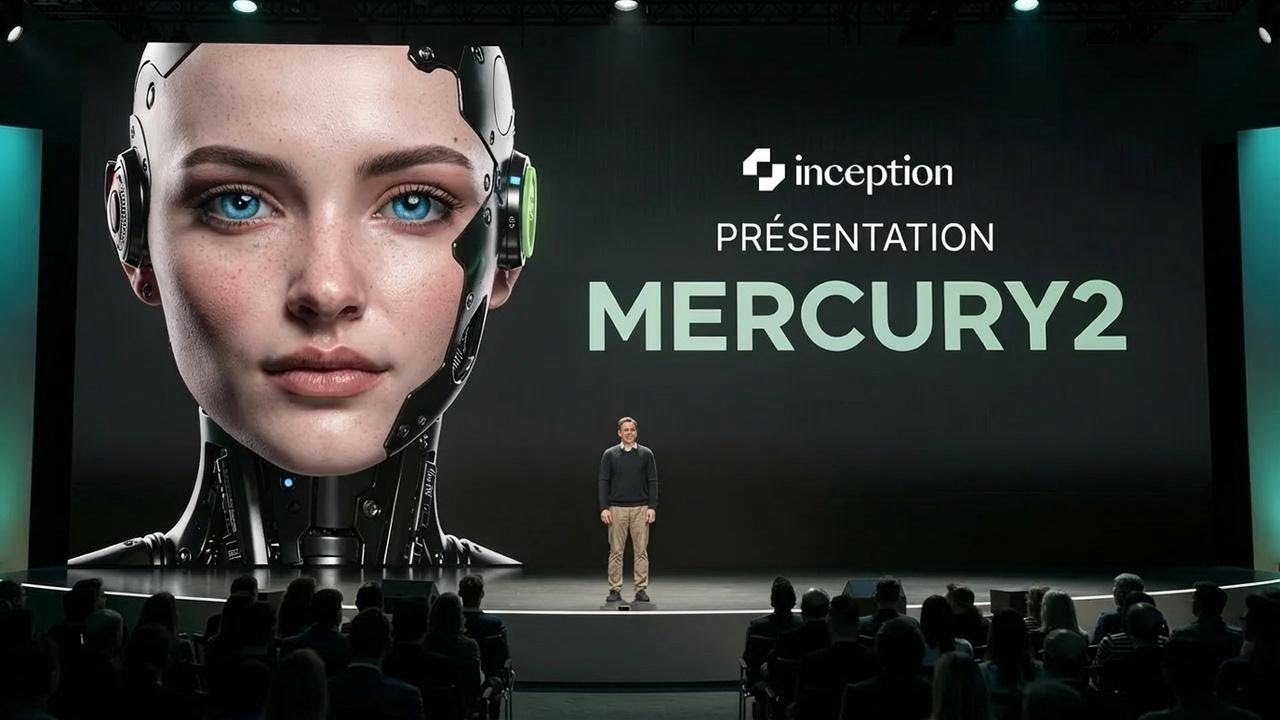
Le nouveau Mercury 2 pulvérise les limites de latence à 1 000 tokens/seconde (écrase les GPT)
The new Mercury 2 smashes latency limits at 1,000 tokens/second (crushes the GPTs)
Keywords
Summary
127 words
Critical Evaluation
Value of the Information & Strength of the Argument
The video provides valuable insights into a novel AI architecture, explaining the technical differences between diffusion and autoregressive models clearly. The argumentation is well-structured, presenting the speed advantages and the implications for reasoning and production use. The presenter supports claims with benchmark numbers and practical examples, making a compelling case for the significance of the model. However, the analysis relies heavily on the company’s provided data and early access, which may introduce bias. The argument that diffusion eliminates the speed-quality trade-off is persuasive but not independently verified.
Scientific Rigor, Source Quality, Title Accuracy
The video demonstrates a good understanding of the technical subject, but the scientific rigor is limited by the lack of independent sources. The primary source is the company itself, and the presenter acknowledges receiving early access. The benchmarks are cited without external verification. The title accurately reflects the content, focusing on the speed and performance of Mercury 2. The video does not engage with potential criticisms or limitations of the diffusion approach, which would strengthen its credibility.
179 words
Title / Content Match
The title accurately reflects the content, which focuses on the speed and performance of Mercury 2.
Quality & Reliability
7/10
The video presents a detailed analysis of a new AI model, based on early access and benchmarks, but lacks independent verification and relies on the company's claims. The presenter's expertise is evident, but the content is promotional in nature.
Key Moments
Markers derived by PSI from the transcript: the creator did not define chapters.
- Introduction to Mercury 2 and diffusion models
- Comparison of speed and reasoning capabilities
- Performance on benchmarks and real-world usage
- Integration, cost, and technical framework
- Architectural impact and scaling
- Reasoning redefined by diffusion
- Practical applications and reliability
- Conclusion and future perspectives
Cited Sources
- Spotify Podcast — The video mentions that the channel is available on Spotify, providing a link for listeners.
Concurring Sources
- Inception Labs — The company behind Mercury 2, providing official information and benchmarks.
Contribution & Novelties
The video provides an early analysis of Mercury 2, highlighting its diffusion-based architecture as a potential paradigm shift in LLM design. It explains how parallel generation can overcome latency bottlenecks, which is a novel perspective compared to traditional autoregressive models. The discussion on the implications for agentic workflows and real-time applications adds practical value.
Pour aller plus loin :
- Diffusion Models — Background on diffusion models, which are the foundation of Mercury 2’s architecture.
- Autoregressive Model — Explanation of the traditional sequential generation approach that Mercury 2 aims to replace.
- Large Language Model — Overview of LLMs, providing context for the advancements discussed.
103 words
Radar Profile
The radar profile shows high scores in information quantity and technical level, but lower in reliability, reflecting the promotional nature and lack of independent verification. The overall shape suggests a technically informative but potentially biased analysis.