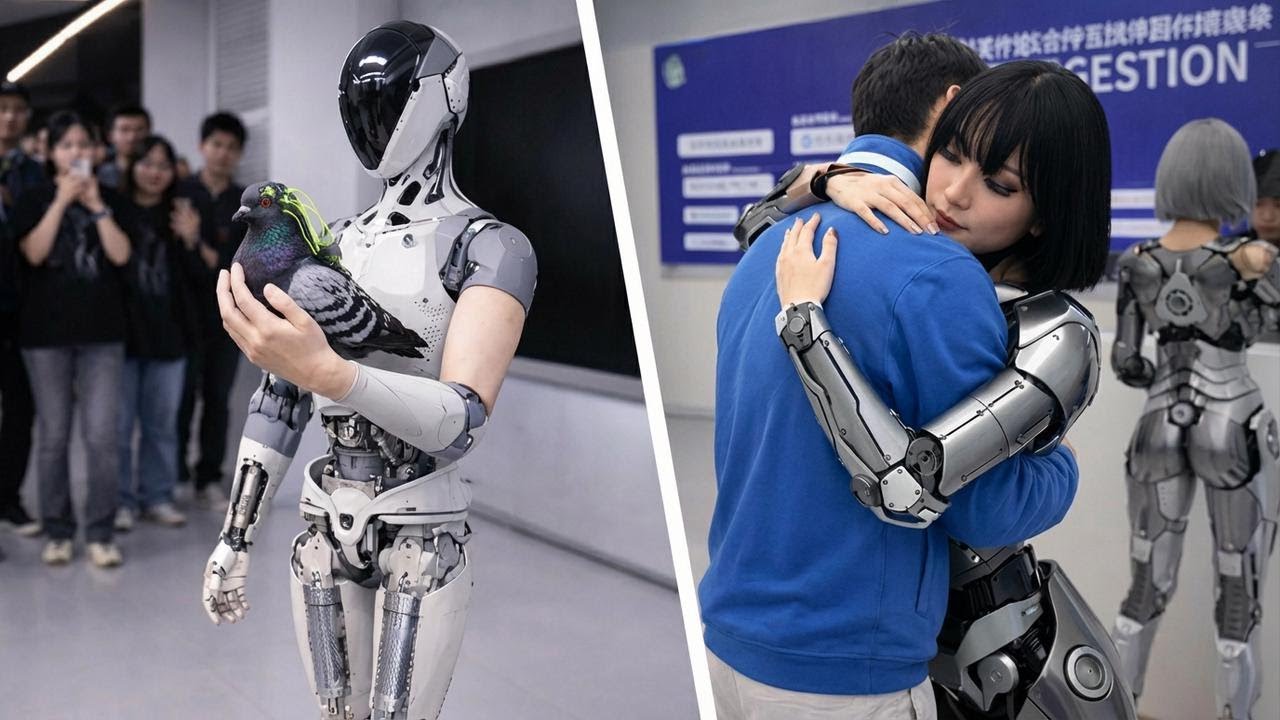
Les nouveaux robots IA de Chine développent des sens humains : toucher, vue, odorat et mémoire
China's new AI robots develop human senses: touch, sight, smell and memory
Keywords
Summary
136 words
Critical Evaluation
Value of the Information & Strength of the Argument
The video provides a broad overview of recent advancements, but the argumentation is largely based on company claims and promotional material. It lacks critical analysis or independent verification of the reported achievements. The presentation is engaging, with clear explanations of technical concepts, but the value is limited by the absence of deep technical details or expert commentary.
Scientific Rigor, Source Quality, Title Accuracy
The video cites company announcements and press releases but does not provide direct links to primary sources. The title is appropriate, but the content sometimes exaggerates the significance of the developments. The video includes a sponsored segment, which is clearly indicated. The overall scientific rigor is moderate, with a mix of credible and speculative information.
127 words
Title / Content Match
The title accurately reflects the content, which covers robots with enhanced sensory capabilities and memory.
Quality & Reliability
6/10
The video presents recent developments in robotics and embodied AI, but relies heavily on company announcements and lacks independent verification. Some claims, such as the Russian pigeon surveillance project, are extraordinary and require more scrutiny. The presentation is engaging but occasionally sensationalist.
Key Moments
Markers derived by PSI from the transcript: the creator did not define chapters.
Cited Sources
- Spotify Show — Link to the channel's Spotify podcast version of the video.
Concurring Sources
- X-Humanoïd official website — Company behind Tiangong 3.0, likely to have official product information.
- Geek+ official website — Company behind Geno 1 warehouse robot.
Contribution & Novelties
The video synthesizes recent news in robotics and embodied AI, highlighting trends such as open-source platforms, bio-inspired sensors, and the integration of AI in logistics. It also raises ethical questions about the use of animals in surveillance.
Pour aller plus loin :
- Embodied AI — Background on the concept of embodied intelligence.
- Mixture of experts — Technical explanation of the model architecture used in RinBrain.
- Compound eye — Biological inspiration for the artificial sensor.
74 words
Radar Profile
The radar profile shows moderate scores across all dimensions, with a slight peak in information quantity. This indicates a video that provides a decent amount of content but lacks depth and critical rigor.