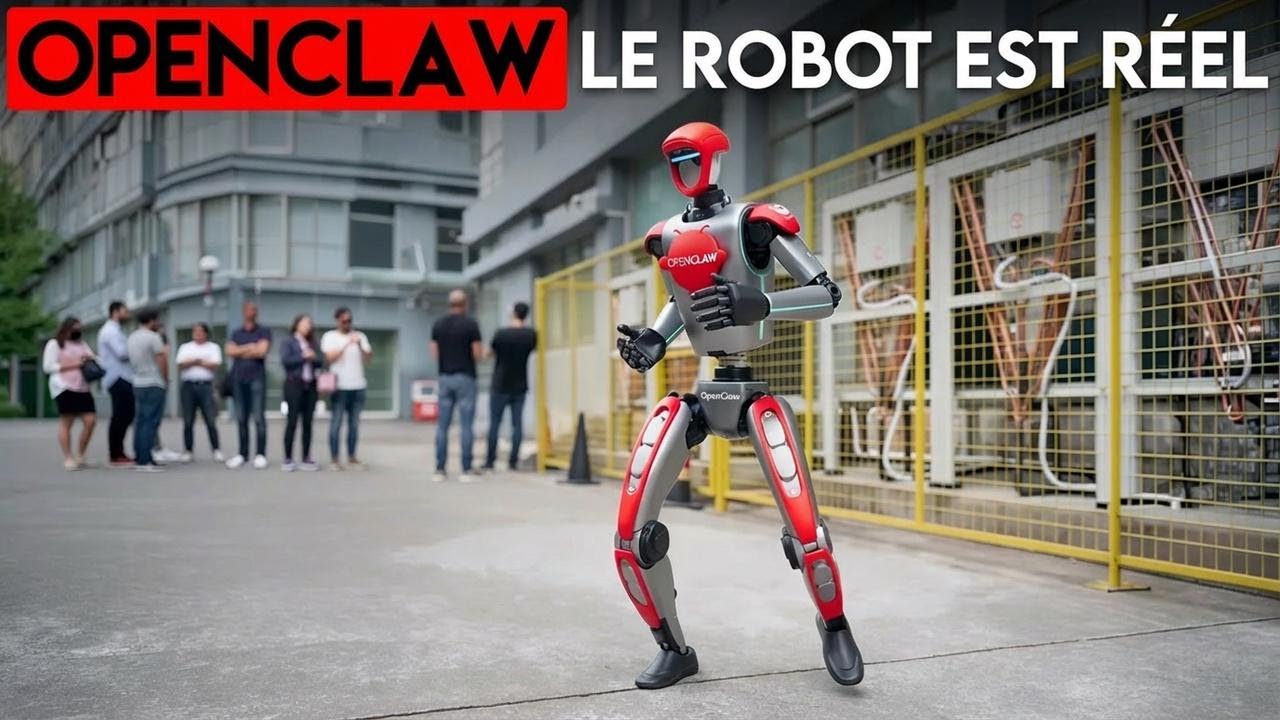
Le nouveau robot OpenClaw donne l’impression d’avoir une conscience (Skynet déclenché ?)
The new OpenClaw robot gives the impression of having consciousness (Skynet triggered?)
Keywords
Summary
157 words
Critical Evaluation
Value of the Information & Strength of the Argument
The video provides a clear overview of the OpenClaw project and its potential implications for embodied AI. It explains technical concepts like spatial memory and voxelization in an accessible manner, and presents both enthusiastic reactions and critical perspectives from the community. However, the argumentation is largely based on anecdotal evidence and community discussions rather than rigorous scientific analysis. The video does not critically evaluate the limitations or potential risks of the technology, and the promotional segment for an AI training event may bias the presentation.
Scientific Rigor, Source Quality, Title Accuracy
The video does not cite specific scientific papers or official documentation, relying instead on community discussions and developer statements. The description provides only a Spotify link, which is not directly related to the technical content. The title is somewhat sensationalist, but the content does align with the general theme. The video’s scientific rigor is limited by the lack of primary sources and the promotional nature of part of the content.
170 words
Title / Content Match
The title is somewhat sensationalist, but the content does discuss the OpenClaw robot and its spatial memory, which could give an impression of consciousness. The 'Skynet' reference is hyperbolic but reflects the tone of the video.
Quality & Reliability
6/10
The video is a news review of the OpenClaw project, presenting its features and community reactions. It includes some technical details (voxelization, spatial memory) but lacks primary sources and in-depth verification. The presentation is enthusiastic and somewhat sensationalist, with a clear promotional segment.
Key Moments
Markers derived by PSI from the transcript: the creator did not define chapters.
- Introduction and context of the robot
- Explanation of spatial memory
- Presentation of OpenClaw and its impact in AI
- Voxelization and advanced spatial memory
- Online reactions and flexibility of OpenClaw
- Debates and system architecture
- Technical challenges in real-world robotics
- Evolutions and interfaces of OpenClaw
- Concrete experiments and future of agents
Cited Sources
- Spotify show — The channel's podcast on Spotify, mentioned in the description.
Concurring Sources
- OpenClaw GitHub repository — The official repository for OpenClaw, likely containing technical documentation and code.
Dissenting Sources
- Critique of LLM-based robot control — Some engineers argue that specialized models would be more efficient than using large language models for robot control, as mentioned in the video.
Contribution & Novelties
The video highlights the OpenClaw project as a significant step towards giving AI agents persistent spatial memory, which could enable more autonomous and context-aware robots. It presents the concept of voxelization as a method to structure spatial data, and discusses the integration of large language models for high-level reasoning. The video also touches on the emerging idea of a machine economy, where robots could have decentralized identities and perform transactions.
Pour aller plus loin :
- Spatial memory in robotics — Overview of spatial memory in robotics.
- Voxel — Definition and applications of voxels in 3D modeling.
- Simultaneous localization and mapping (SLAM) — Key technique for robot navigation and mapping.
109 words
Radar Profile
The radar profile shows moderate scores across all dimensions, with a slight emphasis on quantity of information and technical level. This suggests a video that provides a decent overview of the topic but lacks depth in terms of scientific rigor and source quality.
💬 Sur les 0 commentaires analysés, aucune tendance n'a pu être dégagée.