Hyper Parameter Selection
Keywords
Summary
224 words
Critical Evaluation
Value of the Information & Strength of the Argument
The video provides valuable practical guidance on hyperparameter selection, emphasizing the importance of search spacing and edge effects. The argumentation is clear and logical, using visual examples to illustrate concepts. The explanation of exponential vs. regular spacing and the need to extend search ranges when the optimal value is at the boundary is particularly useful. The discussion of the Cartesian product and its computational cost is accurate, and the suggestion to use an iterative approach for high-dimensional hyperparameter spaces is practical. The introduction of GridSearchCV and its limitations is well-founded, and the recommendation to hold out a test set is statistically sound.
Scientific Rigor, Source Quality, Title Accuracy
The video is scientifically rigorous in its explanation, adhering to standard practices in machine learning. However, it does not cite any external sources or references, which limits the ability to verify claims. The title accurately reflects the content, which focuses on hyperparameter selection methods. The video is a tutorial, and its content is consistent with established knowledge in the field.
177 words
Title / Content Match
The title accurately reflects the content, which focuses on methods for selecting hyperparameters in a statistically sound manner.
Quality & Reliability
7/10
The video provides a clear, structured explanation of hyperparameter selection methods, including grid search and cross-validation, with practical advice. The content is technically sound and aligns with standard practices in machine learning, though it lacks references to external sources and does not delve into advanced topics.
Key Moments
Markers derived by PSI from the transcript: the creator did not define chapters.
- Introduction to hyperparameter selection as a search process.
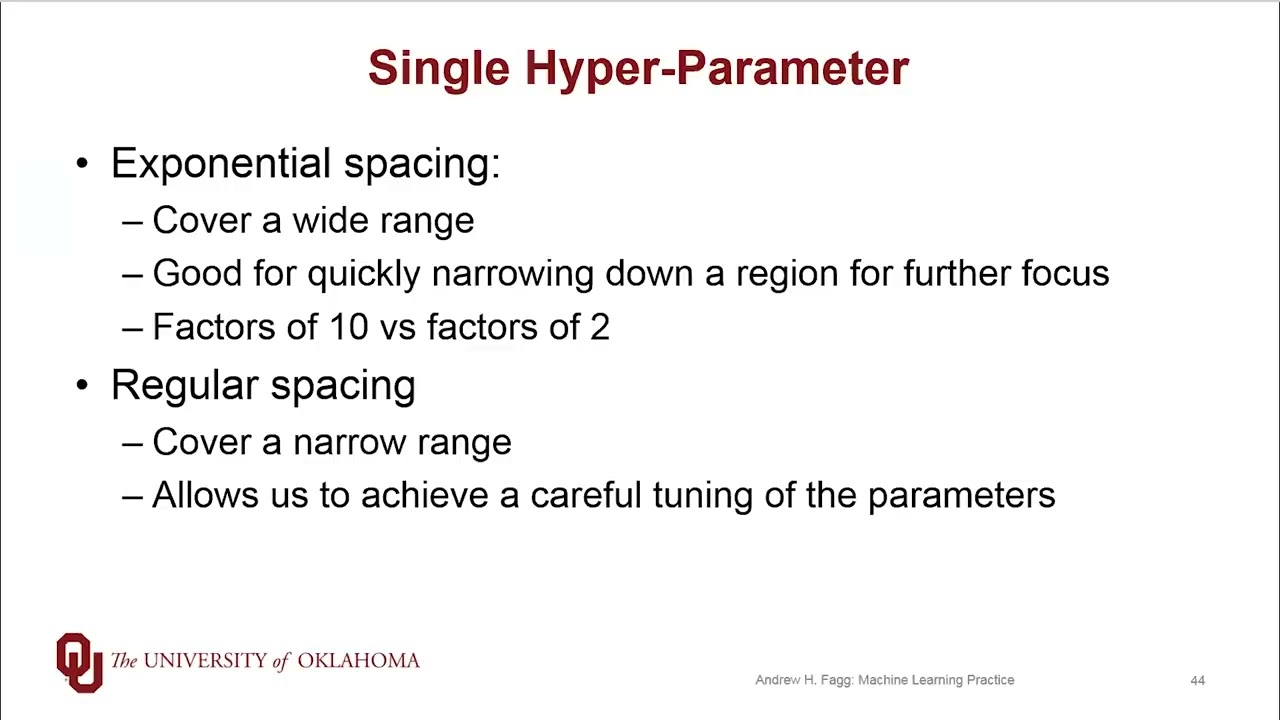
- Discussion of single hyperparameter search using exponential and regular spacing.
- Illustration of performance curve and identifying optimal hyperparameter region.
- Handling edge effects and extending search range.
- Summary of spacing strategies: exponential for wide range, regular for fine-tuning.
- Introduction to multiple hyperparameters and their interactions.
- Explanation of Cartesian product and grid search for multiple hyperparameters.
- Discussion of computational cost and iterative alternative.
- Introduction to scikit-learn's GridSearchCV and its cross-validation feature.
- Limitations of GridSearchCV and recommendation to hold out test set.
Contribution & Novelties
The video offers a clear, pedagogical explanation of hyperparameter selection, emphasizing practical strategies like exponential spacing and edge effect handling. It bridges the gap between theoretical concepts and practical implementation using scikit-learn. The discussion of GridSearchCV’s limitations and the need for a held-out test set is a valuable reminder for practitioners.
Pour aller plus loin :
- GridSearchCV documentation — Official documentation for the tool mentioned in the video.
- Cross-validation (statistics) — Wikipedia article on cross-validation, a key concept.
- Hyperparameter optimization — Wikipedia article covering broader methods like Bayesian optimization.
89 words
Radar Profile
The radar profile shows balanced scores across information quantity, quality, technical level, and reliability, indicating a well-rounded tutorial. The technical level is slightly lower, reflecting the introductory nature, but the content is solid and practical.