Decision Trees: Random Subspaces
Keywords
Summary
132 words
Critical Evaluation
Value of the Information & Strength of the Argument
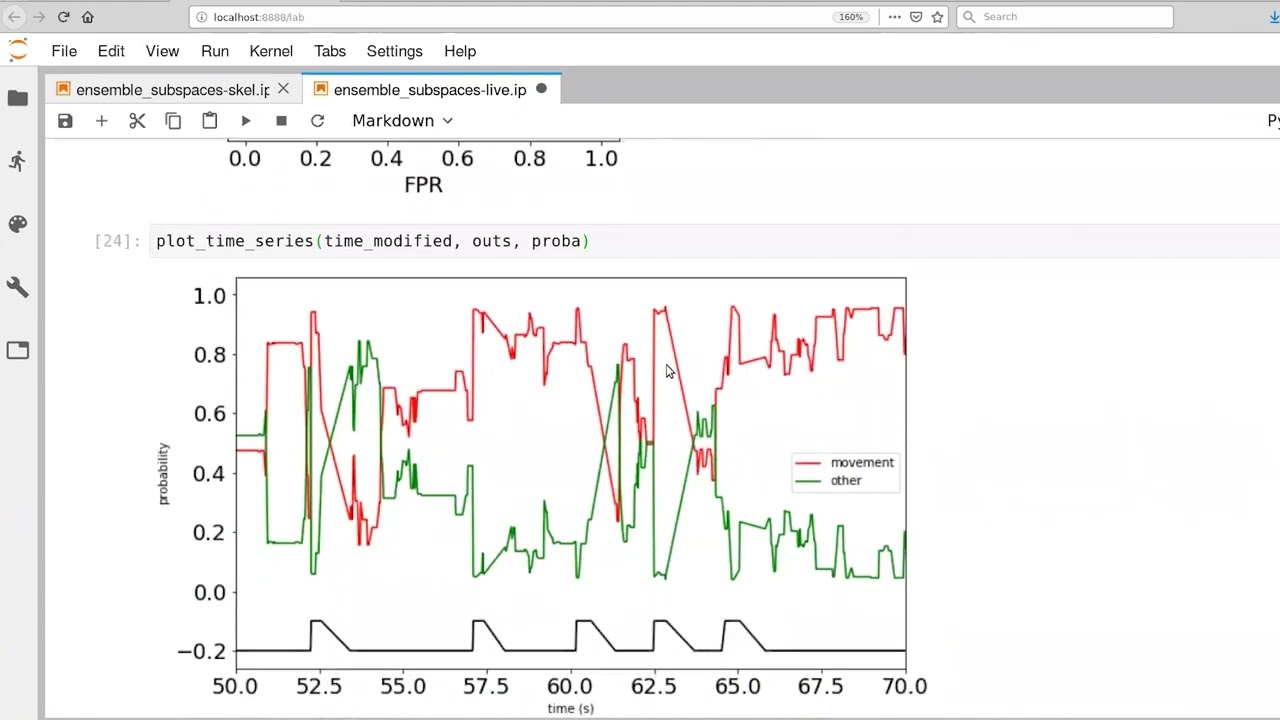
The video provides a clear and practical demonstration of the random subspace method, showing its implementation and the impact of hyperparameters on performance. The argumentation is based on empirical results from a specific dataset, which is appropriate for a tutorial. The presenter explains the concepts intuitively and supports claims with visualizations of ROC curves and time series plots. However, the video does not compare random subspace with other ensemble methods or discuss theoretical foundations, limiting its depth.
Scientific Rigor, Source Quality, Title Accuracy
The video is scientifically sound in its methodology, using standard cross-validation and appropriate metrics. However, it does not cite any external sources, which is typical for a tutorial but limits its scientific rigor. The title accurately reflects the content. No comments were provided for analysis.
137 words
Title / Content Match
The title accurately reflects the content, which focuses on the random subspace approach for decision tree ensembles.
Quality & Reliability
7/10
The video is a tutorial that clearly explains the random subspace method and demonstrates its implementation using scikit-learn. The content is technically accurate, but it lacks formal citations and references to external sources. The methodology is sound, and the results are presented with appropriate caveats.
Key Moments
Markers derived by PSI from the transcript: the creator did not define chapters.
- Introduction to random subspace concept and contrast with bagging
- Visual explanation of feature subsampling in data matrix
- Setup of baby movement dataset and baseline single decision tree
- First bagging classifier with half samples and half features
- Experiments with different sample and feature fractions
- Increasing estimators to 100 and observing performance
- Reducing feature fraction to 0.1 and increasing max leaf nodes
- Achieving AUC of 0.7 with 100 leaf nodes and 0.1 feature fraction
- Discussion of parameter tuning and grid search
Contribution & Novelties
The video provides a practical, hands-on demonstration of the random subspace method, showing how to implement it with scikit-learn and tune hyperparameters. It highlights the importance of feature subsampling in improving ensemble diversity and performance. The tutorial is valuable for practitioners seeking to understand and apply this technique.
Pour aller plus loin :
- Random subspace method - Wikipedia — Overview of the method and its applications.
- BaggingClassifier documentation - scikit-learn — Official documentation for the implementation used in the video.
- Ensemble learning - Wikipedia — General background on ensemble methods.
90 words
Radar Profile
The radar profile shows balanced scores across all dimensions, with slightly higher scores in information quantity and quality, indicating a solid tutorial that provides useful content and reliable information, though with moderate technical depth.