Multidimensional Scaling
Keywords
Summary
170 words
Critical Evaluation
Value of the Information & Strength of the Argument
The video provides a clear and structured explanation of MDS, starting from motivation and distance metrics to the mathematical formulation. The argumentation is logical, building from simple examples to the cost function and optimization. The comparison with LLE helps contextualize MDS’s global approach. However, the video lacks a concrete numerical example or code demonstration, which would enhance practical understanding. The explanation of the optimization process is brief, and the presenter does not delve into solving the optimization problem, which might leave viewers wanting more detail.
Scientific Rigor, Source Quality, Title Accuracy
The video is scientifically rigorous in its mathematical presentation, correctly defining distance metrics and the MDS cost function. However, it does not cite any external sources or references, which limits the ability to verify claims or explore further. The title accurately reflects the content, focusing on multidimensional scaling. The video is a tutorial, and its quality is good for an introductory level, but it could benefit from including references to standard texts or papers on MDS.
176 words
Title / Content Match
Title accurately reflects content, focusing on multidimensional scaling.
Quality & Reliability
7/10
Clear explanation of MDS algorithm, mathematical formulation, and comparison with LLE. Lacks practical code demonstration and references.
Key Moments
Markers derived by PSI from the transcript: the creator did not define chapters.
- Introduction to embedding methods and MDS
- Discussion on distance metrics and limitations of Euclidean distance
- Examples of perceptual distances: color and whiskey tasting
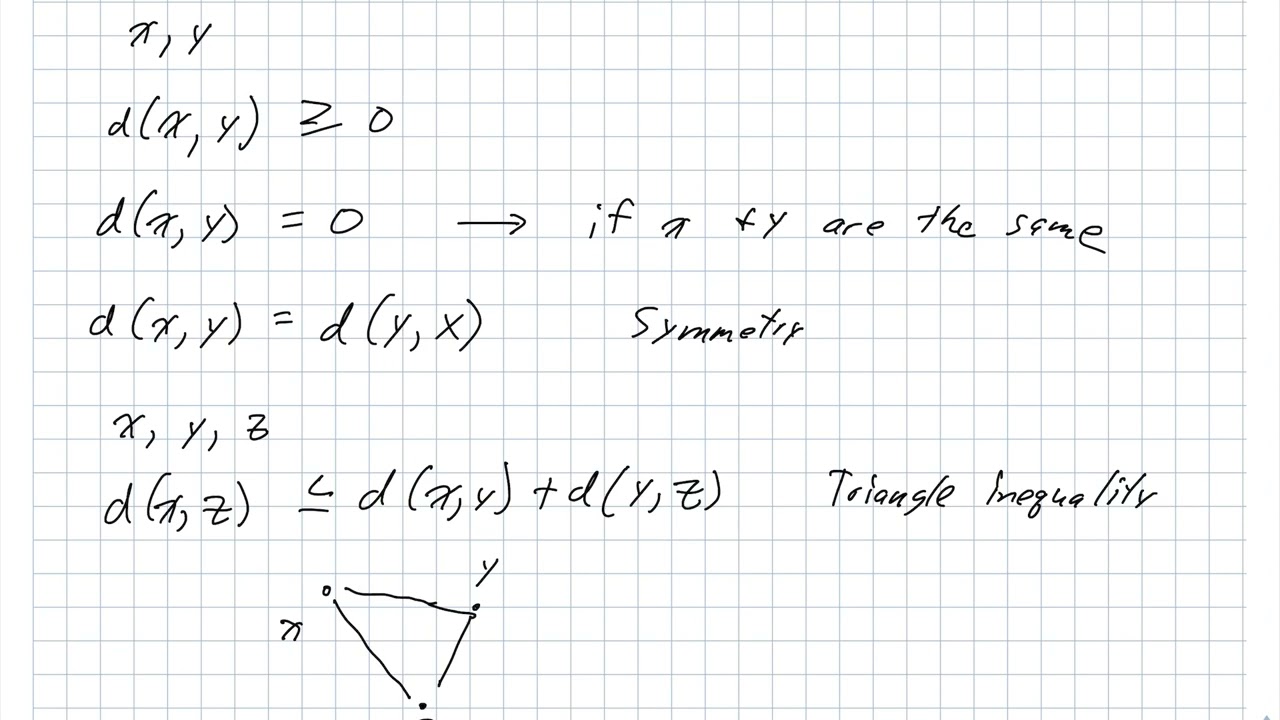
- Definition of a proper distance metric (non-negativity, symmetry, triangle inequality)
- Formulation of MDS cost function and optimization problem
- Handling query points in MDS
- Comparison with locally linear embedding (global vs local)
- Conclusion and mention of code
Contribution & Novelties
The video provides a clear and accessible introduction to MDS, emphasizing the importance of distance metrics beyond Euclidean. It effectively contrasts MDS with LLE, highlighting the global vs local preservation of distances. The mathematical formulation is presented in a digestible manner, making it suitable for learners. However, it does not offer novel insights beyond standard textbook material.
Pour aller plus loin :
- Multidimensional scaling - Wikipedia — Provides a comprehensive overview and historical context.
- Classical multidimensional scaling - Wikipedia — Details the classical approach and its relation to PCA.
- Locally linear embedding - Wikipedia — For comparison with the method discussed in the video.
104 words
Radar Profile
The radar profile shows balanced scores across all dimensions, with slightly higher scores in information quantity and quality, indicating a solid educational video. The technical level is moderate, suitable for beginners, and the reliability is good, though lacking external references.
💬 No comments were provided for analysis.