The Charlatan Problem
Keywords
Summary
186 words
Critical Evaluation
Value of the Information & Strength of the Argument
The video provides a clear and intuitive explanation of hypothesis testing, using a relatable example. The argumentation is logical and builds step by step from the null hypothesis to the p-value and critical value. The connection to model comparison is well-motivated, emphasizing the stochastic nature of performance measurement. However, the video does not discuss practical considerations such as multiple testing corrections or the difference between statistical and practical significance, which are important for rigorous model evaluation.
Scientific Rigor, Source Quality, Title Accuracy
The video is scientifically rigorous in its explanation of statistical concepts, but it does not cite any external sources or references. The title ‘The Charlatan Problem’ is catchy but not immediately descriptive; it becomes clear in the context. The content is accurate and aligns with standard statistical theory. No comments were provided, so no analysis of public reception is possible.
151 words
Title / Content Match
The title 'The Charlatan Problem' is a catchy metaphor for hypothesis testing, but it does not immediately convey the statistical focus. The content matches the title after watching.
Quality & Reliability
7/10
The video provides a clear and accurate explanation of hypothesis testing concepts (p-value, alpha, critical value) applied to model comparison. The reasoning is sound, but it lacks references to external sources and does not address practical issues like multiple comparisons or effect size.
Key Moments
Markers derived by PSI from the transcript: the creator did not define chapters.
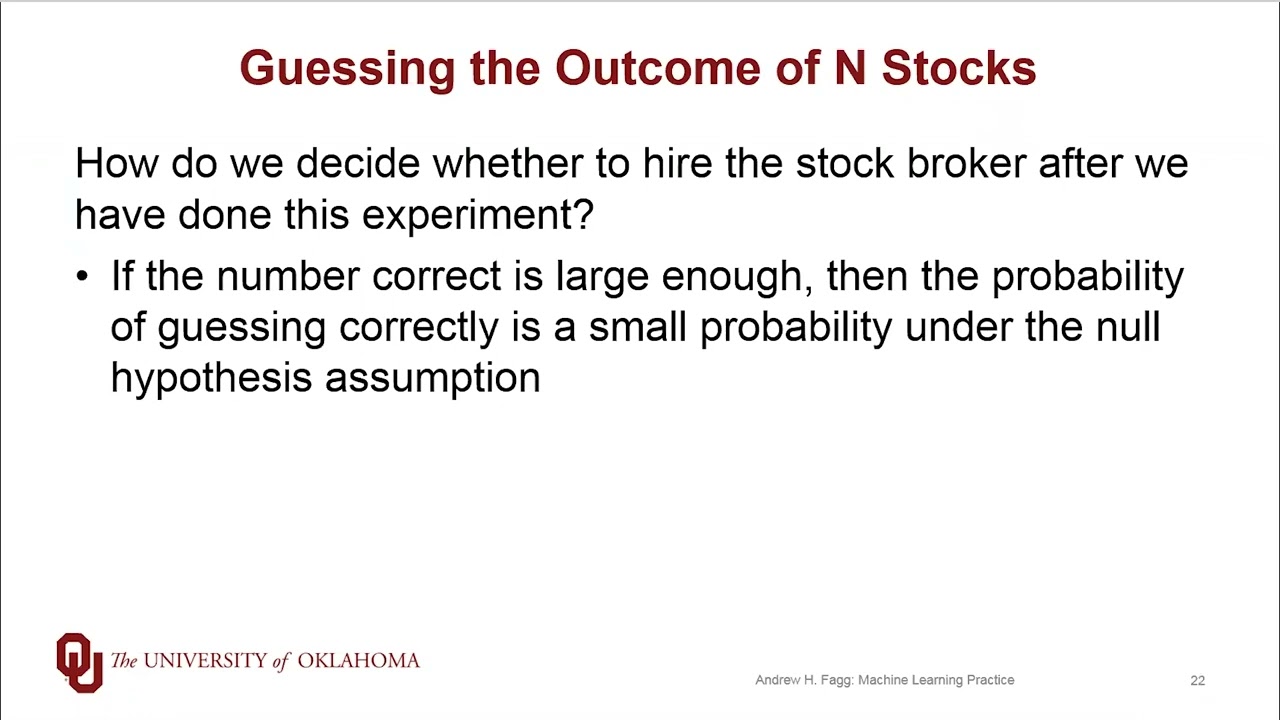
- Introduction to the Charlatan Problem: deciding whether to hire a stock broker based on prediction accuracy.
- Setting up the null hypothesis: the broker is a charlatan (random guessing with p=0.5).
- Expected number of correct predictions under the null: n/2, with variability around it.
- Central Limit Theorem: distribution of correct predictions approaches a Gaussian as n grows.
- Defining the p-value as the probability of observing a result as extreme or more, under the null.
- Introducing alpha as the threshold for rejecting the null hypothesis, and the critical value.
- Choosing alpha based on domain: 5% typical, 1% for high-stakes decisions.
- Connecting hypothesis testing to model comparison: assume no difference, measure performance across validation sets.
- Rejecting the null if the observed difference is unlikely, controlling error via alpha.
- Acknowledging that even a worse model can look good by chance, but alpha controls this risk.
Contribution & Novelties
The video offers a clear pedagogical approach to hypothesis testing, using the ‘Charlatan Problem’ as a memorable metaphor. It effectively bridges classical statistics and machine learning model evaluation, emphasizing the stochastic nature of performance measurement. The explanation of p-value, alpha, and critical value is accessible yet accurate.
Pour aller plus loin :
- Null hypothesis significance testing — Provides a comprehensive overview of the framework.
- Central limit theorem — Explains the theoretical basis for the Gaussian approximation.
- Multiple comparisons problem — Discusses the issue of inflating Type I error when testing many hypotheses, relevant to model selection.
96 words
Radar Profile
The radar profile shows balanced scores across information quantity, quality, technical level, and reliability, with a slight emphasis on quality and reliability. This indicates a solid educational content that is both accurate and well-presented, though it could benefit from more depth and external references.