K-Means Clustering: Example in Scikit-Learn
Keywords
Summary
163 words
Critical Evaluation
Value of the Information & Strength of the Argument
The video provides a practical, step-by-step demonstration of k-means clustering, which is valuable for beginners. The argumentation is clear and logical, explaining the effect of each parameter on the algorithm’s behavior. The presenter effectively uses visualizations to illustrate the clustering results and discusses the concept of local minima and the importance of random restarts. However, the video does not provide a deep theoretical analysis or compare k-means with other clustering methods, limiting its value for advanced practitioners.
Scientific Rigor, Source Quality, Title Accuracy
The video is a tutorial and does not cite external sources. The quality of the information is good, as it accurately explains the k-means algorithm and its implementation in scikit-learn. The title accurately reflects the content. The presenter’s explanations are consistent with standard machine learning knowledge, but the lack of formal references reduces the scientific rigor. The video does not address potential pitfalls such as the need for feature scaling or the impact of outliers.
167 words
Title / Content Match
The title accurately reflects the content, which is a practical example of k-means clustering using scikit-learn.
Quality & Reliability
7/10
The video provides a clear, hands-on tutorial on k-means clustering using scikit-learn, with practical demonstrations and explanations of key parameters. However, it lacks formal citations and does not delve into theoretical underpinnings or validation metrics beyond mentioning BIC.
Key Moments
Markers derived by PSI from the transcript: the creator did not define chapters.
- Introduction to k-means clustering and the scikit-learn implementation.
- Overview of the scatter plot function and its parameters.
- Loading the synthetic dataset and visualizing it.
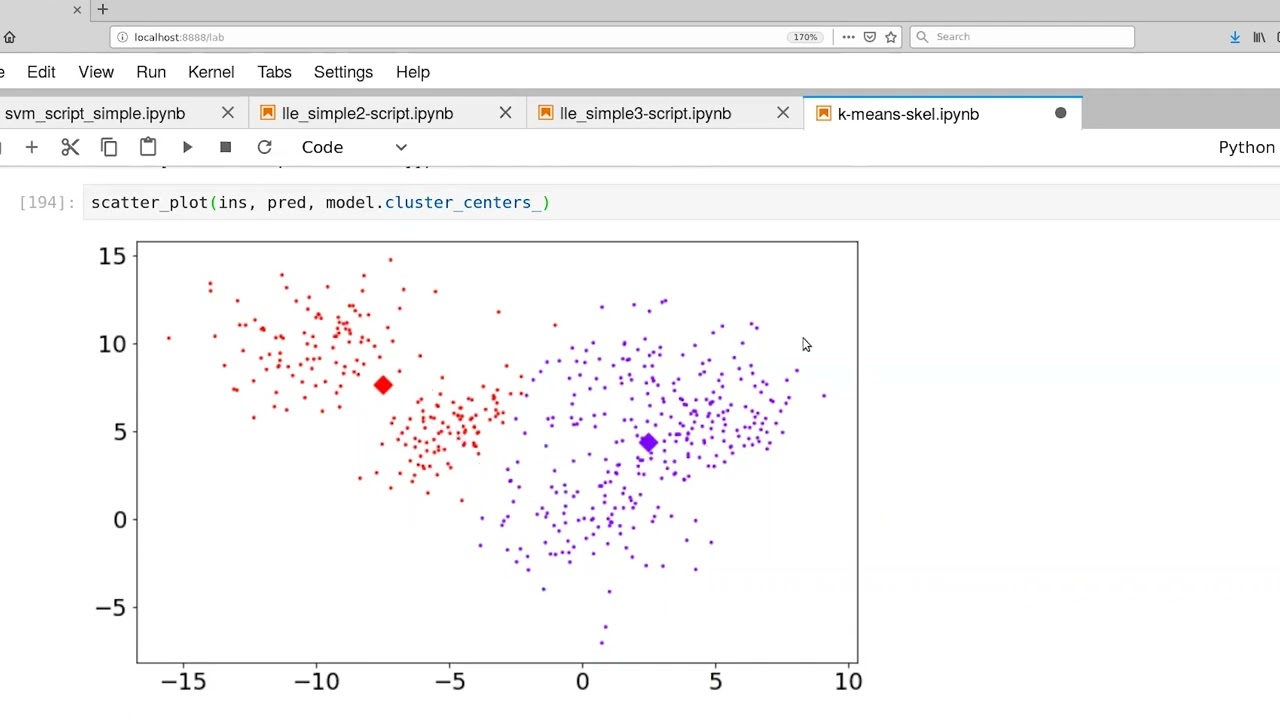
- Creating a KMeans model with n_clusters=2 and random initialization.
- Fitting the model and plotting the resulting clusters and centers.
- Experimenting with n_clusters=3 and observing the partitioning.
- Increasing n_clusters to 5, matching the true number of Gaussians.
- Testing stability with n_clusters=7 and observing less stable assignments.
- Increasing n_init to 10 for more stable results.
- Introducing BIC as a method for selecting the number of clusters.
Contribution & Novelties
The video offers a practical, code-driven introduction to k-means clustering, focusing on implementation details in scikit-learn. It provides a clear demonstration of how to use the KMeans class and interpret its outputs. The discussion on the stability of clustering results with varying numbers of clusters is useful for understanding the algorithm’s behavior.
Pour aller plus loin :
- K-means clustering - Wikipedia — Provides a comprehensive overview of the algorithm, its variants, and applications.
- Scikit-learn KMeans documentation — Official documentation with detailed parameter explanations and examples.
- Bayesian information criterion - Wikipedia — Explains BIC, a metric mentioned in the video for model selection.
102 words
Radar Profile
The radar profile shows moderate scores across all dimensions, indicating a balanced but not exceptional tutorial. The video provides solid practical information but lacks depth in theoretical rigor and source citation.