Example: Grid Search
Keywords
Summary
157 words
Critical Evaluation
Value of the Information & Strength of the Argument
The video provides valuable practical knowledge on using GridSearchCV, a key tool in machine learning. The author explains the process step-by-step, including how to define parameter grids, interpret results, and visualize outcomes. The argumentation is solid, as the author demonstrates the importance of choosing appropriate search ranges and iteratively refining them based on results. The use of cross-validation and scoring metrics is well-justified. The tutorial is clear and actionable, making it useful for practitioners.
Scientific Rigor, Source Quality, Title Accuracy
The video is a tutorial, so it does not cite external sources. However, it relies on the scikit-learn library, which is well-documented and widely used. The content is technically accurate, and the code is reproducible. The title accurately reflects the content. The author does not provide references to academic papers or official documentation, but the practical approach is sound. The video’s rigor is adequate for a tutorial, though it would benefit from linking to scikit-learn documentation.
165 words
Title / Content Match
The title 'Example: Grid Search' accurately reflects the content, which is a hands-on demonstration of grid search in scikit-learn.
Quality & Reliability
7/10
The video is a practical tutorial on using scikit-learn's GridSearchCV for hyperparameter tuning. It demonstrates the process with ridge regression and elastic net, including visualization. The content is accurate and well-explained, but it lacks formal citations and is based on the author's experience. The methodology is sound, and the code is reproducible.
Key Moments
Markers derived by PSI from the transcript: the creator did not define chapters.
- Introduction to grid search and setup of the code skeleton.
- Defining the Ridge regression model and parameter grid for alpha.
- Running GridSearchCV and extracting best parameters.
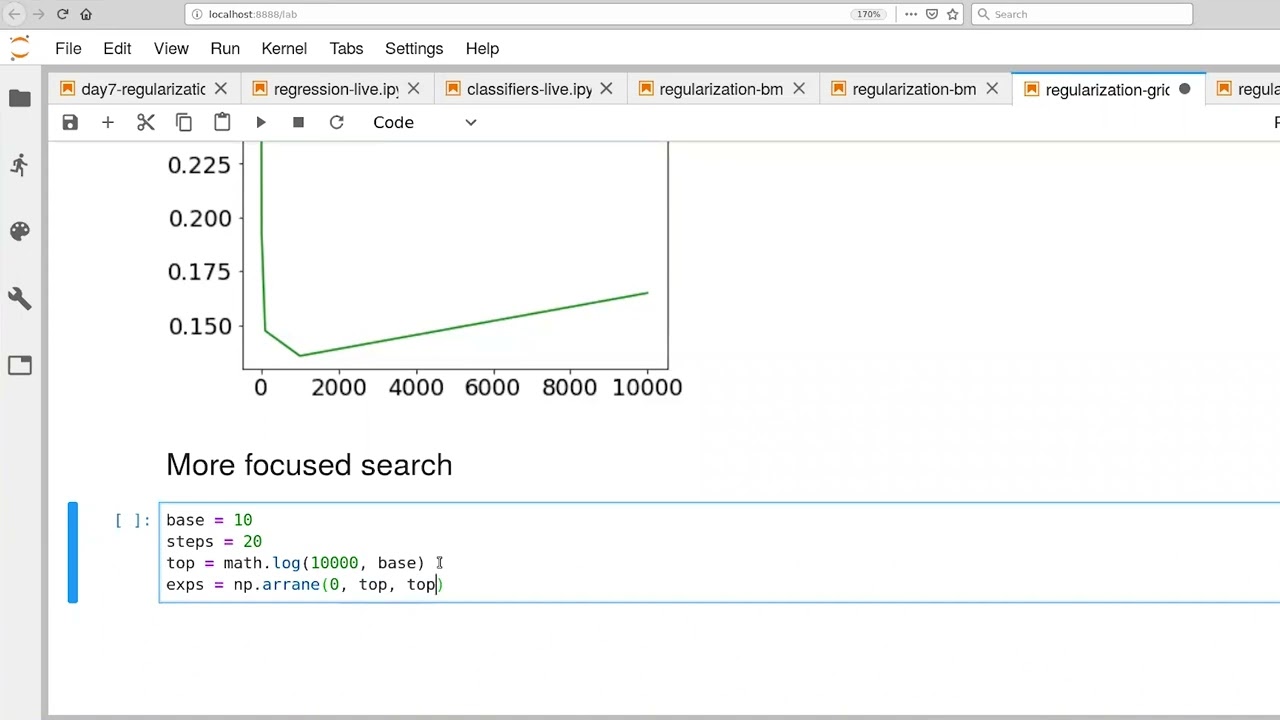
- Visualizing RMSE vs alpha and identifying optimal alpha around 600.
- Narrowing the search range for alpha with finer granularity.
- Applying grid search to ElasticNet with two parameters.
- Adjusting search range for ElasticNet and finding better parameters.
- Creating heatmap visualization of RMSE surface.
- Zooming in on the optimal region and concluding that ridge regression may suffice.
Contribution & Novelties
The video provides a practical, step-by-step guide to using GridSearchCV, which is a standard tool but often underutilized. The author’s approach of iteratively refining the search range and using visualizations to guide decisions is a valuable technique. The tutorial also highlights the importance of checking whether optimal parameters lie on the edge of the search space, which is a common pitfall.
Pour aller plus loin :
- scikit-learn documentation on GridSearchCV — Official documentation for the tool used.
- Cross-validation (statistics) — Background on cross-validation, a key concept.
- Regularization (mathematics) — Explanation of regularization, central to the tutorial.
96 words
Radar Profile
The radar profile shows a balanced performance across all dimensions, with slightly higher scores in quality and technical level, indicating a solid tutorial with good practical value.