Classifier Performance Measures
Keywords
Summary
144 words
Critical Evaluation
Value of the Information & Strength of the Argument
The video provides a solid conceptual foundation for understanding classification performance metrics. It explains each metric with clear definitions and intuitive interpretations, using visual examples of score distributions and threshold placement. The argumentation is logical and builds from the confusion matrix to more complex concepts like ROC curves and AUC. The instructor effectively communicates the trade-offs involved in threshold selection and the importance of considering the costs of different types of errors. The content is valuable for learners who need to grasp these fundamental concepts before applying them in practice.
Scientific Rigor, Source Quality, Title Accuracy
The scientific rigor is high for an introductory tutorial. The definitions and formulas are accurate and align with standard machine learning literature. However, the video does not cite external sources or references, which limits the ability to verify claims independently. The title ‘Classifier Performance Measures’ accurately reflects the content, which focuses on metrics for evaluating classifiers. The presentation is clear and well-structured, with visual aids that enhance understanding. No comments were provided for analysis.
179 words
Title / Content Match
The title accurately reflects the content, which focuses on performance measures for classifiers.
Quality & Reliability
8/10
The video provides a clear and accurate explanation of classification performance metrics, including precision, recall, false positive rate, ROC curves, and AUC. The content is technically sound and aligns with standard machine learning literature. The presentation is pedagogical and well-structured, with visual aids that enhance understanding. Minor limitations include a lack of references to external sources and a focus on conceptual explanation rather than empirical validation.
Key Moments
Markers derived by PSI from the transcript: the creator did not define chapters.
- Introduction to the video and recap of previous classifier model.
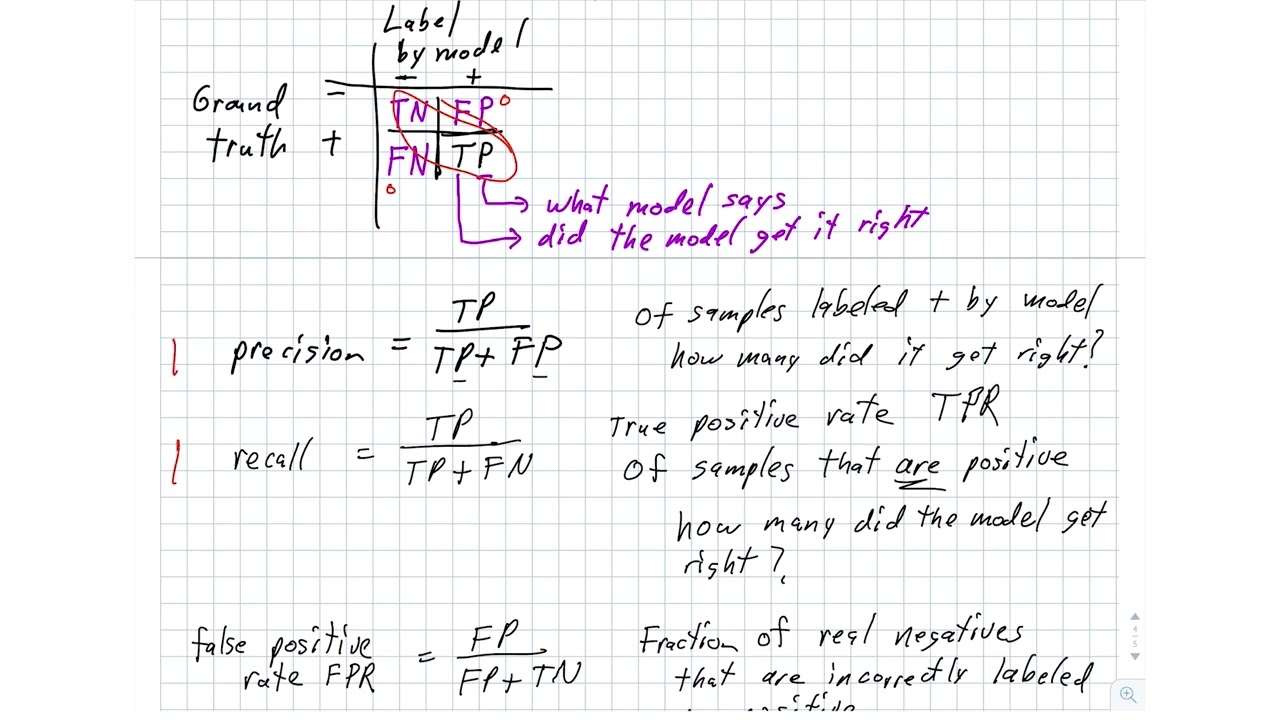
- Explanation of confusion matrix and its components.
- Definition of precision and recall.
- Introduction to false positive rate and its complementarity with true positive rate.
- Discussion on threshold selection and its impact on metrics.
- Illustration of score distributions and threshold placement.
- Explanation of ROC curve construction and interpretation.
- Introduction of AUC as a summary metric.
- Mention of Kolmogorov-Smirnov distance and Peirce skill score.
- Conclusion and transition to code examples.
Cited Sources
- scikit-learn documentation — The video mentions scikit-learn as the library used for building classifiers and computing metrics.
Concurring Sources
- scikit-learn documentation — The video uses scikit-learn for implementation, and the documentation provides details on metrics like precision, recall, and ROC.
Contribution & Novelties
This video provides a clear and accessible introduction to classification performance measures, focusing on conceptual understanding rather than mathematical derivations. It effectively bridges the gap between the confusion matrix and more advanced metrics like ROC curves and AUC. The use of visual examples of score distributions helps intuition. The video is particularly useful for beginners who need to grasp these concepts before implementing them in code.
Pour aller plus loin :
- Confusion matrix - Wikipedia — Provides a comprehensive overview of the confusion matrix and related metrics.
- Receiver operating characteristic - Wikipedia — Detailed explanation of ROC curves and their applications.
- Precision and recall - Wikipedia — Further reading on precision and recall metrics.
- Kolmogorov–Smirnov test - Wikipedia — Background on the KS test mentioned in the video.
- Peirce’s criterion - Wikipedia — Related to the Peirce skill score, though the exact metric may differ.
145 words
Radar Profile
The radar profile shows high scores in quantity and quality of information, with slightly lower technical depth. This indicates a well-balanced tutorial that is informative and accurate, but may not delve into advanced mathematical details. The overall reliability is high, making it a trustworthy resource for beginners.