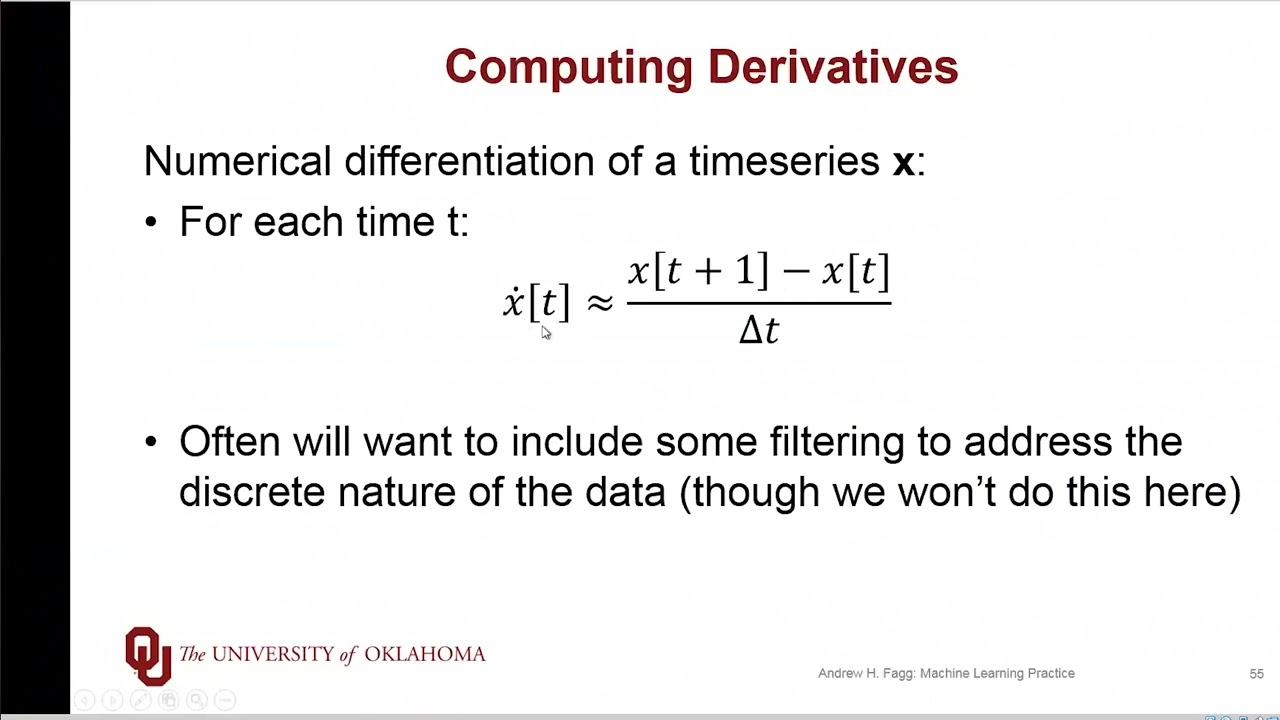
Pipeline Class Example: Computing Derivatives
Keywords
Summary
148 words
Critical Evaluation
Value of the Information & Strength of the Argument
The video provides a clear, step-by-step explanation of how to implement a derivative computation in a pipeline context. The argumentation is logical and well-structured, starting with the mathematical foundation and then moving to code implementation. The presenter explains each line of code, making it accessible for learners. However, the video lacks depth in discussing alternative methods for derivative estimation, such as Savitzky-Golay filtering or spectral methods, and does not address edge cases like missing data handling in detail. The practical example is useful but limited in scope.
Scientific Rigor, Source Quality, Title Accuracy
The video does not cite any external sources or references. The content is based on the presenter’s own knowledge and experience. The title accurately describes the content, which is a tutorial on computing derivatives using a pipeline class. The video is a practical demonstration rather than a rigorous scientific exposition, so the lack of citations is not surprising but limits its scientific rigor. The code is reproducible and follows standard Python practices.
174 words
Title / Content Match
The title accurately reflects the content, which is a tutorial on implementing a pipeline class for computing derivatives.
Quality & Reliability
6/10
Clear explanation of derivative computation in time series data using Python, but lacks rigorous mathematical derivation and references. Code is straightforward and reproducible, but no external sources cited.
Key Moments
Markers derived by PSI from the transcript: the creator did not define chapters.
- Introduction to the video and the concept of computing derivatives in time series data.
- Explanation of the mathematical approach: finite difference approximation.
- Discussion on filtering positional data to reduce noise.
- Start of coding: creating the ComputeDerivative class.
- Implementation of the transform method: computing differences and creating new columns.
- Applying the class to infant data and inspecting the resulting data frame.
- Plotting the original position and derivative to verify correctness.
- Discussion on noise in derivative estimates and potential filtering improvements.
Contribution & Novelties
The video provides a practical example of implementing a custom transformer for a scikit-learn pipeline, specifically for computing derivatives. It demonstrates how to integrate such a class into a data processing workflow. The approach is straightforward and useful for those working with time series data in Python.
Pour aller plus loin :
- Finite difference — Provides a mathematical background on the method used.
- Butterworth filter — A common filter for smoothing signals, mentioned as a potential improvement.
- scikit-learn Pipeline — Official documentation for pipelines, relevant to the context.
88 words
Radar Profile
The radar profile shows moderate scores across all dimensions, indicating a balanced but not outstanding tutorial. The video is informative but lacks depth in scientific rigor and external validation.