Brain Machine Interfaces
Keywords
Summary
177 words
Critical Evaluation
Value of the Information & Strength of the Argument
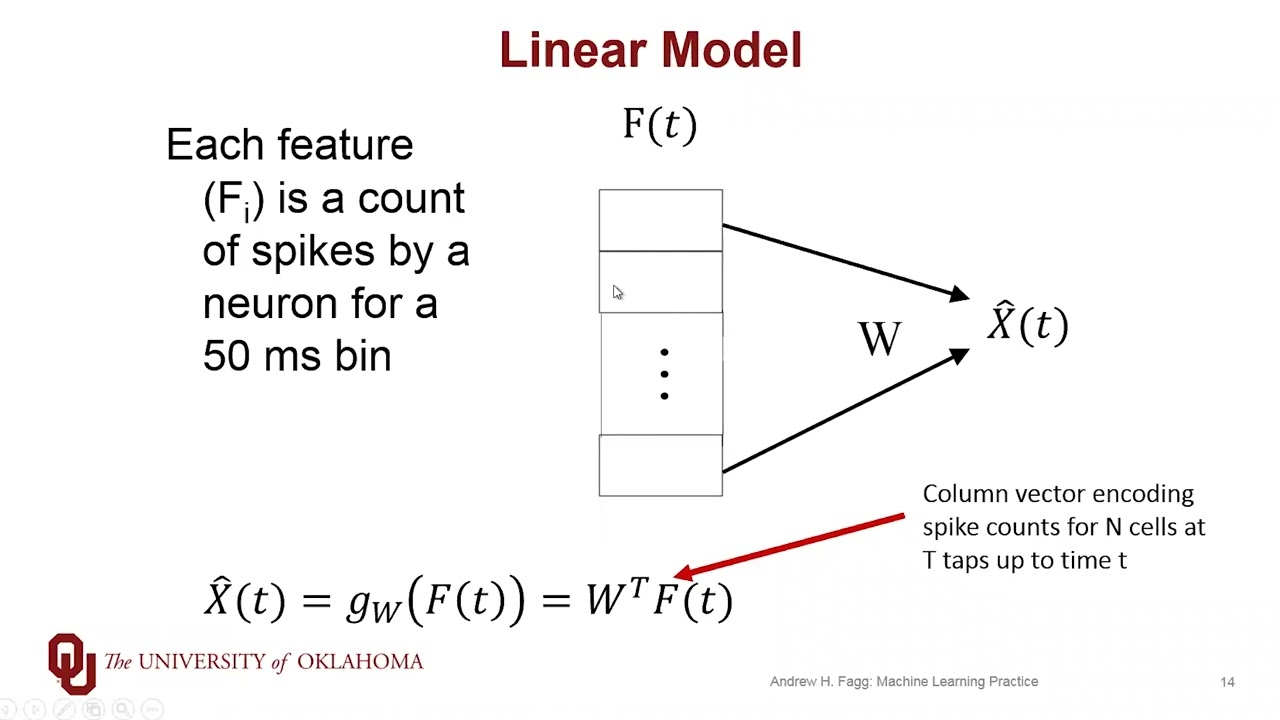
The video provides a valuable introduction to the application of machine learning in brain-machine interfaces, specifically focusing on the use of linear regression for neural decoding. The argumentation is clear and logically structured, starting from the biological context (motor cortex, spikes) and progressing to the mathematical model and training procedure. The presenter effectively explains the process of feature extraction (binning spike counts) and the linear model’s formulation, making the content accessible to those with basic linear algebra knowledge. The explanation of the cost function and the uniqueness of the optimal solution for linear regression is accurate and reinforces the theoretical foundation. However, the video does not delve into more advanced models or discuss the limitations of linear approaches, which could be seen as a gap in the argumentation. Overall, the value lies in its pedagogical clarity and practical demonstration of a real-world application.
Scientific Rigor, Source Quality, Title Accuracy
The video demonstrates scientific rigor in its explanation of the methodology, which aligns with established practices in the field of brain-machine interfaces. The presenter accurately describes the use of electrode arrays, spike counting, and linear regression, which are standard techniques. However, the video does not cite specific sources or references, which limits the ability to verify claims or explore further. The title ‘Brain Machine Interfaces’ is appropriate and accurately reflects the content. The video’s educational nature is evident, and the lack of citations is common in tutorial-style content. The description provides no additional links or references, so the sources cited are minimal. Overall, the scientific rigor is adequate for an introductory tutorial, but the absence of citations reduces its scholarly value.
279 words
Title / Content Match
The title accurately reflects the content, which focuses on brain-machine interfaces and their implementation using machine learning.
Quality & Reliability
7/10
The video provides a clear, technically accurate explanation of a brain-machine interface approach using linear regression on neural spike counts. The methodology is standard in the field, and the presentation is consistent with established practices. However, it lacks citations to specific studies or sources, and the presenter does not discuss limitations or alternative approaches in depth.
Key Moments
Markers derived by PSI from the transcript: the creator did not define chapters.
- Introduction to brain-machine interfaces and the goal of developing advanced prosthetics.
- Explanation of the approach: implanting electrodes in the primary motor cortex to record neural activity.
- Description of the experimental setup with a monkey and exoskeleton.
- Visualization of neural spike data and the concept of encoding muscle contractions.
- Introduction to the prediction problem: using recent neural activity to estimate motion intent.
- Explanation of binning spike counts to create a feature vector.
- Formulation of the linear model and the scalar form of the prediction.
- Discussion of training data collection and the cost function (mean squared error).
- Explanation of the learning algorithm and the uniqueness of the optimal solution for linear regression.
- Application of the trained model to predict movements and drive the exoskeleton.
Contribution & Novelties
The video provides a clear, step-by-step explanation of how linear regression can be applied to neural data for brain-machine interfaces. It bridges the gap between neuroscience and machine learning, making the concept accessible to students. The main novelty is the pedagogical approach, breaking down the process from neural recording to model training and prediction. It does not introduce new research findings but serves as an educational resource.
Pour aller plus loin :
- Brain–computer interface - Wikipedia — Provides an overview of BMI research and applications.
- Motor cortex - Wikipedia — Details the brain region involved in motor control.
- Linear regression - Wikipedia — Explains the statistical method used in the video.
111 words
Radar Profile
The radar profile shows balanced scores across all dimensions, with slightly lower technical depth and source rigor. This indicates a solid introductory tutorial that is informative and reliable but not highly technical or heavily sourced.