Introduction to Classifiers
Keywords
Summary
185 words
Critical Evaluation
Value of the Information & Strength of the Argument
The video provides a clear and intuitive explanation of classifiers, using visual examples to illustrate key concepts. The argumentation is logical and builds from basic definitions to the limitations of a simple learning algorithm. The value lies in its pedagogical approach, making complex ideas accessible. However, the content is introductory and does not delve into advanced topics or formal mathematical foundations. The proposed learning algorithm is simplistic and not practical for real-world use, but it serves as a stepping stone for understanding more sophisticated methods.
Scientific Rigor, Source Quality, Title Accuracy
The video does not cite any external sources, which limits its scientific rigor. The content is based on standard machine learning concepts, but without references, it is difficult to verify specific claims. The title accurately reflects the content, which is a beginner-level introduction. The presentation is well-structured and clear, but the lack of citations and the oversimplification of the learning algorithm reduce its overall scientific quality.
166 words
Title / Content Match
The title accurately reflects the content, which is a beginner-level introduction to classifiers.
Quality & Reliability
7/10
The video provides a clear, intuitive introduction to classifiers, focusing on linear decision boundaries and a simple learning algorithm. The content is accurate but lacks formal rigor and references. The presentation is well-structured with visual examples, but the algorithm described is simplistic and not state-of-the-art.
Key Moments
Markers derived by PSI from the transcript: the creator did not define chapters.
- Introduction to classifiers and their applications.
- Formulation of classifiers with numerical inputs and binary classes.
- Visualization of decision boundary in 2D space and linear function.
- Explanation of how the sign of f(x) determines class label.
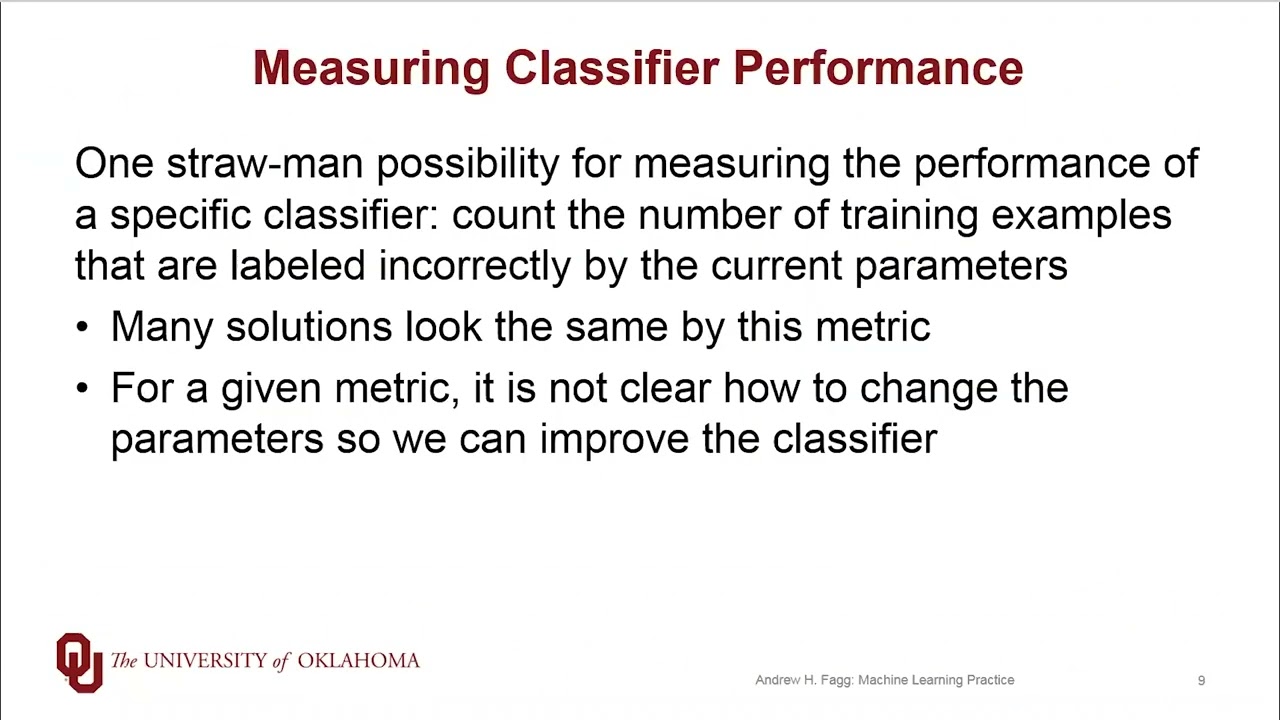
- Introduction of error metric based on misclassified training examples.
- Illustration of multiple lines with zero error and their limitations.
- Proposal of a simple learning algorithm with random parameter tweaking.
- Discussion of generalization and why some zero-error solutions are better.
- Summary and preview of future topics.
Contribution & Novelties
The video offers a clear, step-by-step introduction to classifiers, emphasizing the geometric intuition of decision boundaries and the limitations of a naive learning algorithm. It serves as a foundation for understanding more advanced classification techniques.
Pour aller plus loin :
- Linear classifier - Wikipedia — Provides a comprehensive overview of linear classifiers, including mathematical formulations and applications.
- Perceptron - Wikipedia — Discusses the perceptron algorithm, a simple learning rule for linear classifiers, directly related to the video’s content.
- Support Vector Machine - Wikipedia — Introduces SVMs, which address the issue of finding an optimal decision boundary with maximum margin, a concept hinted at in the video.
106 words
Radar Profile
The radar profile shows moderate scores across all dimensions, with slightly higher scores in quality and reliability compared to quantity and technical depth. This indicates a well-explained but introductory content that lacks extensive detail and advanced technical rigor.