Holistic Approach to Cross Validation
Keywords
Summary
156 words
Critical Evaluation
Value of the Information & Strength of the Argument
The video provides valuable insights into a robust cross-validation methodology that goes beyond standard practices. The argumentation is logical and well-structured, clearly explaining the need for independent data at each stage of model selection. The presenter effectively demonstrates the limitations of using a single test set and proposes a solution that yields multiple performance metrics for statistical comparison. The mathematical formulation for fold assignment is clear and practical, enabling easy implementation. The discussion on varying training fold sizes adds depth, showing how the approach can be adapted to study the effect of training data volume. The argumentation is solid, though it would benefit from empirical examples or comparisons with alternative methods.
Scientific Rigor, Source Quality, Title Accuracy
The video does not cite any external sources or references, relying solely on the presenter’s explanations. The content is presented as a methodological proposal without empirical validation or comparison to existing literature. The title accurately reflects the content, which focuses on a holistic cross-validation framework. The lack of sources reduces the scientific rigor, but the internal logic and mathematical clarity are commendable. The presenter’s experience is evident, but the absence of references limits the ability to verify claims or situate the approach within the broader field.
212 words
Title / Content Match
The title accurately reflects the content, which presents a holistic cross-validation framework that integrates hyperparameter selection and model comparison.
Quality & Reliability
7/10
The video presents a clear, well-structured explanation of a specific cross-validation methodology, with mathematical formulations and practical implementation details. The approach is coherent and addresses important statistical considerations, though it lacks external references and empirical validation.
Key Moments
Markers derived by PSI from the transcript: the creator did not define chapters.
- Introduction to the problem of model comparison and the need for independent data.
- Explanation of the three-way data split: training, validation, and test.
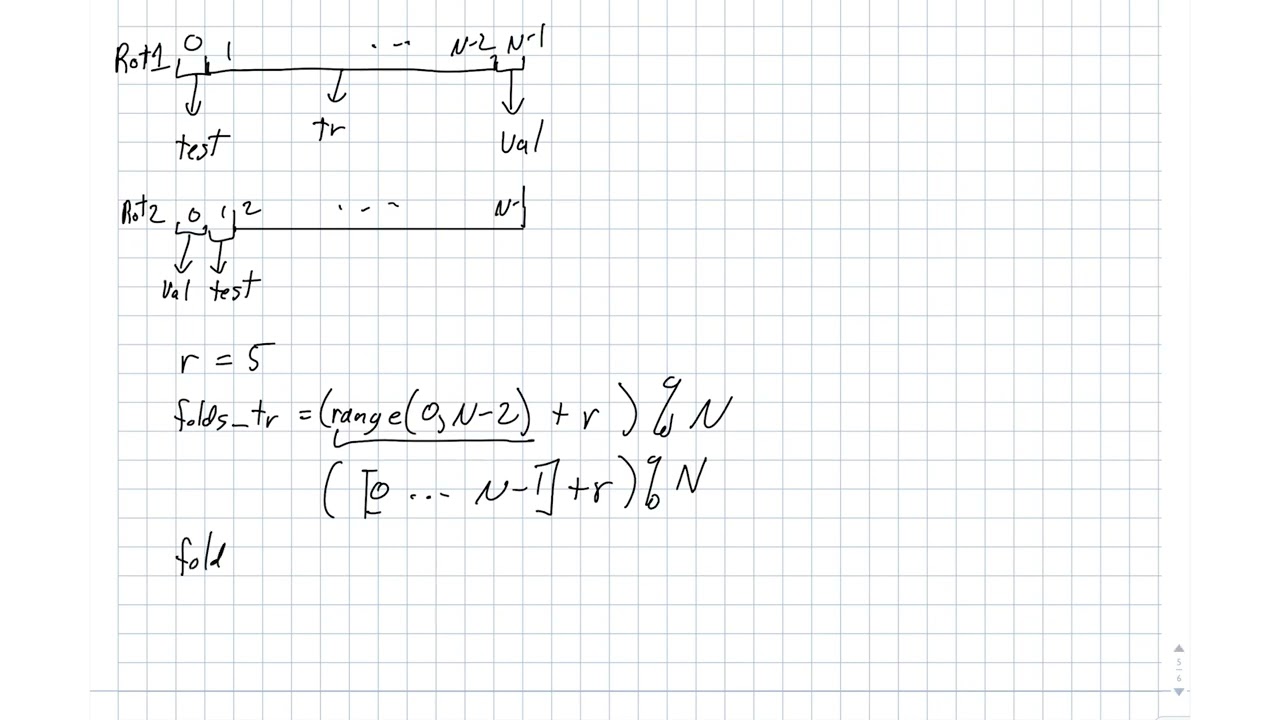
- Overview of the holistic cross-validation approach with multiple rotations.
- Mathematical formulation for assigning folds to training, validation, and test sets.
- Illustration of the rotation process with a grid of hyperparameters and rotations.
- Computing validation performance statistics and selecting optimal hyperparameters.
- Extracting test performance for the selected hyperparameters for model comparison.
- Discussion on varying the number of training folds and its effect on overfitting.
- Example of rotation with different training fold counts.
- Conclusion and preview of next steps in model comparison.
Contribution & Novelties
The video presents a comprehensive cross-validation framework that integrates hyperparameter selection and model comparison using independent data splits. The approach is a modification of standard k-fold cross-validation, introducing a three-way split and multiple rotations to obtain multiple performance metrics for each model. This allows for statistically valid comparisons between different algorithms. The presenter also discusses an experiment varying the number of training folds, providing insights into the trade-off between bias and variance.
Pour aller plus loin :
- Cross-validation (statistics) — Overview of cross-validation methods.
- Model selection — Principles of model selection in statistics.
- Bias–variance tradeoff — Key concept related to training data size.
103 words
Radar Profile
The radar profile shows high scores in quantity of information, technical level, and quality of information, indicating a dense and technically rigorous tutorial. The lower score in global reliability reflects the lack of external references and empirical validation, but the internal consistency and clarity of the presentation compensate.